



Agentic AI is changing economics of human labour with workforce on demand
During a panel discussion at WIEF, industry leaders explored the transition from AI assistance to autonomous agents, the cloudification of human labour, and how outcome-based pricing is replacing traditional per-seat enterprise software models.


Imagine a world where a business can scale its workforce as effortlessly as it scales its cloud storage capacity. For decades, companies have been tethered to the rigid constraints of headcount-based planning, where the ability to execute was dictated by the number of seats filled in an office.
However, a shift is happening in the way global enterprises view the nature of work. The world of work is entering a time where human capital is being “cloudified,” allowing businesses to treat labour as a variable utility rather than a fixed cost.
This transformation is driven by the rise of agentic workflows: AI systems that do not merely assist a human but instead take ownership of entire business processes from start to finish.
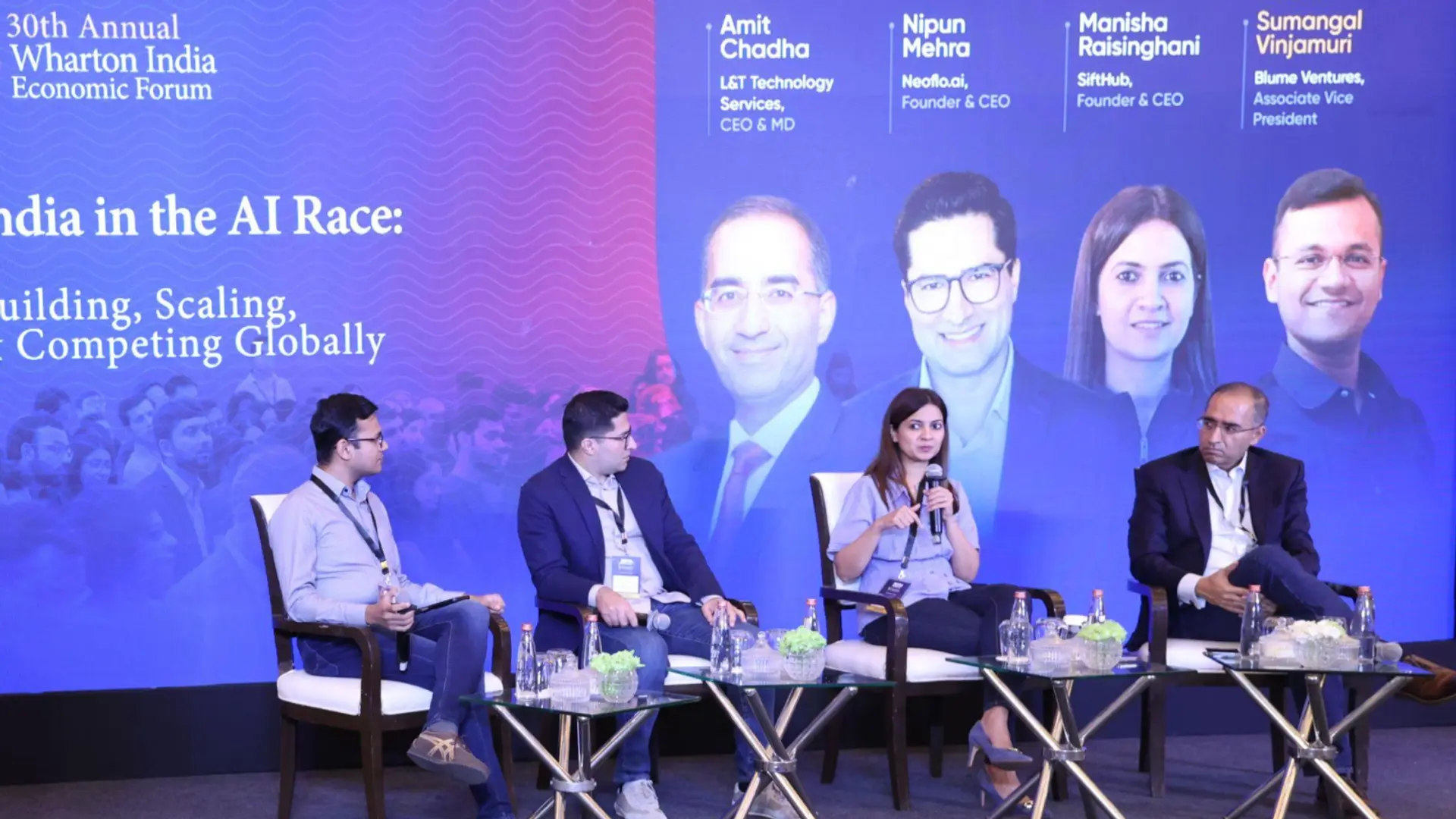
During a panel discussion at the Wharton India Economic Forum, industry experts, founders, and investors, said that there’s a shift beyond simple cost arbitrage toward a reality where AI allows for the orchestration of outcomes rather than the management of hours.
Nipun Mehra, Founder and CEO of Neoflo.ai, compared it to the revolution brought about by Amazon Web Services, noting that AI is now doing for human talent what AWS did for infrastructure.
“What AWS did… imagine this, that you no longer have to say, oh, I need 100 people to do this, and then some days you need 150 people, some days you need 50 people… you should be able to dial it down exactly how you do with everything else,” Mehra explained.
AI adoption lifecycle
Journey to this cloudified future has followed a distinct timeline. A few years ago, enterprises were largely in a state of experimentation, sprinkling large language models (LLMs) onto existing processes to see what might stick. This phase lacked the operational rigour required for enterprise-grade deployment.
Sumangal Vinjamuri, Associate Vice President at Blume Ventures, said that the landscape has matured rapidly, transitioning from experimental proofs of concept to genuine production use cases.
“In the enterprise context… in 2023, 2024 it was more about experimenting and seeing where the use cases are and where there is potential adoption for some of these new models,” Vinjamuri stated.
In 2026, the focus is shifting from assistance to agency. While 2025 saw enterprises operationalising AI as a co-pilot, the next frontier involves AI agents that navigate complex workflows autonomously.
Manisha Raisinghani, Founder and CEO of SiftHub, emphasised that this shift is fundamental to user adoption, especially for those who are not AI proficient.
“2026 is going to be the year of agents, productionizing and operationalising agents and why that is key is because of adoption…Agenting workflows are really critical because we still, especially users who are not AI proficient, they don't know the power of AI,” Raisinghani noted.
This transition relies heavily on technical performance and model reliability. The panelists discussed the triangle of cost, accuracy, and performance is the ultimate deciding factor in model selection.
Reliability is critical in sensitive sectors like drug discovery, where error carries significant legal risk. Raisinghani pointed out that the rapid evolution of models, such as Gemini 3.0, is changing the game by being faster, better, and cheaper simultaneously.
Economics of AI
As AI moves into core operations, the question of return on investment (ROI) has moved to the forefront.
“The money that’s coming out is largely coming out right now in OPEX forms because the OPEX is being spent on hyperscalers… Enterprise customers are right now not spending CAPEX, they are spending OPEX,” Amit Chadha, CEO and MD of L&T Technology Services, explained.
He proposed a mathematical model to help clients calculate savings by comparing original spend and fixed costs against the revised costs of AI-driven iterations.
This economic reality is forcing a rethink of pricing. The “per-seat” model is increasingly obsolete when AI can do the work of dozens. Founders are moving toward outcome-based pricing, where the value lies in the result, such as a closed sales deal, rather than headcount. This allows for higher gross margins, as software begins to absorb budgets previously allocated to labour.
India’s role in this global stack is being redefined. While the country has traditionally provided “cheap labour,” leaders argue this model is insufficient for future growth. India is a formidable competitor in the application and services layers, leveraging a massive repository of global process knowledge.
However, Mehra warned that relying entirely on foreign models carries geopolitical risk, potentially necessitating Sovereign AI to protect government data should international access be restricted.
Global AI organisations
Another challenge is organisational. Indian founders are now building global companies from the outset, balancing customer-facing teams in major markets with high-density engineering talent in hubs like Bangalore. Yet, even in a world of AI agents, the human element remains vital.
Chadha offered a traditional view on the importance of physical proximity for culture-building, arguing that organisational character is forged through in-person collaboration.
“People coming together, working in office for at least three days in a week, if not all five, actually lends to muscle memory, the character building of the organisation itself,” Chadha noted.
Beyond physical presence, there is the challenge of working “globally, yet locally.” This requires a model where leaders from headquarters manage culturally integrated local teams.
The panelists said that empathy and cultural intelligence, respecting local norms from Diwali to Christmas, will be as important as engineering prowess in the coming decade.