



This Hawaiian shirt can trick AI surveillance cameras
AI cameras don’t always see what humans do. Simon Weckert’s Hawaiian-style shirt uses an adversarial pattern to confuse computer vision and expose its limits.

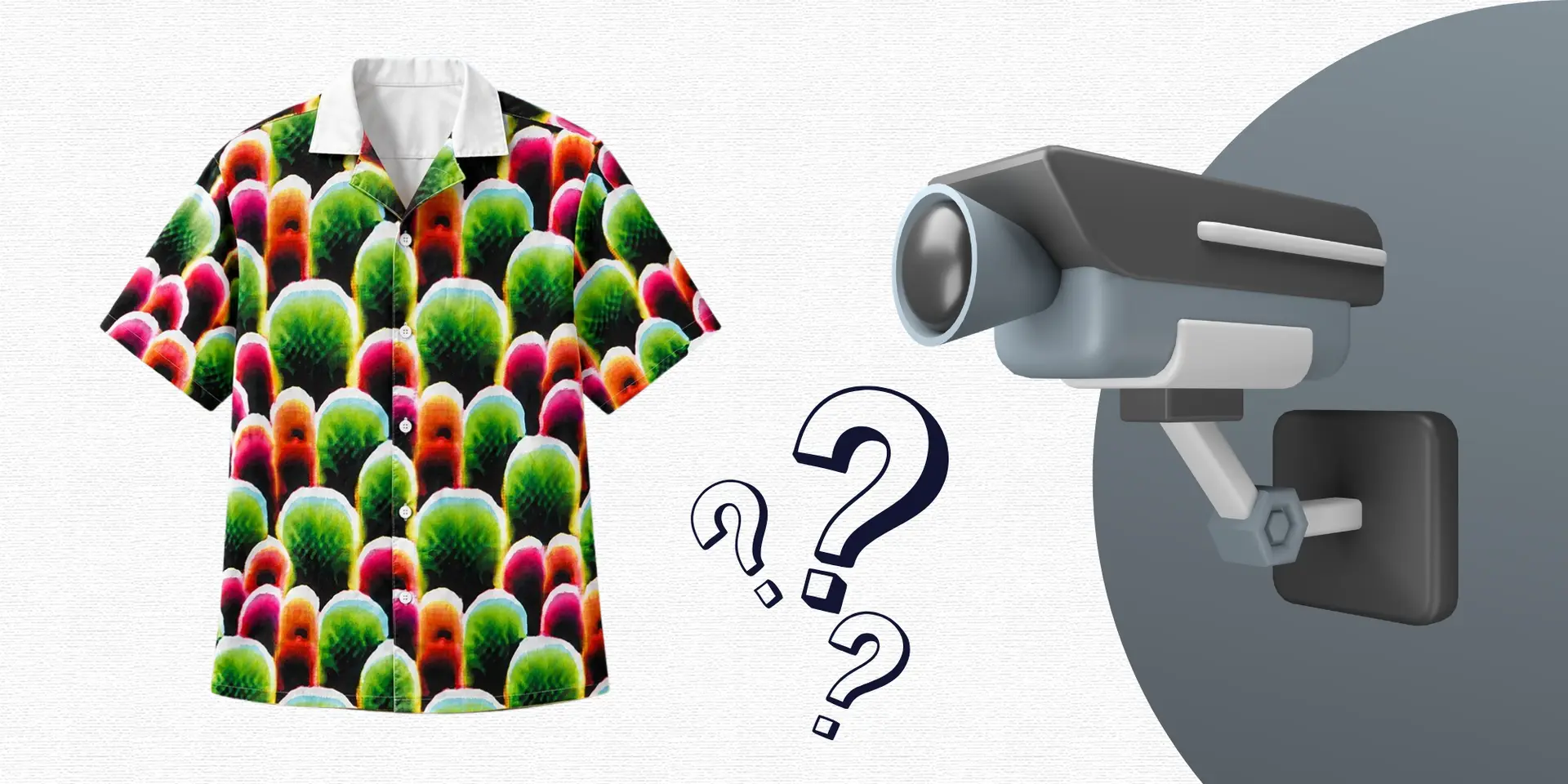

It looks like a colourful Hawaiian shirt. To an AI camera, it's nothing. Berlin-based artist and technologist Simon Weckert created Digital Camouflage, a shirt covered in bright, abstract patterns designed to interfere with computer-vision systems used for object detection.
To humans, the patterns simply look loud and playful. To some AI systems, they can make it harder to recognise the person wearing the shirt.
The idea taps into a bigger question about surveillance: what happens when cameras stop simply recording what is around us and start automatically deciding what they are seeing?
The trick is aimed at the AI, not the camera
The shirt does not make its wearer invisible. A regular camera can still capture the person, and anyone nearby can see them normally. The trick targets the software analysing the footage.
AI object-detection systems learn to identify visual patterns that suggest a person, such as body outlines, shapes, edges and the relationship between different parts of the body. Digital Camouflage uses what is known as an adversarial attack.
So, the pattern introduces visual information designed to interfere with what the AI has learnt to recognise. In demonstrations associated with the project, the open-source YOLO object-detection system identifies other pedestrians as people while failing to consistently recognise the shirt's wearer.
But that does not mean the shirt can fool every AI camera. Different systems use different models, training data and detection methods, so the results can vary.

What the shirt says about surveillance
The project was developed in response to concerns around AI-powered video surveillance planned for Berlin's Kottbusser Tor, a busy public area. Weckert presents the shirt as an artistic intervention rather than a guaranteed privacy product.
The point is less about walking around undetected and more about exposing a weakness in how machine vision works. An AI system can appear remarkably capable while still being sensitive to small changes that humans barely notice.
That also means Digital Camouflage has limits. Its effectiveness can depend on the AI model, camera angle, distance, lighting, movement and even how the fabric sits on the body. It is not a reliable shield against police cameras, facial recognition or sophisticated tracking systems.
Still, the idea makes an otherwise technical problem surprisingly easy to see. The shirt turns a question about algorithms into something you can actually wear. And it highlights an important reality of AI surveillance: cameras may capture the same world we see, but AI does not necessarily see it the same way.