



14-year-old builds AI tool to detect pesticides on produce
Sirish Subash won America’s Top Young Scientist in 2024 for PestiSCAND, a portable AI device that uses light-based sensing to detect pesticide residue.

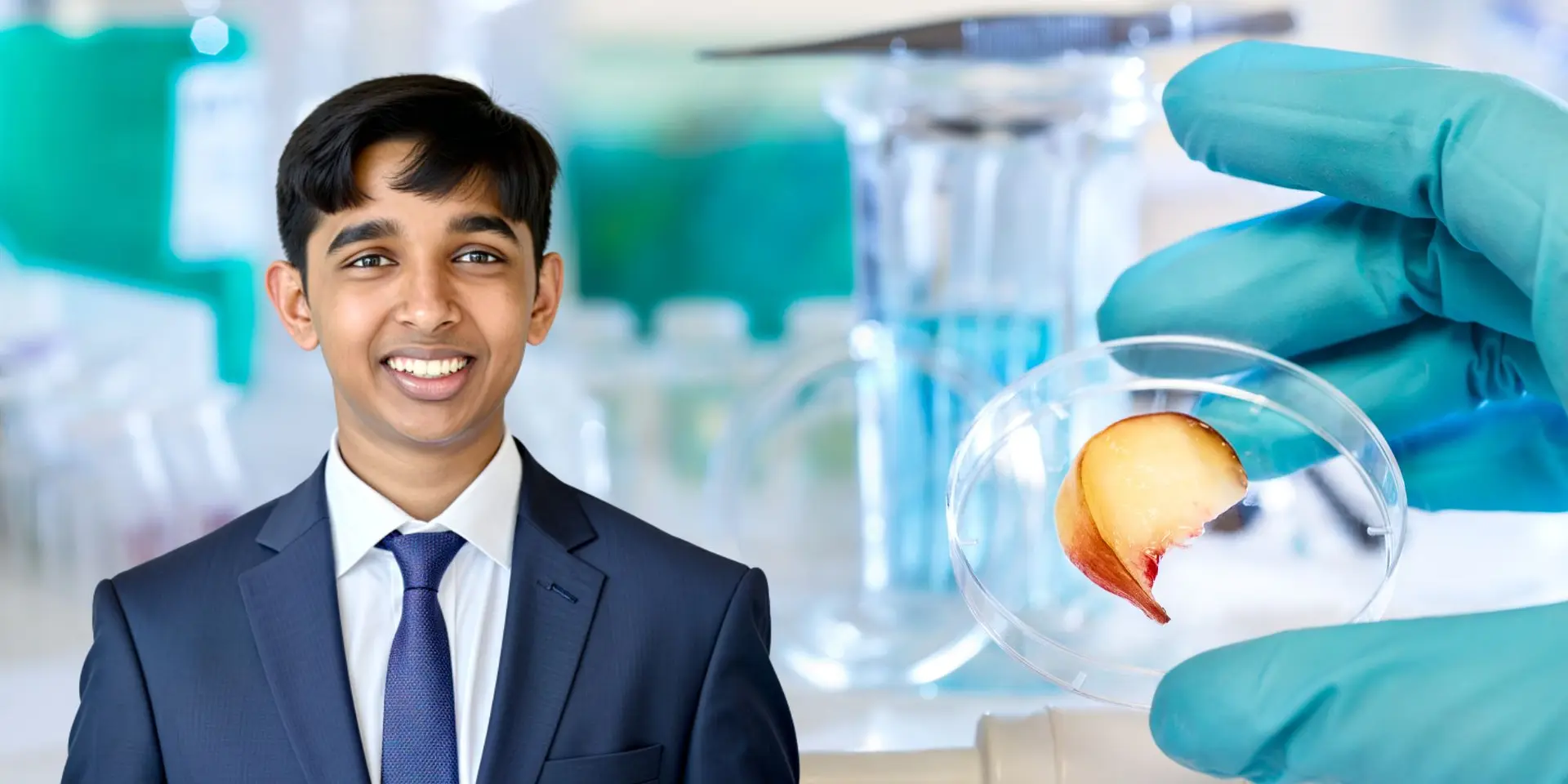

What started with a simple question about the food on his kitchen table turned into an award-winning science project.
Sirish Subash, a 14-year-old ninth grader from Snellville, Georgia, has developed PestiSCAND, a handheld device that uses artificial intelligence and light-based sensing to detect possible pesticide residues on fruits and vegetables.
The project earned him the title of America's Top Young Scientist at the 2024 3M Young Scientist Challenge, along with a $25,000 prize. This achievement has brought attention to how AI and portable sensing technology could make scientific testing more accessible to consumers.
A simple question sparked the idea
Subash began exploring the problem after his parents kept insisting he wash produce before eating it. He wondered how necessary that really was, and how much washing actually removed. Consumers typically cannot tell whether residues remain on the surface of produce.
Laboratory testing can provide detailed results, but it can also require specialised equipment, trained professionals and significant time. That led Subash to explore whether a compact device could provide a quicker indication.
He developed PestiSCAND as a portable, non-destructive detector designed to scan produce without cutting or swabbing it. A student at the Gwinnett School of Mathematics, Science and Technology, he refined the prototype over four months alongside a 3M mentor, senior research engineer Aditya Banerji.
How PestiSCAND uses AI
The device uses spectrophotometry, a technique that measures how materials interact with light. PestiSCAND shines light of various wavelengths onto the surface of a fruit or vegetable and measures the light reflected back. Different substances can produce different patterns of reflected light.
A machine learning model then analyses those patterns and attempts to identify whether pesticide residue is present. Because the process is optical and does not require physical contact with the produce, the fruit or vegetable remains intact.
Early tests showed promising results
Subash tested the prototype across more than 12,000 samples of apples, spinach, strawberries and tomatoes. According to 3M and Discovery Education, the device achieved more than 85% accuracy in detecting pesticide residue on tomatoes and spinach.
That result is encouraging, but PestiSCAND remains a student-developed prototype rather than a certified commercial testing device. Its purpose is also not to replace laboratory analysis or food-safety regulations. Instead, the idea is to provide consumers with an additional source of information.
Why portable testing could matter
Laboratory pesticide analysis remains the established method for accurately measuring chemical residues. However, consumers cannot realistically send every piece of produce for laboratory testing. A low-cost portable scanner could eventually offer a quicker way to identify produce that may need further testing.
It could also make food-safety information easier to access, particularly if the technology becomes affordable and simple enough for everyday use.
Importantly, detecting a pesticide residue does not automatically mean that food is unsafe. Food-safety authorities set maximum residue limits, and those limits are used to assess whether exposure presents a health risk.
What comes next
The current prototype already pairs with a smartphone app over Bluetooth. The user points the device at the produce and taps scan, and the app flags whether another rinse is advisable.
Subash has said he plans to keep improving the device, with a target price of about $20 per unit and a goal of bringing it to market by the time he starts college. He has since begun work on a separate project, a detector for microplastics in water.
The project shows how a school science experiment can evolve into a practical technology concept. It also highlights how AI does not always need to run inside a large data centre. With the right sensors and models, it can become a tool for solving everyday problems.