


AI startup Pramaana Labs secures $27M in seed funding round led by Khosla Ventures
Pramaana Labs develops AI systems that verify answers using formal methods, targeting regulated sectors such as tax, healthcare and finance.

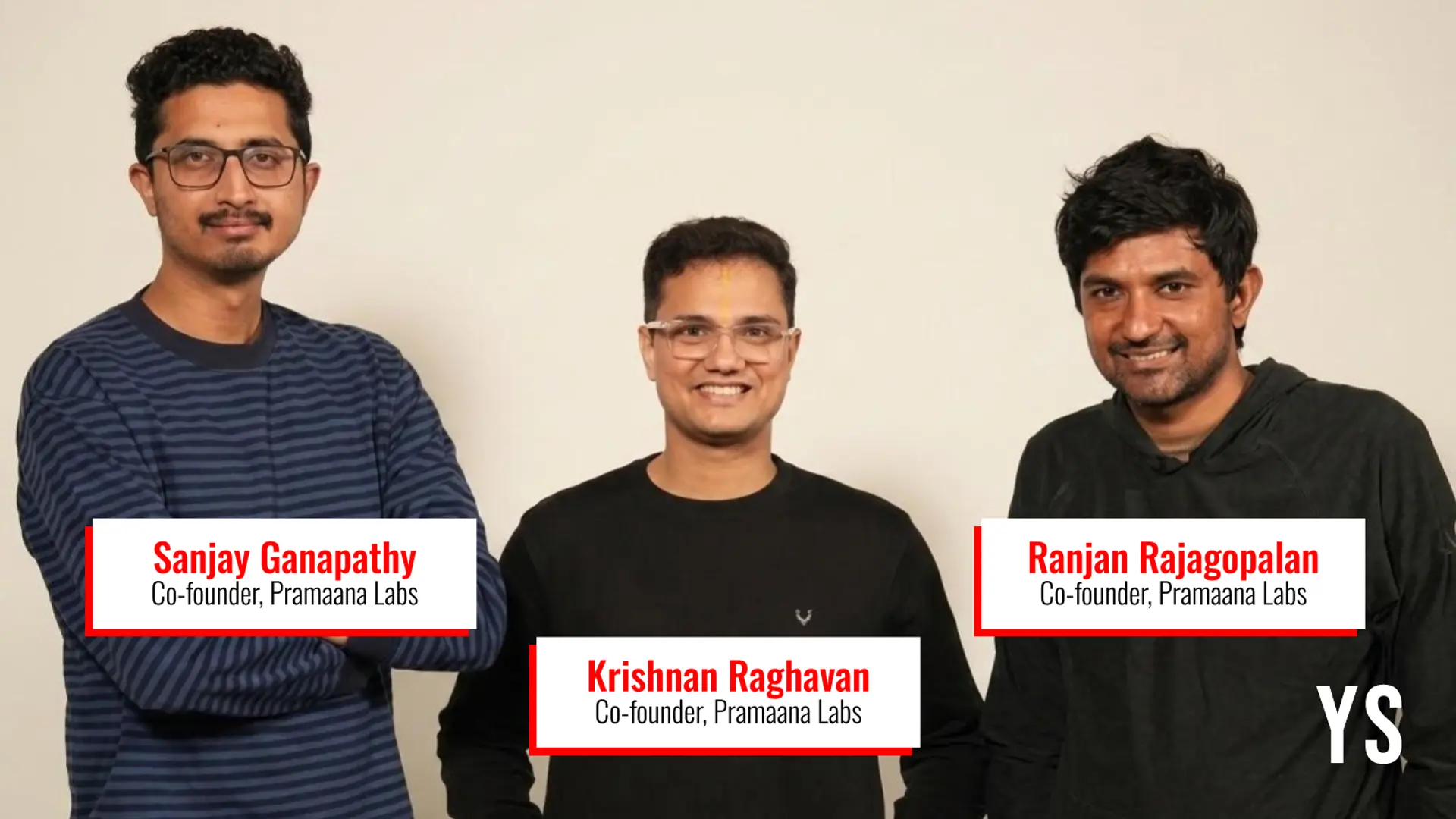

AI startup Pramaana Labs has secured $27 million in a seed funding round led by Khosla Ventures, with participation from Accel, Boldcap, Nexus Venture Partners, Premji Invest, and Unbound.
Pramaana is focused on making AI systems verifiably accurate. The funding underscores growing investor interest in technologies designed to improve the reliability of AI systems, particularly in sectors where errors can have serious consequences.
The Palo Alto-based Pramaana was founded in 2025 by IIT Madras alumni Ranjan Rajagopalan, Krishnan Raghavan, and Sanjay Ganapathy. It is developing technology that enables AI-generated answers to be mathematically verified before they are delivered to users.
The startup plans to use the capital to strengthen its research capabilities, train its verification models, and recruit engineering talent. The funding will also be used to expand its teams comprising domain specialists from fields such as taxation, healthcare, cybersecurity, and financial compliance.
While generative AI has advanced rapidly over the past few years, businesses and regulators continue to grapple with a key limitation: AI systems can produce convincing responses that are sometimes factually wrong. This challenge, often referred to as 'hallucination', has become one of the biggest obstacles to deploying AI in highly regulated industries.
Pramaana is striving to address this issue through a technique known as 'formal verification'. Commonly used in areas such as semiconductor design and software security, formal verification relies on mathematical methods to prove whether a system behaves correctly. The startup applies this principle to AI by translating complex regulations, policies, and specialised knowledge into machine-readable rules that can be checked before an answer is generated.
According to the company, its system analyses a query, converts it into a formal representation, and validates the result against encoded rules. If a response cannot be verified, the system is designed to explain why rather than provide an uncertain answer.
Explaining the rationale behind the business, Chief Executive Officer Rajagopalan said many critical domains already operate according to clearly defined rules and standards. The challenge, he noted, is converting that knowledge into a format that machines can reason through with certainty.
Rajagopalan also said that proving the correctness of AI-generated answers could remove a huge barrier that prevents organisations from trusting autonomous systems.
The company has assembled a research network that includes academics from IIT Delhi, IIT Madras, and the University of California, Berkeley, alongside sponsored work at Stanford University’s Centaur Lab. Its tax-related initiatives are being advised by former US Internal Revenue Service Commissioner Danny Werfel.
Werfel said responsible deployment remains essential as AI becomes more deeply embedded in professional workflows. He described verification technology as an important addition that could help tax professionals and taxpayers achieve faster and more accurate outcomes while maintaining confidence in the results.
Investors believe the technology could play an important role in the next stage of enterprise AI adoption.
In a joint statement, Accel’s Prashanth Prakash and Anagh Prasad said organisations in sectors such as healthcare, law, finance and government require a higher degree of certainty than current AI systems can typically provide. They noted that verification could become a foundational capability for deploying AI safely at scale.
Pramaana’s early investors include Google DeepMind’s Pushmeet Kohli and Microsoft’s Sriram Rajamani, two researchers whose work has helped shape the field of formal verification.
The funding comes amid rising interest in deeptech and AI startups globally. Investor appetite for specialised AI infrastructure companies has grown significantly as businesses move beyond experimentation and seek systems that can meet regulatory, compliance and governance requirements.
Deeptech funding in India has also strengthened in recent times, supported by government efforts to encourage advanced technology development and commercialisation. Companies operating in healthcare, enterprise technology, and AI-enabled research have attracted funding.
Edited by Swetha Kannan