


Is Anthropic Killing Design Tools? Everything About Claude Design
Anthropic just dropped a new design tool everyone’s talking about. Is it a Canva killer or just another AI hype train? Here's all you need to know!


Anthropic just crashed the design party Canva and Figma were hosting.
On 17 April 2026, Anthropic introduced Claude Design, an experimental tool that turns simple prompts into visual outputs like product mock-ups, pitch decks and one-pagers.
So, you describe an idea. It builds a visual. You tweak it with follow-up instructions. Done. But the bigger question is not what it does. It is what it changes and how good it really is!
From blank canvas to instant draft
Traditional design starts with tools. Figma, Photoshop or Canva. Then comes the blank canvas problem. Claude Design flips that process. Instead of opening a design app, users start with a sentence. For example, “Create a fintech app onboarding screen” or “Build a pitch slide for a SaaS startup”.
We have tried to make a mobile app design for a foodtech startup, and the results were amazing. Take a look below:
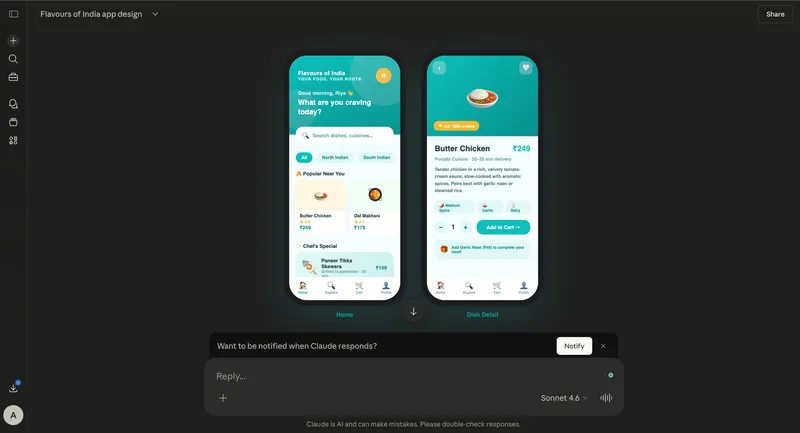
Credit: Claude
The tool generates a working draft instantly. From there, users can refine the output either by editing directly or by giving more instructions. This makes the process feel more like a conversation than a workflow.
The biggest shift here is speed. Ideas move from concept to visual in minutes, not hours.
Built for non-designers first
Claude Design is not trying to replace expert designers. It is targeting everyone else. Founders, product managers and marketing teams often struggle to communicate ideas visually. They rely on designers for even simple drafts, which slows down iteration.
Claude Design removes that dependency for early-stage work. It allows teams to create something tangible quickly, get feedback and then improve it. For startups with limited design bandwidth, this could be a big unlock.
Not a replacement, but a bridge
Anthropic is careful about positioning. Claude Design is not meant to replace existing tools. Instead, it connects with them. One of the key integrations is with Canva.
Users can export Claude-generated visuals directly into Canva’s Visual Suite. Once there, designs become fully editable and can be aligned with brand guidelines.
There is another interesting layer. Claude can generate HTML or interactive prototypes, which Canva can now import. This means coded designs can be adjusted using drag-and-drop tools instead of starting from scratch. In simple terms, Claude handles ideation. Canva handles polishing.
Where it gets serious for enterprises
Beyond quick visuals, Claude Design is moving into deeper territory. The tool can read existing design systems and apply them across outputs. That includes typography, colour tokens and reusable components.
For large organisations, this is significant. Maintaining design consistency across teams is a constant challenge. If Claude can automatically apply brand systems, it reduces manual effort and errors.
There is also a potential impact on engineering workflows. By generating assets that are closer to production-ready, Claude Design could shorten the gap between design and development. This has been a long-standing bottleneck in product teams.
Access and rollout
Claude Design is currently available in research preview. It is being rolled out to paid users across Pro, Max, Team and Enterprise plans. Anthropic is treating it as an experimental feature, which means usage limits and feedback loops are part of the process.
This suggests the product is still evolving, and early adopters will likely shape how it develops. So, is this the end of design tools? Not quite. Claude Design is not killing design tools. It is reshaping when and how they are used.
Instead of replacing platforms like Canva or Figma, it shifts the starting point of design work. The first draft no longer requires manual effort. It is generated. Design tools then become spaces for refinement rather than creation. This is a subtle but powerful change.

What to watch next
Claude Design is still in its early stages, but a few areas will determine its success. First, how well it handles complex user interfaces and detailed design requirements. Second, how reliable its exports are when moving between tools like Claude and Canva.
Third, how organisations manage security and governance when the tool accesses internal design files and codebases. And finally, how teams actually adopt it.
Claude Design signals something larger than a new feature. It reflects a shift towards AI-first creation, where ideas are translated into outputs instantly. For designers, this does not remove the need for skill. It changes the role. Less time on repetitive tasks and more focus on creativity, systems and experience.
For everyone else, it lowers the barrier to entry. And that might be the real disruption. Not replacing designers, but making design accessible to everyone.