



CynLr is building robots that learn like babies
CynLr’s object intelligence platform aims to teach robots to learn like babies, enabling real-time adaptation and accelerating the shift from rigid automation to cognitive robotics.

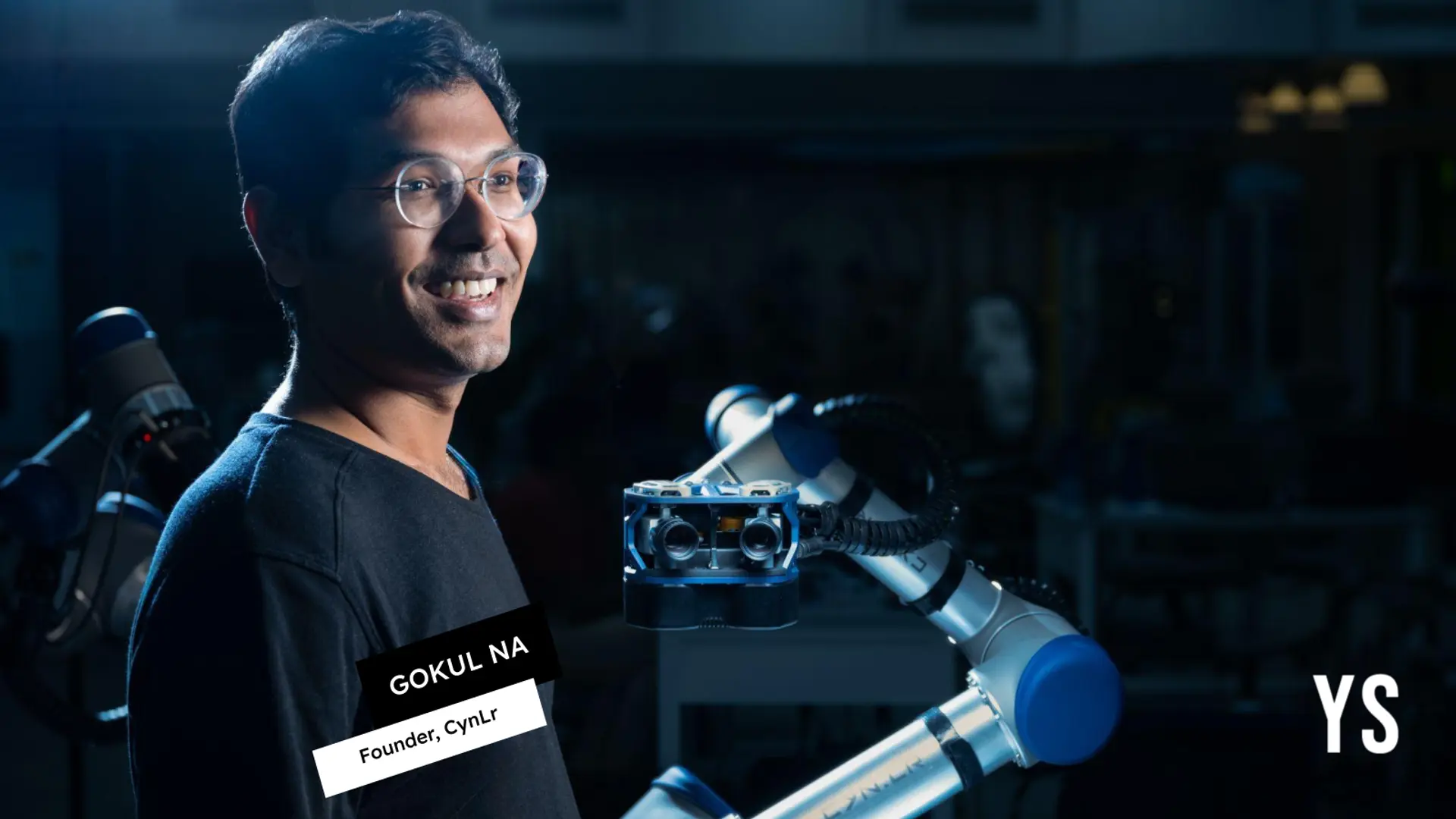

To build robots that can survive the real world, Gokul NA, Founder of Bengaluru-based CynLr, believes we must teach them to act like a baby.
By using a sensorimotor approach that lets machines see, touch, and interpret objects in real time, CynLr is bridging the gap between robots that merely execute tasks and those that can truly reason.
A baby does not need a formal database or a label to understand a bottle before interacting with it. Instead, the child reaches out instinctively, grabbing, turning, squeezing, and even putting the object in its mouth to learn its shape and texture through direct experience.
This instinctual, sensorimotor approach—how humans learn by coordinating their senses with physical movements—serves as a foundation for a new era in physical intelligence.
Most artificial intelligence systems, by contrast, are constrained by prior training. If they encounter something they were not explicitly trained on, the object effectively does not exist in their digital world. This limitation creates a divide between machines that can follow instructions and those capable of adapting in the moment.
“If you show an AI system something it has not been trained on, that object simply does not exist for it. The system is effectively blind to it. A human baby, on the other hand, does not need prior knowledge. Even without knowing what the object is, the baby can use its eyes, move its hand, and pick it up,” Gokul explains.
By mimicking this baby-like ability to deconstruct an object’s geometry and texture in real-time, robots can finally become teachable and resilient on the fly. On Thursday, the deeptech startup unveiled its ‘object intelligence’ (OI) platform, a system that enables robots to learn and adapt in real time, much like a human baby.
Shift from repetition to cognition
For decades, the robotics industry has focused on perfecting the dancing mannequin - machines that appear intelligent because they can perform complex, pre-programmed movements. However, the true indicator of intelligence is not motion, but sensing, according to Gokul.
While the public is often fascinated by humanoids that look like people, the real breakthrough lies in on-the-fly adaptation, which allows a robot to handle unpredictable real-world scenarios.
The industry is currently moving away from an era where every movement and exception had to be meticulously programmed.
“The last fifty years of robotics were about controlled environments. Programming every movement, every condition, every exception. We built machines that could repeat but not respond, execute but not adapt. That era is ending. The next fifty years will be about cognition. Machines that observe, reason, and adapt,” Gokul notes.
This cognitive shift is what will finally make robotics useful in factories where conditions change and nothing stays the same twice.
Infrastructure gap
Despite the rapid progress in software AI, physical AI continues to lag behind due to what can be described as the infrastructure gap. This gap is a combination of technical bottlenecks and harsh industry realities.
In the world of software, developers have the luxury of the control-Z command to undo mistakes, but in hardware, errors are costly and time-consuming. There is also a distinct lack of modular components, such as standardised motors, efficient sensors, and tactile “skin”, because the supply chain has not yet evolved to support general-purpose robotics.
The lack of an established ecosystem means that many robotics companies are forced to use components that were never intended for their specific needs.
“It’s like trying to build a car with bicycle wheels. The biggest bottleneck in scaling with customers is the limitation of the supply chain. None of the components we use were originally designed for our robot,” says Gokul, highlighting this struggle.
This bottleneck is compounded by high non-recurring engineering costs, the one-off expenses for designing new parts, and a shortage of talent that can synchronise the complex layers of hardware and neural architecture.
Furthermore, the sensing technology used in current robots is often insufficient. Most systems rely on vision language models, which use human-generated data and words to interpret the world.
However, for a robot to be truly dynamic, it requires vision force models that combine sight with physical touch, according to CynLr.
“The bottleneck for physical intelligence today is sensing. Every AI system built today uses senses to act. But human beings act to sense - you pick up a coin and tilt it so you can see better. You don’t create massive datasets of hard-to-see coins and train on them. Robots need their own eyes, touch and feel,” explains Nikhil, Founder-GTM at CynLr.
Flexible automation
The solution to these challenges lies in the marriage of OI and the concept of the ‘universal factory’.
OI is the technological engine that allows a robot to instantly perceive an unseen object as a “recipe” of geometry and reflectance. This capability is the key to creating the universal factory, a software-defined manufacturing floor where machines can switch between different products just by updating their code.
In this future of flexible automation, a single production line could handle a thousand different stock-keeping units (SKUs), a term for distinct types of products, without needing to be physically retooled.
This would allow factories to be as adaptable as the markets they serve. Tasks that have historically resisted automation, such as fitting tiny screws or handling reflective metallic parts, become possible when robots can intuitively learn through interaction.
Every failed grasp becomes a learning event that triggers real-time recalibration, much like a baby adjusting their grip on a toy.
The transition to this new world of robotics is a long-term game that may take 15 years to fully manifest, according to Gokul.
Many companies are currently raising large amounts of capital, including the $75 million CynLr aims to raise over the next three years, primarily to push until the market and supply chains mature.
By focusing on the “sitting human” rather than the “dancing mannequin,” the industry can build the intelligence blocks required for machines to function in the unstructured and unpredictable real world, remarked Gokul.
Edited by Jyoti Narayan