



Elon Musk says AI will probably become smarter than all humans in 4-5 years
Responding to a post on X, the Tesla and xAI chief set an aggressive timeline as investment in advanced models and robotics accelerates

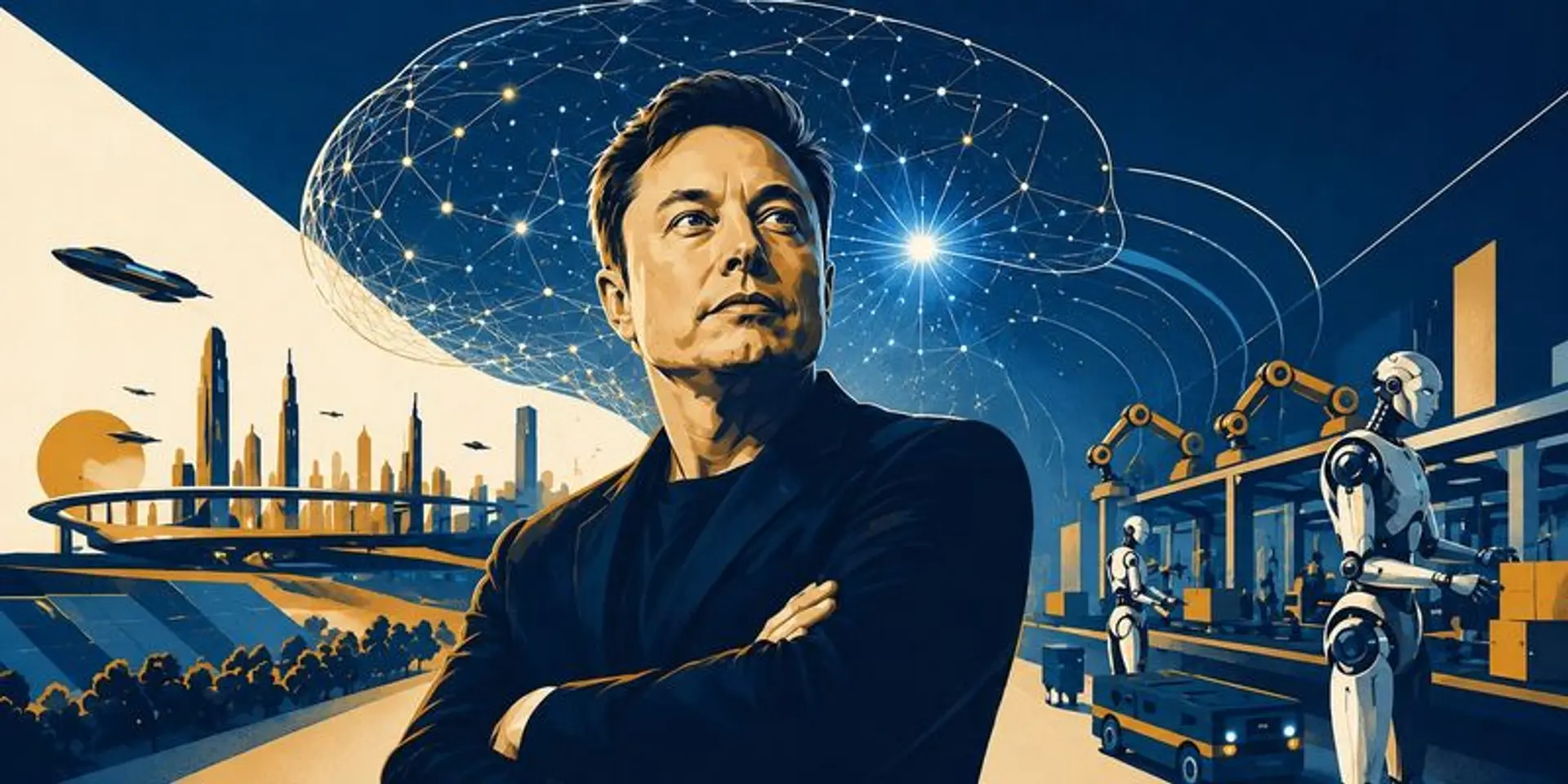

Artificial intelligence is advancing at a remarkable pace, and Elon Musk believes the technology is on track to surpass the combined intelligence of all humans within the next four to five years. The Tesla and xAI chief made the prediction in response to a post on X by entrepreneur Peter H. Diamandis, who argued that abundance stems from expanding human potential through better tools and wider access to resources. Musk replied that “AI probably exceeds the sum of all human intelligence in 4 or 5 years,” positioning machine intelligence as the next great step in that trajectory.
This is not the first time Musk has outlined an aggressive timeline. He has previously suggested that Artificial General Intelligence (AGI) could emerge as early as 2026 and that a single model might outthink any individual human around 2027. Speaking earlier in Davos, he estimated that by 2030 or 2031, AI could be “smarter than all of humanity combined.” His latest comment on June 22, 2026, narrows that window and keeps the focus on the end of the decade as a pivotal period.
Why now: rapid progress and massive investment
AI systems from companies such as OpenAI, Google, Meta, Anthropic and xAI are already writing code, generating content, assisting with research and tackling increasingly complex tasks. Behind the scenes, firms are investing billions of dollars in data centers, high-speed networks and advanced AI chips to train and deploy more capable models, accelerating development cycles and expanding real-world applications.
Abundance through automation and the Optimus bet
Musk links AI’s rise to economic abundance, arguing that intelligent machines will eventually take on much of today’s work in manufacturing, logistics, construction and other labor-intensive sectors. The result, he says, could be dramatically cheaper goods and services. That vision underpins Tesla’s humanoid robot program, Optimus, which Musk has described as potentially more important to the company’s future than cars, by performing repetitive, dangerous or physically demanding tasks in factories, warehouses and, potentially, homes.
Debate over timelines and risks
Experts remain divided on when AGI might arrive and whether “smarter than all humans combined” is a meaningful benchmark. Some researchers expect steady, incremental improvements short of broad human-level reasoning; others warn of sharp capability jumps as compute and data scale. Alongside hopes for productivity gains and scientific breakthroughs, many call for stronger safety research, rigorous evaluations and governance to ensure powerful systems remain aligned with human values.
For now, Musk’s forecast serves as a provocative marker: as of June 22, 2026, he argues humanity may have only four to five years before AI surpasses our collective intelligence—placing the inflection point around 2030–2031. Whether that brings the “amazing abundance for all” he envisions will depend on how the technology is built, deployed and governed in the years ahead.