



Google's AI ATLAS reveals how 1 billion users are reshaping the global economy
Google's AI & Economy ATLAS analyses 15 million AI interactions from over 1 billion users, revealing how AI is transforming work, households and economies.

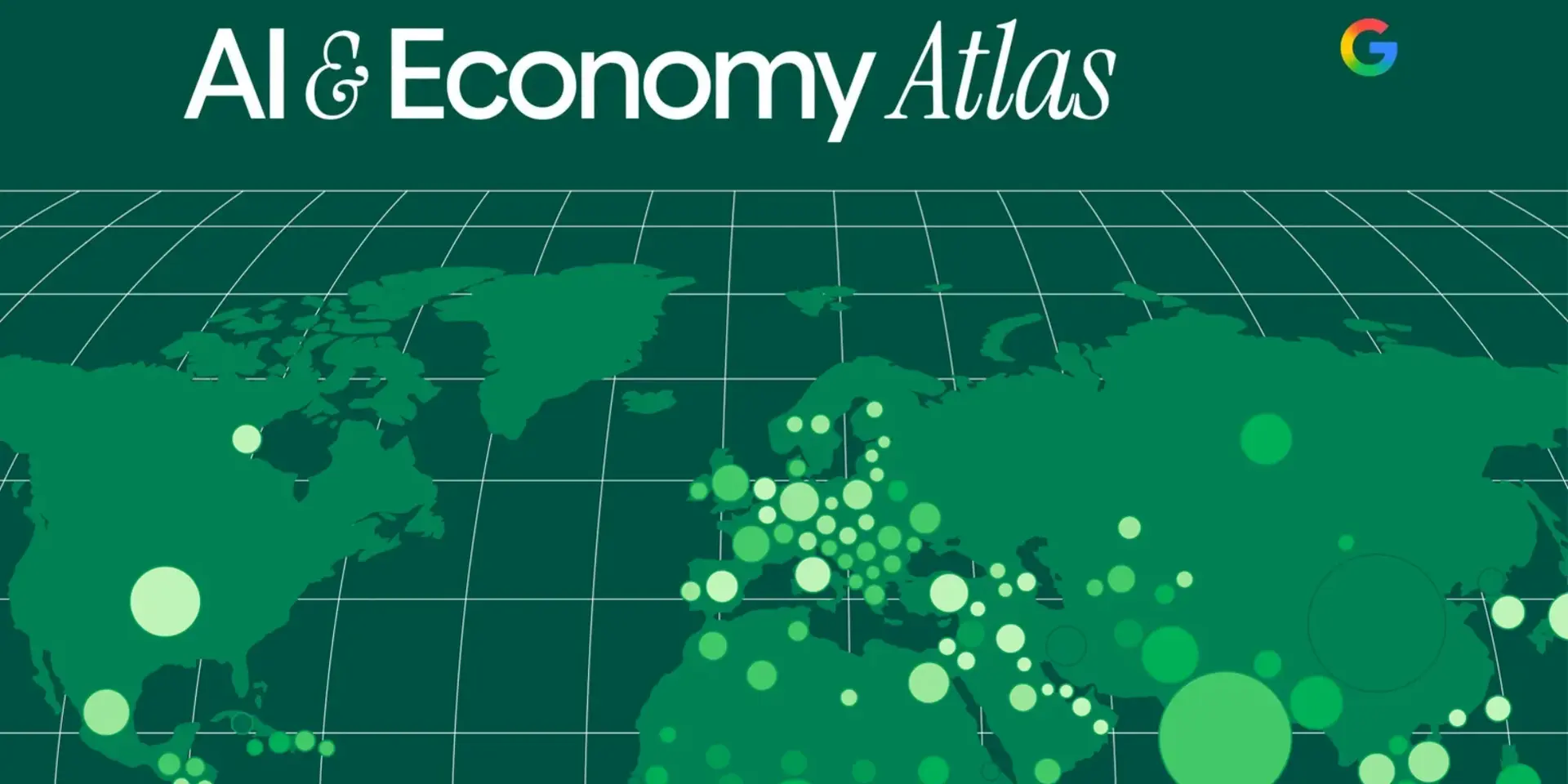

The AI conversation is entering a new phase. Instead of asking what artificial intelligence could do, researchers are beginning to measure what it is already doing. Google's latest study offers one of the clearest pictures yet, analysing billions of real-world interactions to understand how AI is changing work, daily life and the global economy.
The findings suggest that AI is becoming less of a novelty and more of an everyday utility, with its biggest impact often taking place outside the workplace.
A closer look at Google's AI Economy ATLAS
On July 23, 2026, Google unveiled the AI & Economy ATLAS, an ongoing research initiative designed to track how people use AI across different countries, industries and languages.
The first edition, ATLAS 1.0, analyses 15 million de-identified interactions from more than 1 billion monthly users across the Gemini app, AI Mode and the Gemini API.
The dataset spans over 150 countries, 140 languages, 800 occupations and 4,000 tasks, making it one of the most comprehensive snapshots of AI usage to date. Rather than predicting the future, the project aims to establish a living baseline for how AI is already being integrated into everyday life.
AI is changing jobs one task at a time
One of the report's key findings is that AI is transforming work gradually rather than replacing entire professions. Google found AI activity across all major industries and in 68% of occupations, representing around 90% of employment in the United States.
However, within a typical job, only about 21% of tasks currently involve AI assistance. The examples are practical rather than dramatic. Mechanics use AI to diagnose wiring problems, technicians interpret equipment data more efficiently, and professionals rely on AI to support routine decision-making.
The findings suggest AI is largely augmenting workers instead of replacing them.
Most AI use happens beyond the office
Perhaps the biggest surprise is where people are actually using AI.
According to the study, more than 86% of recorded AI interactions happen outside formal workplaces. People increasingly turn to AI for researching purchases, understanding household appliances, completing government paperwork, filing taxes, renewing licences and managing everyday administrative tasks.
These activities improve productivity and save time, yet many of their economic benefits are not captured by traditional measures such as GDP.

AI adoption is becoming increasingly global
The research also highlights AI's growing international reach. Only about one-third of conversations take place in English, showing that users continue to engage with AI in their native languages, even for complex queries.
Google also found that AI adoption broadly follows income levels, with wealthier economies generally recording higher usage. However, several middle-income countries in South America and the Middle East are adopting AI faster than expected, suggesting the technology is spreading beyond traditional digital leaders.
Why these findings matter
Google's AI & Economy ATLAS highlights a critical transition in how policymakers and businesses should think about AI.
Rather than focusing solely on automation, the findings suggest priorities should include developing new workforce skills, recognising productivity gains outside traditional employment and expanding digital infrastructure to reduce adoption gaps.
As Google continues updating ATLAS with fresh data, the project could become an important benchmark for understanding not just how AI evolves, but how it reshapes economies around the world.