



Google brings Gemini AI to Maps with smarter search, 3D navigation
Google is adding Gemini-powered features to Maps, allowing users to ask complex questions about places and navigate with a more realistic 3D view of roads and landmarks.

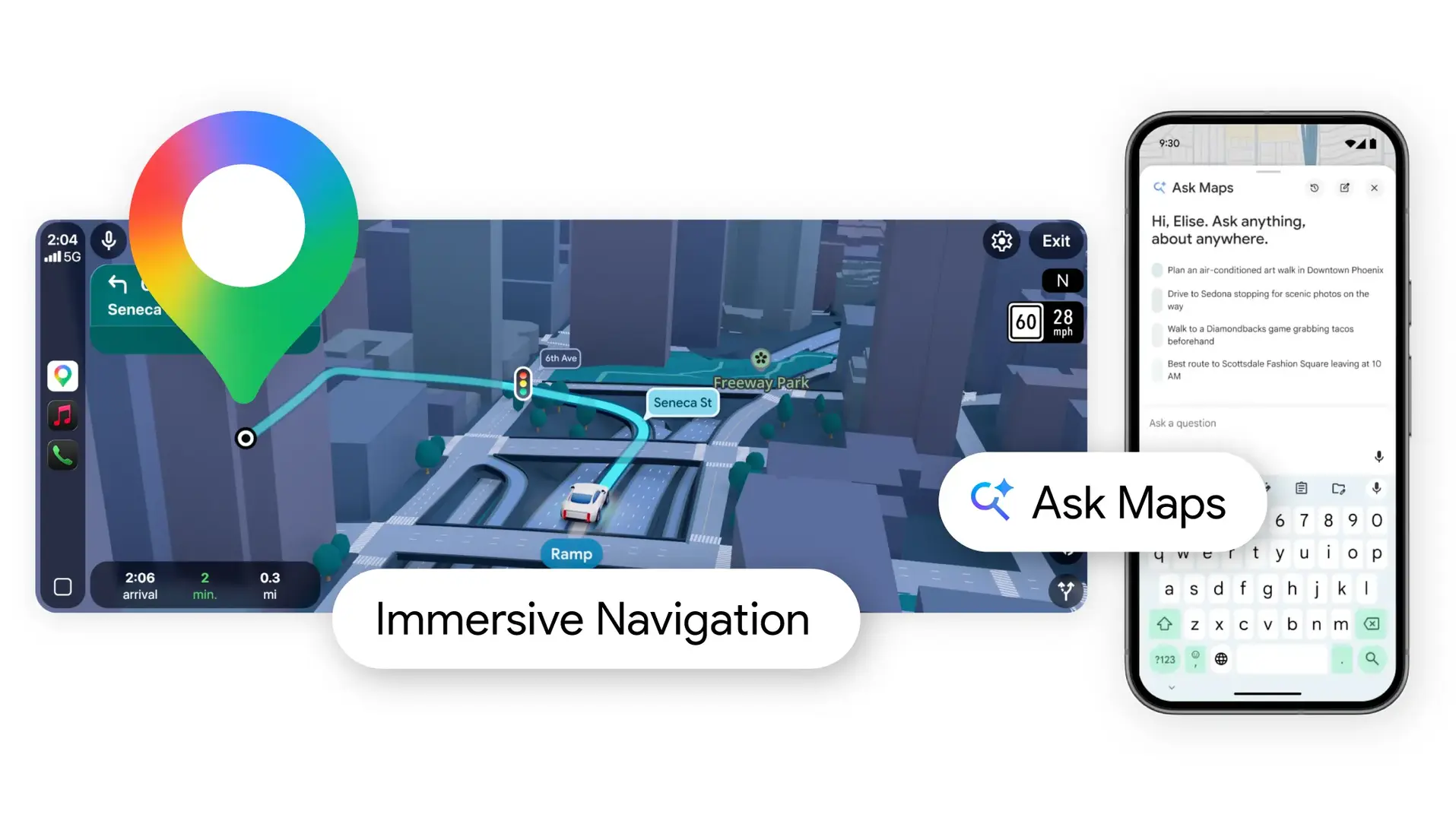

Alphabet and Google chief Sundar Pichai said that Google is rolling out two major Gemini-powered upgrades to Google Maps that aim to change how people find places and follow directions.
The features are called Ask Maps and Immersive Navigation, and they promise more conversational search and a more realistic navigation view that shows roads and landmarks as they really look.
Ask Maps lets users ask Google Maps complex, natural-language questions instead of typing short keyword searches. Users can request multi-part things like “Find me the best 3-hour family hikes in the Grand Tetons and a spot for a packed lunch” and the system will return suggested routes, places and practical details in one response.
The feature uses Maps data such as reviews, photos and opening times to tailor answers to your query. The underlying AI is generative, it composes responses rather than just listing links, so it tries to combine many data points into one helpful reply.
Pichai described Immersive Navigation as Google’s “biggest navigation upgrade in over a decade”, a remark that highlights both the scale of the update and the central role of Gemini in powering it.
Immersive Navigation replaces the traditional flat map view with a vivid three-dimensional scene that reflects buildings, terrain, lanes, crossings and visible landmarks.
The aim is to help drivers, cyclists and walkers understand complex junctions before they reach them, by showing lane markings, traffic lights and crosswalks in context.
Google noted the feature is built by analysing Street View photos and aerial imagery so the visuals match what users would see on the road. This is intended to reduce confusion at tricky intersections and make landmark-based directions easier to follow.
Google has said Ask Maps is rolling out now in the United States and India on Android and iOS, with desktop support expected later. Immersive Navigation begins its rollout in the United States first, and Google intends to widen availability over time to more devices and regions.
Google Maps has evolved steadily since its launch. Early changes focused on routing and traffic. Later additions included Street View, real-time traffic, and user-contributed reviews and photos.
The company first began integrating Gemini-style AI into Maps and navigation experiments in recent years, and this release expands that work to a mainstream audience. The current update is one of the more ambitious shifts because it blends generative AI with live mapping imagery, rather than just adding new map layers or business data.
Maps is a product hundreds of millions of people rely on daily. Turning it into a conversational assistant and adding photo-real navigation changes the product from a routing tool into a planning and orientation tool.
This shift also follows Google’s broader push to integrate Gemini across its apps, from search to productivity tools, in an effort to make services more proactive and personalised.