



How NxtGen is riding the AI-data centre wave
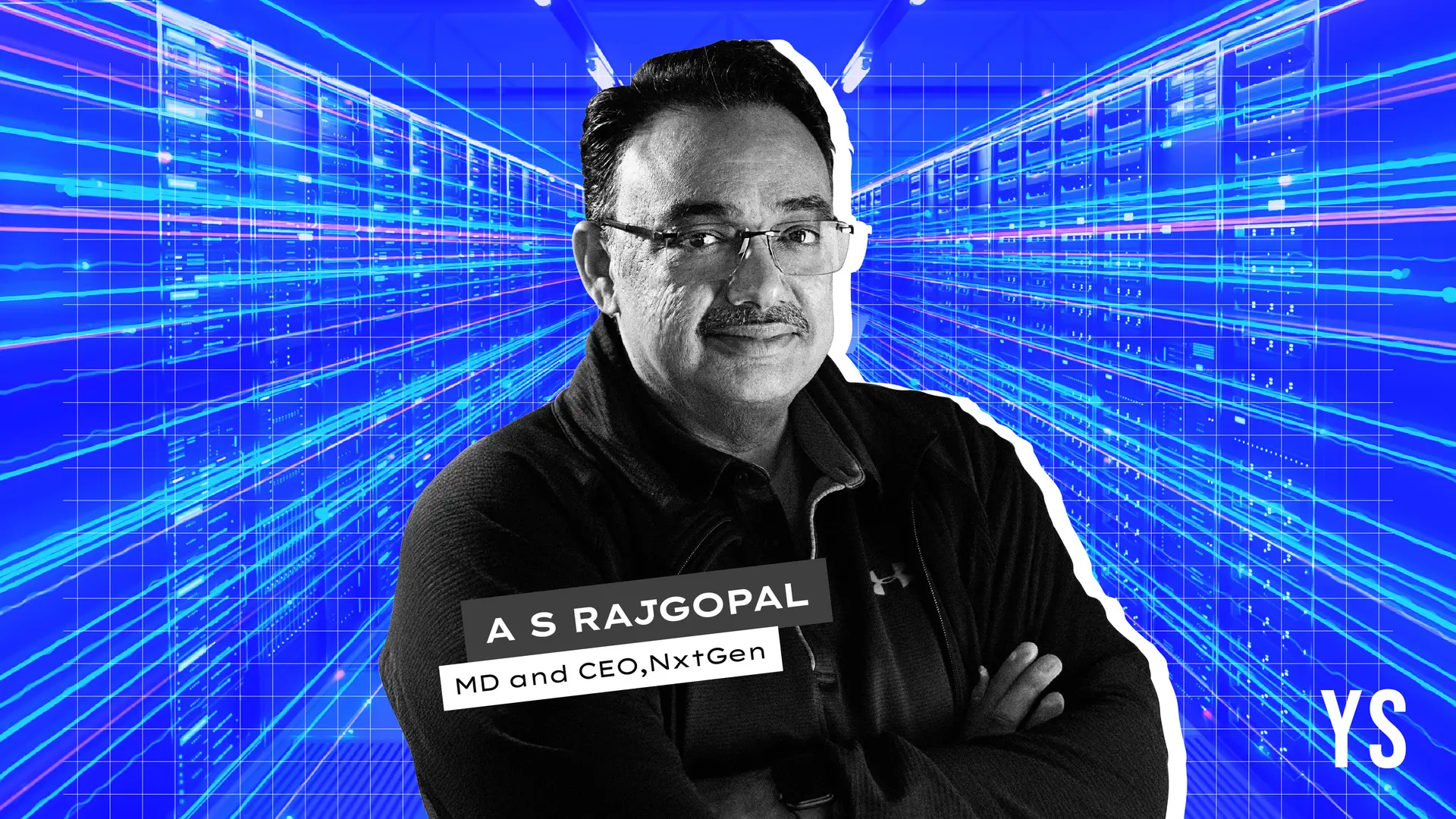
NxtGen CEO AS Rajgopal weighs in on the AI infrastructure boom, as the company transitions from 12 years of cloud computing expertise to GPU-powered data centres, in tandem with India’s push for technological independence.


The data centre industry is at an all-time high thanks to the ever-growing appetite of AI models for raw compute power, making high-performance chip racks the most valuable asset in technology.
Standing at the centre of this transformation is NxtGen, a Bengaluru-based company that has been the cornerstone of India’s cloud computing industry for over a decade. The firm now finds itself uniquely positioned to cash in on the AI boom.
Inside its flagship campus in Bidadi, at the city’s outskirts, the company is wiring in GPUs, the specialised chips serving as the backbone of AI workloads, to fuel India’s AI ambitions.
NxTGen’s CEO, AS Rajgopal, believes the demand for computing power from enterprise applications (such as AI-driven business software and services) will become much greater than the demand for training AI models within the next two years.
“The game has shifted from floor space to compute density,” Rajgopal tells AI Story.
Physical data centres have become redundant today, and what matters is the ability to pack compute power, he says.
The company’s newest machines draw 100 kilowatts per rack—a metal frame that holds several servers in a data centre. This is more than 12 times the power of traditional servers. Rajgopal says that next year’s chips could consume six times that amount.
The firm currently offers the country’s lowest-priced order of Nvidia's H200 processors through the government’s IndiaAI Mission, which subsidises GPU access by up to 40%.
However, NxtGen doesn’t want to just provide the chips. Instead, it is focusing on building and running AI enterprise-ready applications, solutions, and use cases for customers.
Rather than simply renting out computing power, NxtGen is layering its physical infrastructure (including CPUs and GPUs) with proprietary cloud software called ‘SpeedCloud’, which, the company says, cuts cloud bills by more than 80% compared with US hyperscalers (large cloud service providers). The platform that helps customers to build, deploy, and manage AI applications.
The cloud and data centre provider has rolled out a series of AI solutions for Indian enterprises, which will help them with real-world use cases on top of its sovereign cloud infrastructure.
The approach has attracted 40 enterprise customers spanning banking, healthcare, manufacturing and government, including India's Election Commission and Ministry of Health.
Notably, Rajgopal says, the firm’s AI-driven business applications could eventually eclipse NxtGen’s traditional cloud services.
Edited excerpts from the interview:
AI Story [AIS]: Could you talk about your current developments with AI?
AS Rajgopal [ASR]: We have embarked on a mission to deploy 12,000 GPUs. We are raising approximately $400 million to achieve this goal. That’s at a very advanced stage of engagement with prospective investors, and we will soon close with one of them. In addition to this, we started deploying GPUs some time back.
More importantly, we have become an AI-first company. I didn’t want to tell our customers that they do AI and we don't. We have put a team in place, starting in April last year, and we received our first set of GPUs in May last year. Since then, the team has been working on various use cases internally.
We have developed three solutions internally. First, we have a solution architect, which is a model that you can query about what solution can be offered in a particular situation. Second, we've developed an enterprise search, which searches all the information we have and provides answers for senior management.
Third, we have built NxtChat, which is an internal chat platform.We have been using this for almost three years. A user can seek information across teams, while it provides a summary of what’s happening across all employees and projects. We started utilising these solutions internally first, and are now offering them to the market.
In the last four months, we have built 40 use cases for our customers, from video processing to chatbots.
We want to ensure there is a baseline level of consumption happening. So we approached IndiaAI as a business opportunity, not merely as a customer opportunity. We made a very competitive bid. Our bid is globally the lowest—nobody matches our pricing on H200 and other cards. Over the next 4-5 months, our orders will precede our current infrastructure capacity… So we are in a strong position.
AIS: What is NxtGen doing to provide more value in cloud computing now that it's become a commoditised space?
ASR: Cloud is indeed commoditised today. We are trying to tell our customers there is no more value from traditional cloud. You need to extract every last rupee from it. Hence, we are promoting a high-value cloud called SpeedCloud to our customers, which saves 80-85% compared to any global cloud providers.
We’re also moving beyond basic cloud services by launching vertical-specific industry clouds. Our financial services cloud, for instance, has over 800 regulatory controls to meet requirements of six different regulators. We had to make it exceptionally secure, and that paved the way for our partnership with Thales—to secure our cloud platform, ensuring readiness for future threats, including quantum computing.
These are a few initiatives in AI that will become very large businesses for us. Perhaps these industry-specific clouds, starting with government and financial services, may even overtake our traditional cloud business in value, especially as we layer them with AI capabilities.
AIS: There’s a lot of talk about the GPU crunch and startups struggling with access. What’s your take on this?
ASR: The US Diffusion Act came into force in January this year, primarily putting restrictions on imports. I have been given confirmation by the OEMs (original equipment manufacturers) that those limitations no longer exist.
This means we will have unfiltered access to GPUs. While access to GPUs is still a challenge, the real issue is not the volume of GPUs. It’s the ability to generate tokens and compute efficiently. We’ve been investing heavily in GPU infrastructure and plan to deploy at least 12,000 units soon. Over the next 2–3 years, we anticipate a $2 billion–3 billion capex requirement.
The regulatory restrictions are easing. We don’t have an immediate threat to it. We need to invest a lot of money and create that infrastructure.
The IndiaAI initiative is playing a key role here. Startups can apply for GPU access through IndiaAI and receive subsidies up to 40%, depending on the project. We’ve already fulfilled GPU orders for some startups, making us the only H200 provider in the country at this scale. It is an excellent card for training AI models.
While the initial 18 months will focus on training, we expect inference workloads to overtake training within two years, and we are preparing for that transition.
AIS: NxtGen started as a data centre company. How has the journey to a full-stack AI and cloud firm looked like?
Data centres have become a real-estate play. On the compute side, significant changes have happened. What we saw for the first 12 years of our existence as a company—the same data centre space, same amount of power—our compute has increased 10 times.
Hardware density has drastically improved—where we used to run 12 CPUs in one unit, we now run up to 196. The form factor hasn’t changed much, but compute and storage have increased 10x, while power consumption has only grown ~30%.
The surprise came with AI. Our current AI deployments require up to 100 kilowatts per rack—compared to the 8 kilowatts per rack used in traditional cloud workloads. And that’s only increasing. Next year, with NVIDIA's upcoming Ultra Rubin, we’ll need to support up to 600 kilowatts per rack.
Physical data centres have become very redundant in that sense. It is the ability to pack compute that is the real game. We currently operate five hyperscale data centres (large-scale facilities) along with 16 on-premise edge (local data centres) deployments.
We are a pure-play cloud, and it has been a natural progression into AI-services in the cloud. We are not going to play the GPU-as-a-service game. We ourselves are going to build use cases for our customers and run them for the long term. In two years, that will be a fairly large market.
AIS: Could you highlight a few interesting AI use cases you’re currently working on?
Video summarisation is an interesting use case. We are helping one of the state governments search and analyse all parliamentary videos. For instance, we took about 1,000 hours of footage, where they wish to gain more information around the discussions regarding women and child welfare. So, you ask that question, and AI extracts snippets of all related discussions.
Juris, our legal AI model, enhances efficiency for legal professionals. It analyses complex cases, identifies relevant precedents, and summarises lengthy documents. With access to a repository of over 5 lakh documents, it includes legal information comprising cases, court judgements, acts, regulations, and laws.
AIS: Are you monetising these AI solutions?
ASR: Our AI chat offering is currently being piloted with two large PSUs, each with around 30,000 users. For example, our internal AI assistant helps retain organisational knowledge that would otherwise get lost in WhatsApp conversations.
We’re not pricing by GPU usage. Instead, we look at the workload. For instance, if a physical customer support agent costs Rs 28,000–31,000 a month, our AI agent should provide better performance and empathy at a lower cost. That’s the benchmark we’re aiming to beat.
AIS: AI is moving faster than customer demand. Are enterprises ready for this shift, especially with data sensitivity and on-premise requirements?
One of our key decisions was utilising our existing foundation of 140 petabytes of storage from approximately 1,000 customers. We decided to first deploy AI on this production data, knowing that enterprises would naturally be hesitant to grant data access—and understandably so, given the uncertainties around AI data processing.
Now, technology is evolving so fast that enterprises are playing catch-up. Many are hesitant about sharing data. That's precisely why we chose to focus on enterprise-owned data as our starting point.
However, the ecosystem is changing. Tools like Microsoft CoPilot and Office365 are already accessing enterprise data; so the reluctance is slowly easing. We’re now seeing proof-of-concepts turn into production rollouts more quickly than before.
Edited by Swetha Kannan