



How Proshort is turning AI into a real-time sales coach
Gaurav Mishra’s Proshort is an AI-powered sales coaching platform that delivers real-time insights to improve win rates. The Bengaluru-based startup has already crossed $1M ARR within a year, with customers across the US and India.

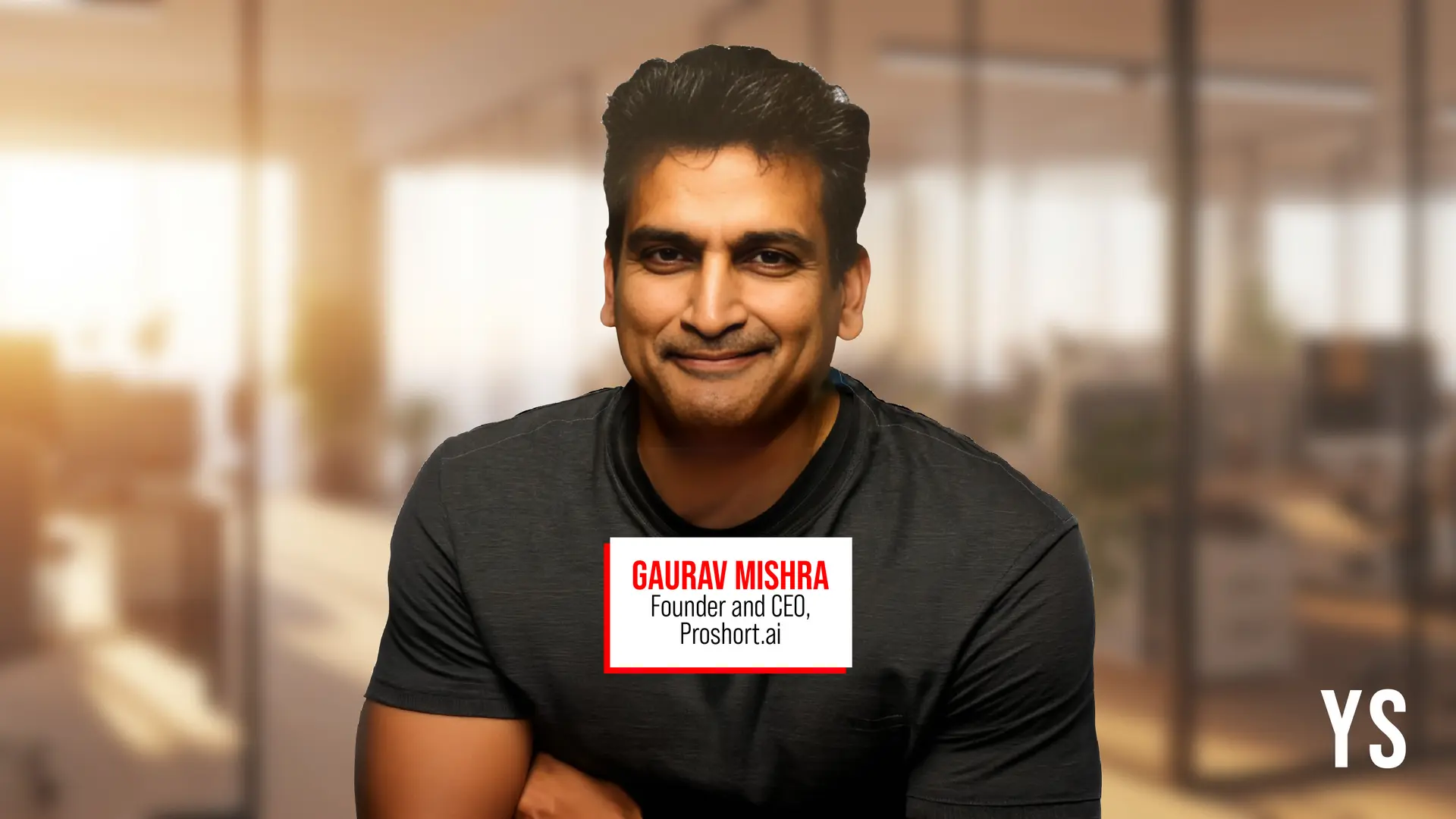

When Gaurav Mishra built his first company, Guruji, in 2006, India was still in its pre-mobile internet era with only about 30 million internet users. Despite this, the company managed to raise $10 million and was later acquired by Flipkart. Many would say that the search engine company was ahead of its time.
After Guruji’s acquisition, Mishra spent many years in senior roles at consumer tech companies, building large-scale platforms spanning search, knowledge graphs, and machine learning systems. But he found himself drawn back to entrepreneurship.
In 2022, Mishra returned to the startup world with Proshort, tapping into the rise of generative AI to address a persistent gap in how sales teams operate.
An IIT Delhi graduate, Mishra brings nearly three decades of experience in consumer technology with stints at companies like Microsoft, Yahoo, Uber, ShareChat, and Meta in both product and engineering roles.
Identifying the gap
Mishra had been tracking the rise of generative AI and the new possibilities it was unlocking in how machines could process and interpret information. He had also observed a persistent gap in how large organisations were quite ambiguous in terms of their output, particularly in their sales departments.
He explains that while the nature of the output itself was clear, whether one has won a deal or not, the problem lies in the reasons attributed to why someone wins and why someone loses.
Mishra thought about fixing this issue with AI.
“If you look at most of the companies that exist in the ecosystem, they are very focused on different things, and what AI can do. When we started thinking about the problem, we kind of flipped it and we said, yes, of course, AI can do a lot of things. It can be your assistant,” he elaborates.
The AI coach
Building on this idea, Mishra conceptualised Proshort, which he describes as an AI-powered “super coach” for sales professionals.
The platform delivers contextual, real-time guidance by analysing sales calls, conversations, and workflows. It identifies where a salesperson may be falling short, and offers specific, actionable feedback on how to improve.
Thus, Proshort helps bridge a critical gap between training and execution, something that traditional sales departments still struggle with due to their static nature.
According to Mishra, this approach has already started showing results. During certain case studies, the platform has helped improve sales win rates up to 20%, while reducing time spent on administrative tasks such as CRM updates and follow-up communication, which saves up to 10 hours per week. This allows sales teams to focus more on selling rather than operational overhead.
The firm had been working on the product since 2020, and developed the alpha version of the programme in June 2024.
Early momentum
Proshort has over 45 customers spread evenly between the US and India. However, in terms of revenue, the US business accounts for 65% compared to 35% in India. The company also claims to have crossed $1 million in Annual Recurring Revenue (ARR) within a year.
Proshort operates in a highly competitive AI-driven sales intelligence and enablement space, alongside players like Gong and Chorus.ai (now part of ZoomInfo), as well as revenue platforms like Clari. It also overlaps with engagement tools such as Salesloft and Outreach, which are increasingly embedding AI guidance into workflows. Some other companies that function similarly are Fathom, Agentforce Sales (formerly Salesforce Sales Cloud).
The AI-driven sales market is not just growing, but is shifting from traditional enablement built on static training and playbooks to real-time systems that guide representatives during live interactions. Early adopters are already seeing improvements in sales efficiency, including faster deal cycles and better conversion rates.
According to Grand View Research, the global AI-sales market was estimated at around $25 billion in 2024 and is projected to exceed $140 billion by 2033 at over 20% CAGR.
From a technology standpoint, Proshort has been built as an AI-native platform, with a significant portion of its core capabilities developed in-house. These include systems around knowledge graphs, search, and data processing.
Instead of building its own large language system, the company uses models from providers like OpenAI, Anthropic, and Google, selecting the most suitable model depending on the specific use case as it handles over 150 languages.
Another interesting feature is its dynamically-generated interface. Unlike traditional software systems that rely on fixed workflows, Proshort’s outputs and interactions are shaped in real time through AI .
The company raised a seed capital of $8 million in 2022 from Correlation Ventures, WestWave Capital, and Neotribe Ventures, which was used to set up a team and build on the core capabilities of its system during its initial years. The team is relatively small, consisting of around 25 people across India and the US. While its operations are mostly remote, it has a small office in Bengaluru.
Scaling the vision
In terms of challenges of building a startup in 2006 vs now, Mishra says that in 2006, one of their biggest challenges was there wasn’t enough experienced talent in India. Adding to that was the fact that startups were harder to justify socially and professionally.
However, while startups may now be considered a more acceptable working path, competition has intensified.
“Building a company from zero to one is always hard. The challenges change, but the difficulty doesn’t,” Mishra explains.
Looking ahead, Proshort plans to expand beyond India and the US into global markets.
“We will be selling worldwide. We have a few customers in Europe also that have evaluated our product,” notes Mishra, adding, “It’s a global product, and we have built it in a way in which it can be used anywhere.”
Mishra explains that the company currently follows a SaaS-style, per-seat pricing model for ease of adoption. He notes that this is likely to evolve as AI-driven cost structures become more prominent.
“We acknowledge that this is not how it will be as we grow,” Mishra adds.
This points to the role of token-based usage in shaping future pricing.
At present, the platform operates across three broad tiers, ranging from basic call recording and note generation to deeper integrations and full-scale enterprise solutions offering end-to-end sales intelligence and coaching.
Mishra says, “The goal right now is growth in our case and what we are doing. It’s not like growth by burning a lot of capital, it’s growth by winning a lot of customers.”
At its core, the journey back to entrepreneurship for Mishra was driven less by opportunity and more by instinct.
“It’s about truly understanding the pain point and recognising that this is the right time to do it,” he shares.
“Once you have been on this journey before, you feel confident you can build something unique and valuable. For anyone who has started a company, that pull never really goes away. It keeps you motivated. You feel like you have to do it, because if you don’t, you miss 100% of the shots you don’t take,” Mishra explains.
Edited by Megha Reddy