



IIT Bombay alumni build AI weather platform for Mumbai
WeatherEx, built by IIT Bombay alumni, uses AI to deliver local monsoon forecasts, helping Mumbai residents and civic authorities prepare better.

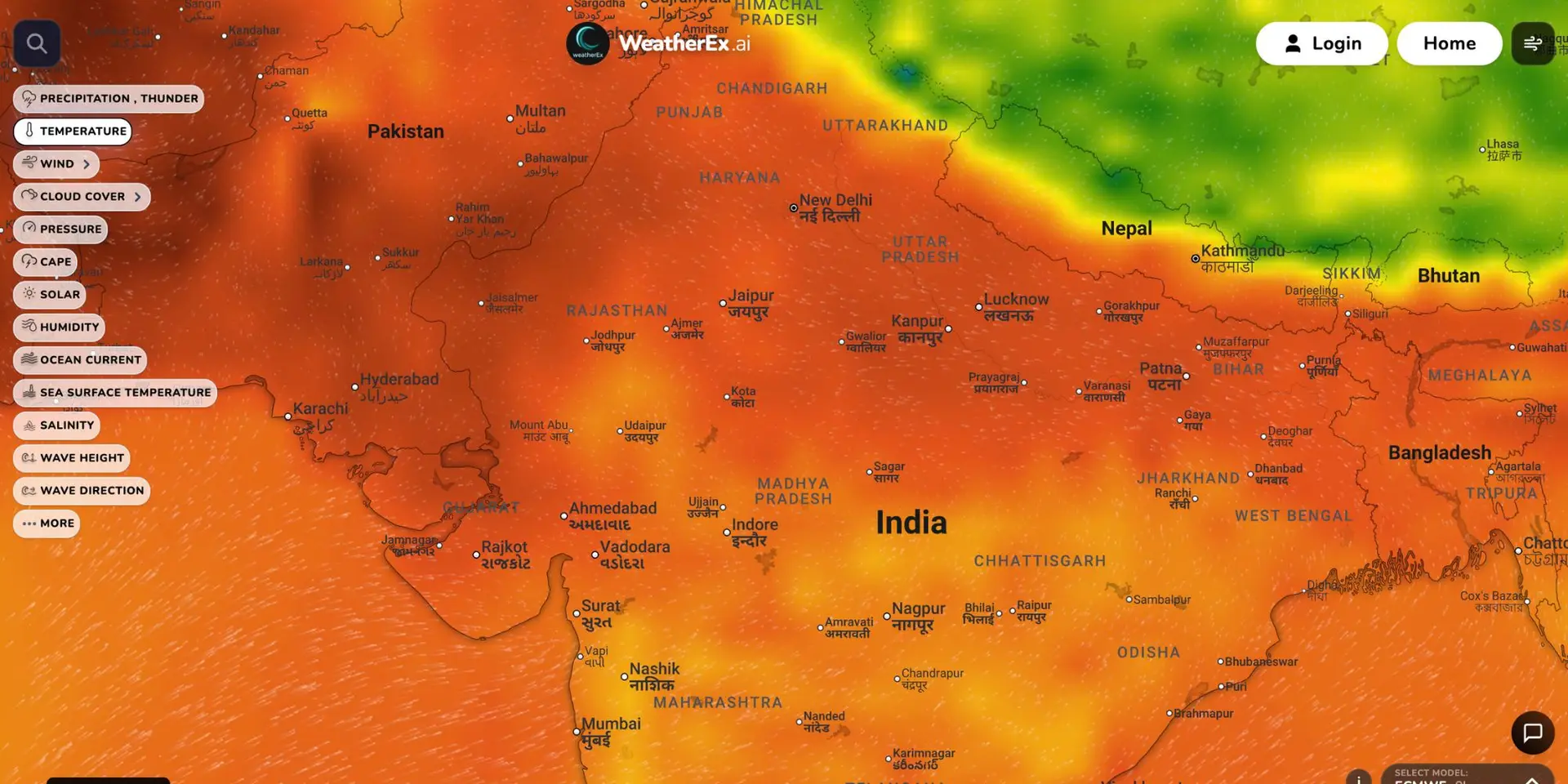

Mumbai's weather can change in minutes, and during the monsoon that can mean flooded roads, delayed trains and sudden disruption. WeatherEx, an AI-based weather intelligence platform whose founding team includes IIT Bombay researchers, is positioning itself as a way to read those changes earlier.
The platform is built by Experiqs Private Limited, where Dr Akshay Sunil, an IIT Bombay research alumnus and climate-tech specialist, serves as vice president for WeatherEx. According to a Mid-Day report, the platform offers customised forecasts for Mumbai and helps users interpret monsoon winds, rainfall patterns and weather conditions across different local scales.
What WeatherEx is, and isn't
WeatherEx is not a new launch or a Mumbai-only product. By Sunil's own account, the platform began roughly two years ago with Mumbai as its first focus, and its founders were publishing experimental Mumbai rainfall nowcasts publicly before that. Today the company describes WeatherEx as a global-to-hyperlocal platform serving energy, agriculture, aviation, navigation and other weather-sensitive industries, combining numerical weather models, atmospheric physics and proprietary AI/ML with geospatial analytics.
The Mumbai case for it is straightforward. Most people rely on broad city-level forecasts, which do not capture how uneven the city's rainfall can be. A heavy spell in one suburb can leave another relatively dry. WeatherEx offers localised forecasting modules intended to give users more context about weather behaviour in specific areas.
The early-warning claim
The team says the platform accurately identified heavy rain spells in early July. That figure is self-reported: there is no published independent verification or third-party skill scoring of WeatherEx's Mumbai forecasts, and readers should treat the claim as the company's own until such an assessment exists.
Sunil has said the platform is also intended to help with flash flood prediction, noting that alerts often arrive only a few hours before heavy showers and that longer lead times would let civic agencies prepare earlier. That gap is real: IMD's nowcast products for Mumbai typically cover a three-to-four-hour window.
What Mumbai already has
Any new forecasting tool enters a crowded field, and the assumption that Mumbai lacks early warning is not quite right.
The city already runs iFLOWS-Mumbai, an integrated flood warning system developed jointly by the Ministry of Earth Sciences and the BMC and launched in 2020. It provides flooding forecasts up to three days ahead of heavy rain events and 12-hour advance warnings for flood-prone areas across all 24 wards. Separately, the Indian Institute of Tropical Meteorology maintains a live Mumbai rainfall portal collating IMD and civic measurements from roughly 139 sites across the city, suburbs and Navi Mumbai.
There is also a parallel academic effort with the same lead researcher: an AI nowcasting model developed at IIT Bombay's Centre for Climate Studies, led by Sunil during his post-doctoral work, which analyses IMD radar data to predict rainfall up to 90 minutes ahead with updates every eight minutes, and is being integrated with IMD radar systems at Mumbai's Regional Meteorological Centre. That project is distinct from the commercial WeatherEx platform.
The BMC question
WeatherEx's developers have said they hope to work with the Brihanmumbai Municipal Corporation to improve preparedness ahead of heavy rainfall events. No agreement has been announced. It is worth stating plainly that this is a private company seeking a municipal client, not a public-interest project offering itself for free.
Whether that partnership makes sense will depend on questions the coverage so far has not answered: how WeatherEx's forecast skill compares with iFLOWS and IMD outputs on the same events, what it costs, and whether its outputs would be openly available to residents or sold as a subscription. For a city where forecast accuracy is a public-safety matter, those are the tests that count.