



Impact beyond the hype: How Indian innovators are shaping India’s AI agenda
In an exclusive round-table with YourStory, AI experts discuss how Indian startups are using AI to tackle critical problems in public health, mental wellness, and agriculture and develop impactful solutions.


The story of India’s artificial intelligence (AI) is often subsumed in talk around billion-dollar valuations and building the next sovereign large language model (LLM). However, behind the scenes, a quiet revolution is brewing, with Indian innovators solving critical problems and building sustainable solutions on the ground.
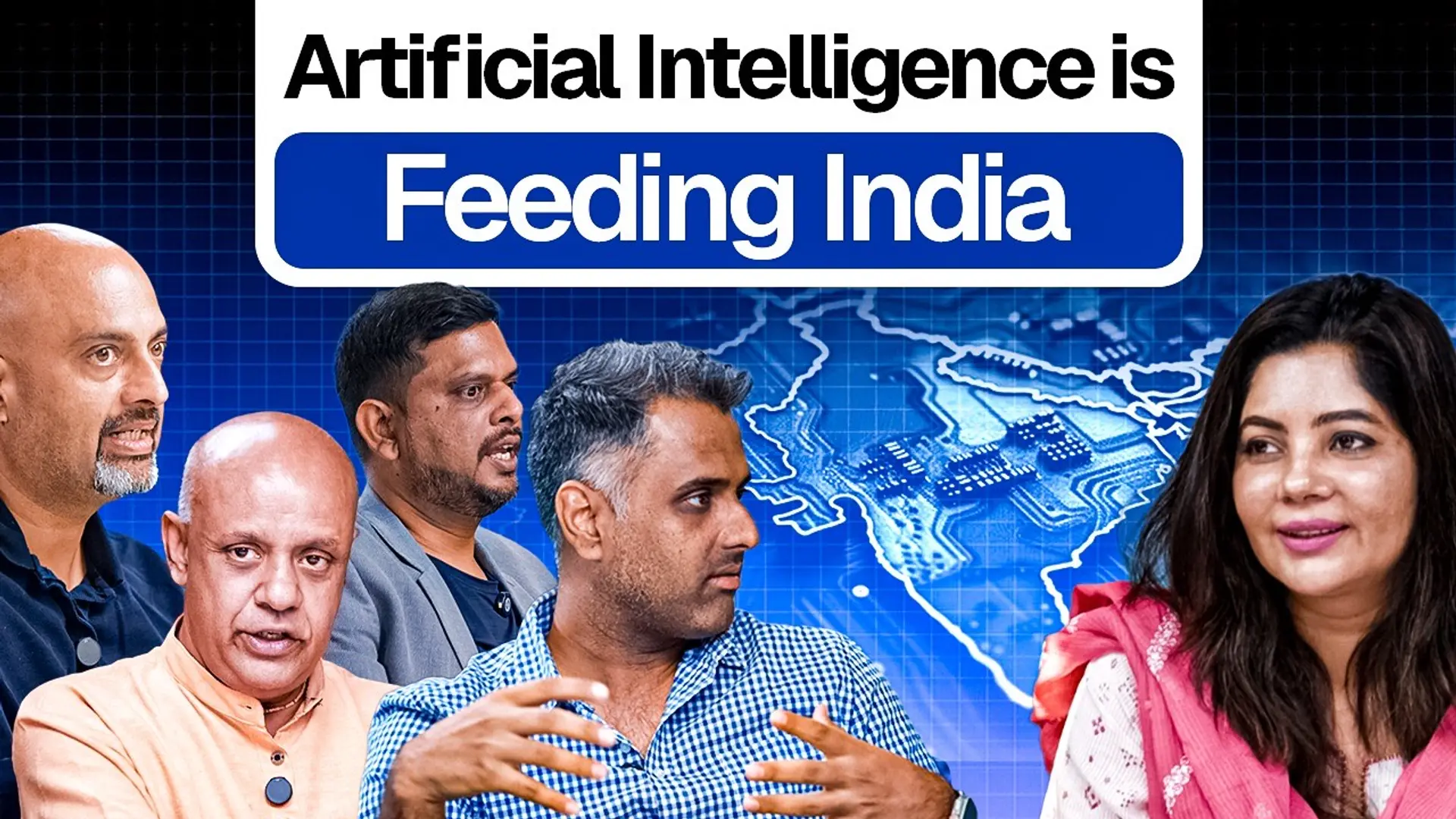
This forms the crux of the conversation of four experts in the AI sector with YourStory’s Founder & CEO Shradha Sharma, as they explain how they are using algorithms to create real impact in agriculture and healthcare.
AI veteran Shekar Sivasubramanian, who steers Wadhwani AI’s public-interest health initiatives; Ramakant Vempati, Co-founder of mental-health platform Wysa; Krishna Kumar, Founder of agritech startup Cropin; and Jaisimha Rao, Founder of Niqo Robotics, which specialises in vision-guided farm robots, also discuss the all-important question of how India can shape an AI agenda that’s rooted in impact rather than hype.
Problem first, AI next
At Wadhwani AI, a non-profit AI institute dedicated to social good, the term ‘AI’ is intentionally understated, so that the focus is on problem-solving.
Led by Shekar Sivasubramanian, an AI veteran, the institute is leveraging AI technology to tackle intractable problems.
In the context of computing, intractable problems are problems for which there exists no efficient algorithm or technology to solve them.
“Our mission is to deploy AI solutions. It is to make people experience AI, learn from it, and then build a strategy. AI, by definition, is a point solution. It can solve a specific problem in a specific context.
“Therefore, if you have to impact an ecosystem that has several problems, you need to build multiple AI solutions,” says Sivasubramanian, who spent two decades at Carnegie Mellon University as an applied scientist in information retrieval and artificial intelligence.
Today, the institute has over 250 full-time employees and 150 consultants who work closely with central and state governments across India to build AI-driven solutions. It has delivered 25 real-world solutions across agriculture, healthcare, education, and other sectors.
For instance, the firm has built ‘Shishu Maapan’, an AI tool that helps ASHA (Accredited Social Health Activists) workers to use a smartphone to record a newborn’s weight, length, and head circumference, which are key indicators of growth and nutrition.
Around 450 ASHA workers have been trained to use this tool in Dadra and Nagar Haveli, and Daman and Diu.
“AI is the least important (part) of AI problem-solving. The problem, in that statement, is most important. One of our maxims is, whenever we start solving a problem, everything is (worth) crores. Nothing we think of is less than that,” he emphasises.

AI in mental health
In 2016, Ramakant Vempati and his team, despite having no prior background in AI, launched mental-health platform Wysa long before the technology had entered mainstream conversation.
Personal experiences of dealing with suicide and depression in their family and friend circles led the team to build a conversational agent that could offer immediate and accessible mental-health support.
“We realised how hard it is for someone to seek help. With all the will, resources, and access in the world, it’s still extremely hard,” says Vempati.
Though the team was initially unsure about the platform’s efficacy, Vempati says, the company found its true product-market-fit when a teenager shared that the platform had saved her life.
“I thought nobody’s going to talk to an AI chatbot about their deepest, darkest fears… I would never do it is what I thought. After the first five months of the launch, we got this mail from a 13-year-old girl from the US saying that she had depression and tried committing suicide, and Wysa is the only thing that is helping her hold on. That’s when I started believing that this is real and has a high impact,” he elaborates.
The COVID-19 pandemic turned a spotlight on mental health, prompting the rise of alternative mental health channels as traditional health systems struggled to meet demand.
“We saw users just explode, and without any marketing, because people were looking for help. Existing health systems had failed, and there were lots of barriers because of taxes, affordability. COVID-19 made it extremely real from a business point of view.”
Today, Wysa is a Series B-funded, for-profit venture with partnerships with public health bodies, insurers, and businesses. It has helped more than 7 million people in 100 countries via 500 million conversations.
Agricultural intelligence
Bengaluru-based Cropin has spent over a decade turning raw farm data into what it calls agricultural intelligence. The startup’s cloud platform ingests satellite feeds, weather updates, agronomic records, and on-ground images to generate insights on crop health, yields, and risk factors.
So far, the startup has digitised 30 million acres of farmland, benefitting over 7 million farmers around the world.
The company has raised roughly $54 million to date. Most recently, it signed a deal with Walmart to help the retailer forecast yields and monitor crop health across the United States.
“We are an AI and data company in the food and agriculture space. We zoom into the farms, where we try to decode the past, present, and future of it. We focus on areas such as how it [crop] has behaved in the past, and what is the potential today? What are the risks that can hit that farm from disease or climate?” says Founder Krishna Kumar.
The platform then provides predictive data. If a particular crop variety is chosen, it estimates the potential yield based on historical trends, helping with planning for the next season and a few years down the line.
“Every crop and variety has different traits and resistance to a certain disease, and how long it will take to grow. The AI model needs to see and learn from those features, and that’s where we become the most data-rich platform… of high-quality data, which is helping us to scale the solution and remain consistent. Currently, we sit on top of 0.5 billion crop records from 103 countries on 500 crops and 10,000 varieties of the crop,” says Kumar.
While Cropin offers an aerial monitoring solution to map plant health, Niqo Robotics handles the next step, which is precision action on the ground. Its camera-guided robots detect individual plants that need treatment and spray pesticides or fertilisers only when necessary, thus reducing the use of chemicals.
The Bengaluru-based agritech startup, which focuses on building robotic solutions for sustainable farming, has deployed its technology across 1,50,000 acres, particularly in regions such as Akola, Maharashtra, and Guntur, Andhra Pradesh.
“We are extremely excited about the India opportunity. Most of farming is wisdom-driven. Farmers will pay only when they see value. But when they see value, they are loyal, and it’s easy to scale,” insists Niqo’s CEO, Jaisimha Rao.
Shaping India’s AI agenda
As the conversation draws to a close, the speakers discuss the central question of how India can shape an impact-driven AI agenda.
For Cropin’s Kumar, the answer lies in making AI invisible but indispensable.
“The deepest work is going to happen in agriculture. It’s a trillion-dollar, massive industry. If you can marry science with agriculture in a way where the grower doesn’t need to understand the science, (but) just trust that the (technology) wall will secure them, then technology can stay in the background,” he says.
Wadhwani AI’s Sivasubramanian believes that making AI work at scale in India means addressing the country’s diverse needs.
“In India, if you have to accomplish something, you need to do it pan-India, multilingual, multicultural, and solve it in the context of the people you’re trying to help,” he explains.
Citing the example of the Shishu Maapan tool, he adds, “In our solution, we take a five-second video of a baby, and estimate its critical parameters. I want this to become the de facto standard for children between 0 and 42 days in India by 2026.
“We already have data from 15,000 to 20,000 babies, our largest collection so far. If we can train the model on data from half a million babies, the error rate will drop significantly. But you have to commit to building from first principles—in India, for India.”