



ISRO, Andhra University build AI system to warn beach visitors
ISRO has partnered with Andhra University to build an AI-based coastal safety system that detects rip currents and aims to reduce beach-related deaths in India.

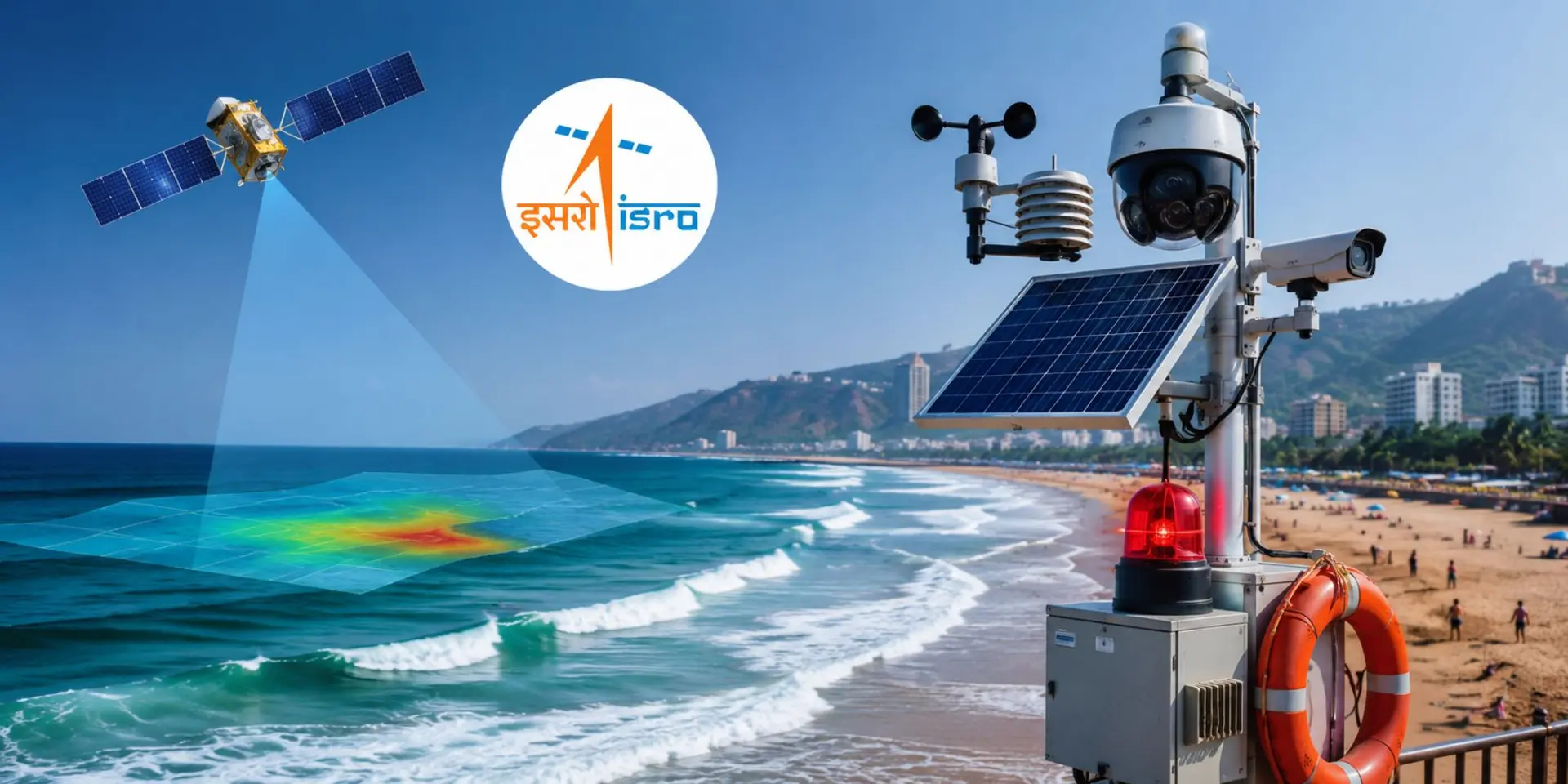

A smart guard for India’s beaches is taking shape. The Space Applications Centre (SAC) of ISRO has teamed up with Andhra University on an AI-enabled system designed to detect dangerous rip currents and issue rapid warnings to save lives along the coast.
Reported on 12 June 2026, the pilot sits under Project Bharati and targets real-time alerts for lifeguards, police and beach visitors.
How the AI warning system works
The two-year project, sanctioned by SAC-ISRO in Ahmedabad at an estimated cost of Rs 22 lakh, is led by Dr S V V Arun Kumar and Prof C V Naidu. Researchers are training software to flag where and when rip currents are likely to form by analysing satellite data, weather, ocean conditions, and live video feeds.
Nearly 60% of the software build is already complete. A Next‑Gen AI Lifeguard Alert System will underpin operations. It combines 360‑degree AI cameras and thermal imaging for low‑light monitoring, with a compact weather station that tracks wind, temperature, humidity, and pressure.
Once hazardous flow patterns are detected, the system classifies beach sections as safe, caution or danger zones and triggers sirens, flashing lights, public announcements and LED information boards. Alerts also reach lifeguards, Coastal Security Police and control rooms over 4G/5G networks for faster response.
Mobile, solar-powered safety units
To fit changing shoreline conditions, the alert setup will be mounted on solar-powered, movable platforms that authorities can redeploy between beaches as seasons shift. Each mobile unit is expected to cost around Rs 2 lakh, enabling scalable coverage without heavy infrastructure.
Beneficiaries include the Coastal Security Police, the Greater Visakhapatnam Municipal Corporation (GVMC), the Tourism Department and local beach managers.
Why rip currents matter
Rip currents are fast, narrow streams of water that race away from the shore through the surf. Along Visakhapatnam, they are often seen near spots where drains and streams meet the sea.
They can move at up to five metres per second and extend 50–150 metres offshore, making them difficult for the public to spot and dangerous for swimmers. Andhra Pradesh records about 45–50 rip current deaths each year, with 69 in 2023 and 39 in 2024, underscoring the need for early warnings and better awareness.
Building on years of research
The initiative builds on SAC and Andhra University studies of nearshore hazards in Visakhapatnam since 2017, including a locally deployed warning setup and public information efforts. The current pilot aims to translate this research into a practical tool that can be rolled out more widely if successful.
What comes next
Project Bharati is a pilot, but the goal is national scale. If the AI system proves reliable in field conditions, similar mobile units and alert workflows could be adopted across India’s beaches to reduce risk and support smarter lifeguard deployment. For now, the partners are focused on completing the software, testing the mobile platforms and refining alert protocols with local agencies over the project’s two-year timeline.