



How a Chennai-born researcher helped build ChatGPT—the AI transforming the world
While ChatGPT became a household name overnight, its foundation was years in the making. Arvind Neelakantan, the Chennai-born engineer who helped architect GPT-3, reveals how academic curiosity and small experiments laid the groundwork for its development, which led to the big break.

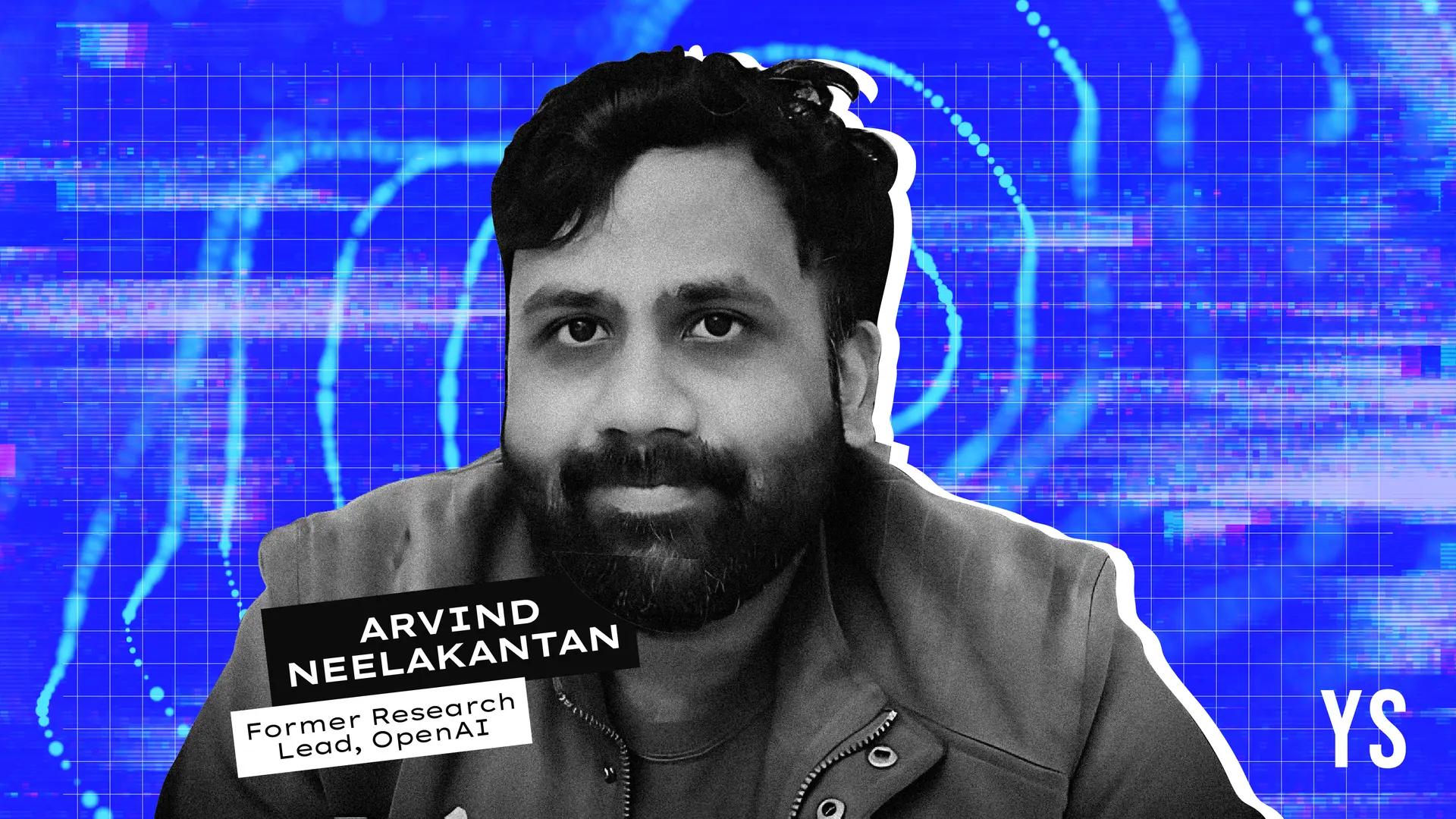

In 2022, ChatGPT altered the software world forever. While the AI chatbot quickly became a household name, very few realised that its meteoric rise was built on a quieter, earlier revolution: the creation of GPT-3, or Generative Pre-trained Transformer 3.
This powerful model laid the groundwork for modern conversational AI, becoming the invisible engine behind the scenes.
At the heart of this foundational leap was Arvind Neelakantan, a Chennai-born engineer whose early fascination for making computers “do complicated things” helped architect one of the most crucial breakthroughs of our time.
With a Ph.D. in Computer Science from the University of Massachusetts Amherst, a Master’s from Columbia University, and a Bachelor's from NIT Tiruchirappalli, Neelakantan’s academic journey mapped a path through some of the most respected institutions in the world, eventually landing him key roles at Google Brain, Meta, and OpenAI.
As the Research Lead at , he played a pivotal role in shaping GPT-3, leading machine learning and natural language processing projects, and became instrumental in GPT-3's development.
Speaking at the “Inside the Mind of AI,” a mentor session held at Scaler School of Technology in Bengaluru, Neelakantan told YourStory that the path from GPT-3 to ChatGPT was built on numerous experiments and breakthroughs—turning academic curiosity into the technology that is now being embedded in the way we work and interact.

All you need to know about OpenAI’s U-turn as it walks away from for-profit path
Edited excerpts:
YourStory [YS]: You’ve worked on GPT-3, which eventually became ChatGPT. Now that we’re seeing even more advanced models, what’s it really like behind the scenes from your lens as a researcher?
Arvind Neelakantan [AN]: Honestly, it’s just a lot of hard work. These models operate at such massive scales that getting things right takes a ton of experimentation. We do small-scale tests to determine what works, how to scale them, and how to do it efficiently. It sounds simple at a high level, but it’s really about getting the fine details right.
The earliest parts of the research and product are quite similar. You have a rough picture that there’s something here, and it’s hard to make it more concrete. At that stage, you basically set yourself up and try a lot of things very quickly and see what works.
But with projects like GPT-3 and GPT-4, those were very mission-driven efforts that required deep focus on the technical details to get things right. Deep learning is a very empirical field, where you have to try a lot of things and see what sticks. The details matter.
YS: There's been a lot of talk about foundational models, but do we still need more of them? Or is the shift now more towards practical applications, especially in a country like India? And where do you think we stand globally?
AN: It’s hard to say definitively. But I’d say we’re still very early in the field. Integrating modalities, tools.. those areas are still very nascent. So yes, there’s definitely more foundational work to be done. I don't know where they [startups] are exactly in terms of the Indian AI scene. I've not used these models. But I do think it'll be hard to catch up, as a five-month project…it’s gonna take longer.
YS: For Indian startups or researchers, what should be top of mind in AI right now?
AN: There are many open problems. One worthwhile goal is making the scaling laws steeper through algorithmic breakthroughs. That’s something you can test at a small scale, write a paper on, and publish code. That’s where a lot of meaningful research work happens. That's where I believe a researcher should focus.
YS: When you’re building AI products at a population scale, understanding social behaviour becomes crucial. Do you think engineers need to factor that in now?
AN: I think most organisations take ethics very seriously… It’s often part of onboarding and orientation. Having that perspective helps, but it’s one of many facets. Being good at it is useful.
YS: You grew up in Chennai, studied undergrad in CS with a regular degree. What started your interest in computer science?
AN: I always liked Maths. I got into programming around 10th grade and started liking the concept of expressing the subject in a very procedural way. I just thought computers were cool, where you get to have these machines to do complicated things.
Then I went to undergrad. I had a lot of fun there and explored a bunch of different topics. I did some research internships and started developing an interest in research during my second-year summer. I was helping PhD students at IIT Madras and also at NIT on a few research topics.
But it got me thinking about how research works, why fundamentals matter, and how the foundations of knowledge are built.
Honestly, the world often feels kind of static when you look at it, and I think the biggest agent of change is scientific progress. It was the idea that something entirely new can happen when you focus on a hard technical problem. I developed a liking for research. I did some work in computer architecture and AI, and I just really liked AI. It wasn’t nearly as big then as it is now, but the idea that people are trying to replicate human intelligence in a computer was just fascinating.
YS: How has working at OpenAI shaped you?
AN: It's hard to sum up briefly. Just going through a change like that increases your self-belief. It opens your mind. Big things can happen, and before they happen, they don't look like big things. They look shabby and chaotic. If you keep placing the right bets, working hard, and iterating, great things can happen.
YS: With so much development and open-source collaboration, how are companies protecting their “secret sauce” today?
AN: Honestly, that kind of mobility has always existed in tech. In some sense, there are no big, deep secrets. AI as a field has been open and academic from the beginning. People publish almost everything. So, it’s not that there are no secrets, but the culture is open.
YS: Every firm wants to be AI-first now, especially startups and SaaS giants. Do you think we are headed toward a hype cycle?
AN: Maybe for some companies. But I can’t think of any other technology before that has changed the world this fast. But few companies are working outside of the current buzz and we will talk about them in a few years.
YS: A recent MIT study claimed that AI might be making people dumber. Do you see that happening, especially among younger engineers who haven’t built on fundamentals?
AN: I use AI a lot—especially for coding. It’s super helpful. But yes, if that’s all someone uses without learning fundamentals, it can be a problem. I think it's similar to how exams of the previous generation were not useful, and how they need to be adapted. Because when you enter work, using AI is just more efficient, and AI is gonna make you more productive.
YS: What’s the best opportunity and the toughest challenge for AI researchers today?
AN: The opportunity is incredible. I recall attending conferences around 2012, where you’d show up, and it was mostly academicians talking about some obscure dataset no one had heard of. We’d celebrate improving performance from 50 to 50.5%. Now, it feels like the world is your oyster, and that’s amazing.
Maybe the hardest part now is that it’s become a bit more difficult to do meaningful, long-term work, simply because there’s so much buzz and noise everywhere.
YS: Apple recently released a paper titled “The Illusion of Thinking,” suggesting that while larger models appear to reason better, they still struggle with complex tasks. How alarming is this scenario?
AN: It’s kind of like being stuck on one result. A year ago, if you'd asked anyone whether models would have the capabilities they do now—like Gemini 2.5 Pro and others—it would’ve seemed mind-blowing. And yet, they still make mistakes.
But the bigger trend is that over time, models are getting smarter and solving more of these issues. So yes, you can always pause and point out the current flaws, but I think that’s going to be the case for a while. Still, that’s not the main story.
Edited by Megha Reddy