



Lost in Translation: How NAAV AI wants to break language barrier in Indian publishing
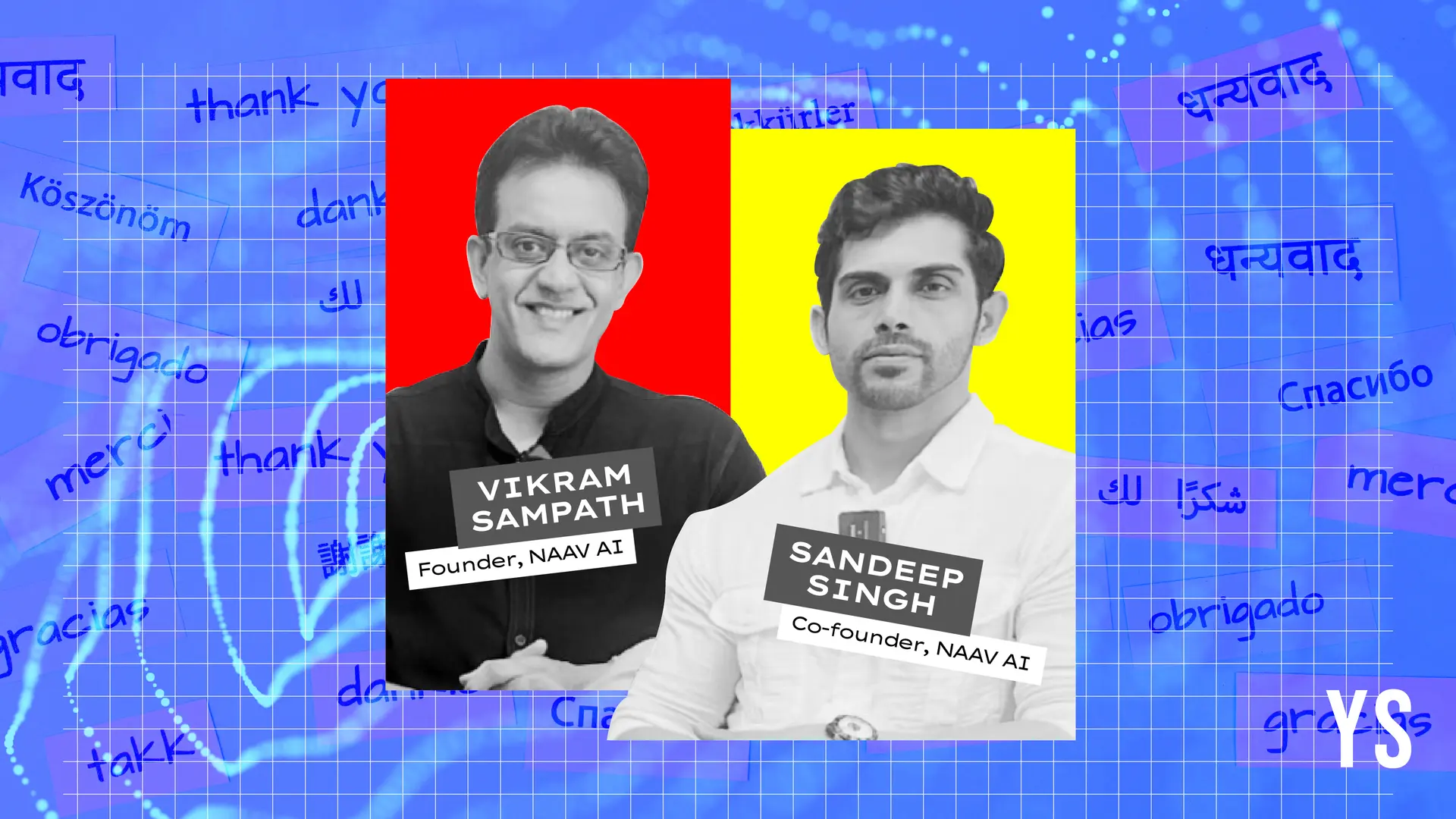
Founded by author Vikram Sampath and technologist Sandeep Singh, NAAV AI is an AI-powered translation platform that is designed to help authors, content creators, and publishers struggling with translation delays.


A global bestseller in English hits the bookstores, quickly topping charts and flooding social media. But for millions of readers across India’s vast regional languages, the wait begins, often stretching into several months or even years.
The problem isn’t new. Translation has remained slow, expensive, and labour-intensive for decades. While major publishers release hundreds of titles every year, making them accessible in regional languages like Hindi, Tamil, Telugu, and others remains a persistent challenge.
For renowned author and columnist Vikram Sampath, this wasn't just a market observation.
“Being a published author myself, I felt a gap in this space: so much good-quality content is available in English...even from well-known authors. When it makes it to Indian languages, there's often a long gestation period, and by then the buzz around the book gets lost,” Sampath tells YourStory.
This led to the creation of NAAV AI, an AI-powered translation platform launched in January this year by Sampath and Sandeep Singh. The Bengaluru-based startup is designed to help authors, content creators, and publishers struggling with translation delays.
Building beyond basic translation tools
NAAV AI, which stands for “Navigating AI Across Vocabularies,” positions itself as a content transformation platform designed to meet India’s growing demand for regional language content.
According to Sampath, unlike Google Translate, which struggles with nuance, NAAV AI is tailored for long-form, context-heavy content like books.
“A lot of people have been talking about using AI for translation. We hear this on a regular basis and thought, why not explore this technology for translating large-format content such as books?” Sampath explains.
His perspective as an author gave him a unique lens into the market gap that existing solutions couldn't address.
The platform has two core offerings: TransLit and ZuNAAV-FM.
TransLit is an AI-assisted and human-refined translation tool that currently supports English-to-Hindi, Marathi, Kannada, Tamil, Telugu, and Malayalam translations. Unlike traditional tools that work well for short texts, TransLit is capable of handling large documents and books which are text-heavy, offering contextual accuracy and well-formatted output.
At present, NAAV AI utilises AI models such as Claude and GPT-4, and is evaluating Ola’s Krutrim for select languages to leverage each model’s specific strengths for different languages.
“TransLit stands for translation of literature. Our B2B product helps publishers, marketing agencies, or individuals create large volumes of text—ranging from 100 to 1000 pages to translate their work in their required language. The platform enables them to upload PDF content. In the backend, we use core LLMs and multimodal models based on the strength of certain models for each language,” Singh explains.
Sampath explains that TransLit’s effectiveness is in its human oversight component. Along with onboarding technological experts, the firm also employs dedicated linguists and language experts for each supported language who review AI-generated translations.
Once the content is translated, it is reviewed by translators who make changes, improvise, and add the human element.
“A lot of cultural and linguistic nuances—such as phraseology and idioms that are very specific to each language—can only be provided by a human being, and this is exactly what gets captured by them,” Sampath says.
The real-world impact of this hybrid approach becomes clear when examining the time savings TransLit delivers. The system dramatically accelerates the translation process while preserving the essential human touch that literature demands.
“TransLit is an AI tool that helps produces a draft translation, which we then refine for context and accuracy. As with our initial version, it still requires human input, as AI can miss nuances, such as words with multiple meanings. We correct these manually,” says Shrigouri S Joshi, an in-house translator.
“What once took 3–4 months to translate four chapters now takes two months for three books, saving translators time and effort. The interface is simple...anyone can use it like a standard word document with familiar editing and saving functions. Our team is actively working on enhancing its contextual understanding,” she adds.
Sampath adds that the AI-generated first draft of a chapter cuts translation time from roughly a month to just ten days, achieving up to 70-75% in terms of accuracy, with translators only needing to refine and polish the existing text instead of starting from scratch.
The road ahead
In April, NAAV AI raised $200,000–$250,000 in early-stage funding from investors, including Ola’s Bhavish Aggarwal and Silicon Valley-based venture capitalist Asha Jadeja Motwani.
The firm has also completed its first major project, which includes translating three children's books on Indian history into six languages, creating 18 books in collaboration with the Foundation for Indian Historical and Cultural Research (FIHCR), and publishing partner BluOne Ink.
The company currently operates on a service model, charging per-word translation rates below traditional human-only workflows.
The Indian publishing industry is highly fragmented and competitive with more than 9,000 publishers and 21,000 retailers, and is expected to reach Rs. 800 billion in value by 2024 according to a report by EY.
The inaugural series of books translated by NAAV AI for BluOne Ink was officially inaugurated last week by Sudha Murty, Yaduveer Wadiyar, and Sadhguru Madhusudan Sai.
“This itself was a very fast turnaround, because if the same project had gone through the manual process, the books would probably have come out only by the end of the year or early next year. This also served as validation and to test the waters—to see how people are going to accept the product,” Sampath explains.
NAAV AI's growth strategy focuses initially on strengthening capabilities in Indian languages before expanding to reverse translation—taking Indian content to global audiences.
“Incidentally, when we did our initial trial, the system achieved 80–85% high accuracy levels, given the vast corpus. But for now, our first focus is to build strong competency in Indian languages, and then we can work on the reverse, i.e. by taking Indian content to global audiences,” Sampath explains.
Going ahead, the firm aims to partner with private institutions, universities, and competitive examinations like NEET and UPSC for their translation needs. The company is also aiming to support self-published authors–a group that majorly lack access to resources from a traditional publishing house.
The company also plans to expand from its current six languages to 10-12 Indian languages while developing ZuNAAV into a comprehensive audio content platform. The company is also targeting working with marketing agencies and digital content creators for both print and digital applications.
“Currently, even some of the top publishing houses, who publish around 300 to 350 books in English every year, only about 50 to 60 titles get published across all 22 Indian languages. There’s a huge gap between the volume of content produced and the ability to translate it, primarily because of the long, laborious manual process,” Sampath says.
“How quickly we can generate more content—whether in text or audio form—and how well it is consumed by users will be key metrics for us to track our success going forward, given the clear need for such content,” he adds.
The team faced challenges making the tool user-friendly for translators and selecting quality language models, particularly for complex Indian languages with limited datasets. The firm’s tech and AI teams are addressing these through customised workflows and a multi-model approach.
Singh adds that data security is a top priority for NAAV AI. All projects are covered under NDAs with clients and translators to ensure confidentiality.
NAAV AI’s infrastructure partner, which is ISO certified, is ensuring compliance with global standards while keeping unpublished works secure at every stage of the translation process.
“Access to content is strictly controlled within the NAAV AI platform and is limited to authorized team members and assigned translators only. The platform is hosted on reputed cloud providers with enterprise-grade security and end-to-end encryption for data at rest and in transit,” he explains.
Edited by Megha Reddy