



When machines dream of melodies: Can bytes ever recreate the genius of Beethoven?
Beethoven’s unfinished symphony is still a question of debate. With AI giving birth to new-age virtual pop stars, can it truly capture the creative spirit of artists?

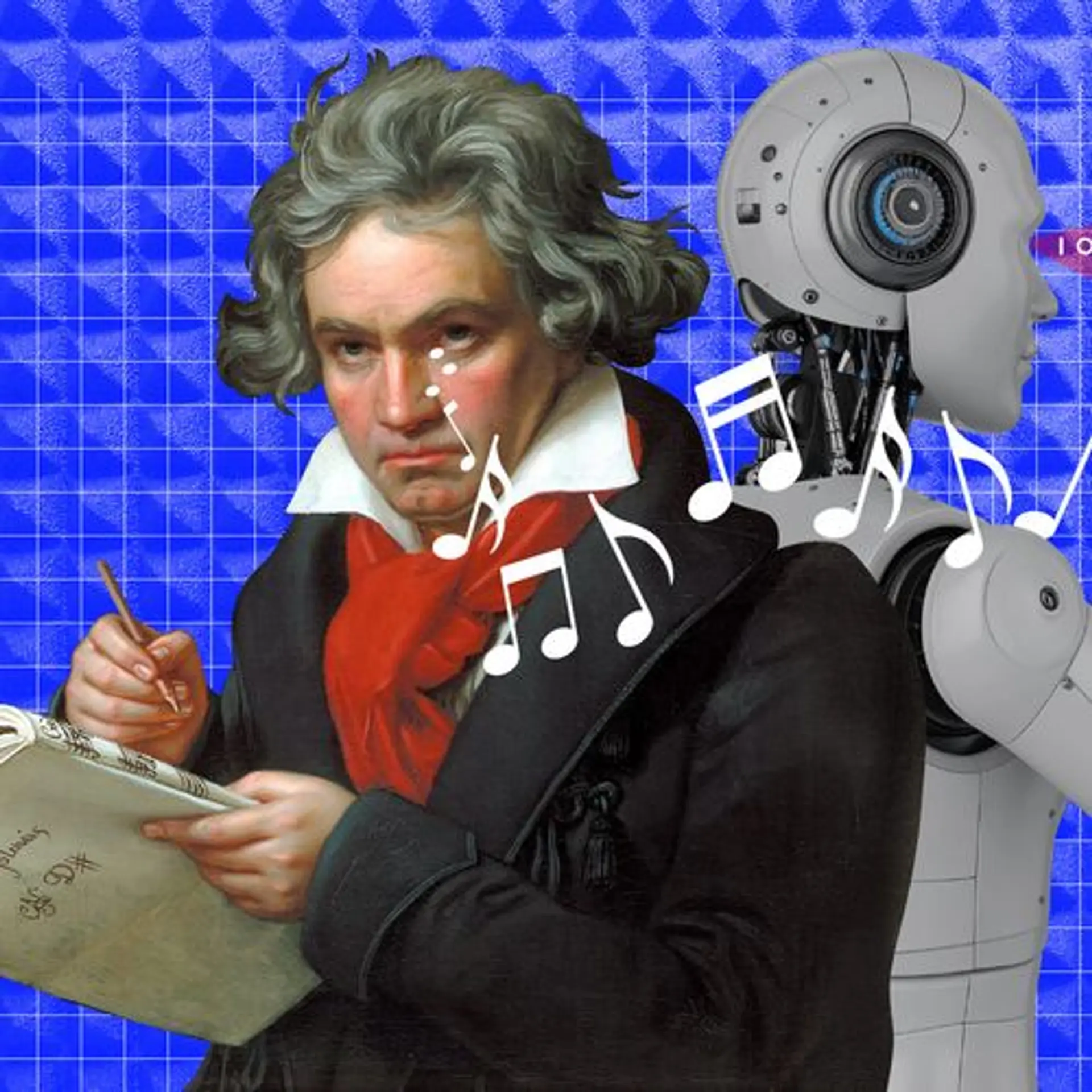

Musical genius Ludwig van Beethoven was 44 years old when he gradually began to lose his hearing. However, that did not impede the German pianist's creative spirit, and he went on to compose the iconic Symphony No. 9, a masterpiece that would be regarded as a shining example of classical music for centuries to come.
In addition to decades of hard work, his brilliance lay in his ability to imagine each instrumental layer without ever hearing them physically, capturing the music’s essence that lay in its building blocks. However, Symphony No. 10, one of Beethoven's penultimate works, remains unfinished to date.
All he left behind were a few handwritten notes and musical sketches. Ever since then, musicologists have pondered what it could have been.
In early 2019, Dr Matthias Röder, an award-winning music and technology strategist, gathered a team of music experts from all around the world to create an AI tool that would complete this unfinished melody.
Gathering in a large room equipped with a piano, a blackboard, and the composer’s original sketches, the team examined how the handful of musical fragments could be used to create the final music piece, all with the help of AI. By 2021, this collaboration was premiered as “Beethoven X: The AI Project” in Bonn, Germany.
The AI models excelled at mimicking the musical notes. But for Beethoven, who was suffering from the slow progression of deafness, composition meant pressing his ear against the piano's wooden frame, desperately straining to catch even the faintest echo of sound through his failing hearing.
But is AI capable of creating great music that emerged from such a struggle, and beyond the awe of what this technology achieved, can machines truly ever be creative?

Whose music is it anyway? OpenAI v top music labels sparks talks on fair use, licensing rights
A cure for creative block
While technology is being adopted in various industries, AI has been tuned into the music industry for a while. Using machine learning models and newer techniques to detect patterns and relationships within massive datasets, it is helping artists understand what listeners find appealing, along with finding ways to create fresh compositions.
“AI has had an impact. I use it as a tool to speed up certain aspects of music production—things like stem separation, generating rough melody ideas, or cleaning up audio. For example, when working on a remix of an old Indian classical track, I used AI to isolate the vocals, rather than spending hours manually extracting them. It saved me a huge amount of time and let me focus on the creative part of the process,” Shanit Ghose, Founder of Sur, tells YourStory.
Ghose built Sur, an AI-powered stem splitter and sample library designed for Indian classical music, allowing modern producers to make use of traditional elements in their work easily. In other words, AI tools can take over some technical grunt work in the studio, freeing artists to concentrate on inspiration and storytelling.
For 24-year-old Ajesh MC, a recording and mixing engineer currently working at a renowned film post-production studio, AI is a useful tool—especially when it comes to refining chord progressions and suggesting additional instruments—yet it is only one part of the creative process.
“However, while some suggestions are valuable, others may not resonate with me. Ultimately, it's up to me to decide what works best. I've noticed that many talented musicians are hesitant to use AI-generated music, as they rely on their own talent and inspiration – I count myself among them,” he explains.
Shourya Malhotra, an indie-folk singer-songwriter and a media and entertainment lawyer, turns to AI whenever he finds himself creatively blocked.
“AI hasn’t changed my creative process much, but I do use it for idea generation—especially when I feel stuck. That said, I don’t rely on AI to express my emotions because I believe that’s something only a human can truly capture,” says Malhotra.
Last year, music composer AR Rahman used AI to recreate the voices of late singers Bamba Bakya and Shahul Hameed for the track “Thimiri Yezhuda” in Rajinikanth's film “Lal Salaam.” The two, who had previously worked with him, are credited as playback singers.
“In such cases, AI can be a valuable tool, allowing composers to pay tribute to iconic artists and bring new life to their music. Nevertheless, over-reliance on AI-generated vocals can pose a threat to human singers. That being said, AI can also be useful in specific situations, such as when a singer records in a crowded space and needs to deliver a high-quality file quickly,” Ajesh explains.
He warns that while AI tools can clean up recordings to about 75% of studio quality in urgent cases, they should remain a last resort rather than a regular practice. However, just because AI helps get things done more easily, artists believe that it doesn’t make their processes any better.
“AI is great for handling technical tasks, but when it comes to actual composition—the emotion, the storytelling—that’s still something only a human can bring,” Ghose says.
Malhotra adds that an artist’s personal story will gradually become the key differentiator in an ocean of AI-generated music.
“As AI models stand today, they struggle to be truly genuine in their thematic expression. More importantly, they can’t replicate the uniqueness of a human performer, with their emotions, nuances, and the deeply personal way they play or sing. I also believe that an artist’s community and genuinely engaged following will play a much bigger role in shaping their success and identity,” he says.
This week in AI: From Chennai to ChatGPT, Zoho’s robotics play, and xAI’s $10B bet
On replacing human creativity
One thing’s for sure: besides musicians, the whole of the creative industry is at a point where decisions now made about AI will shape how we create and value art for decades to come.
“Our focus is on using AI to replace the camera, but not the people behind it,” says Dipankar Mukherjee, Co-founder and CEO of Studio Blo, a creative tech firm.
His company has been experimenting with AI in visual media but still relies on human production designers, cinematographers, and directors to shape the final visuals.
“When it comes to the audio, we have largely preferred working with human sound designers & music directors, as we feel that the audio track has a huge role to play in impacting the audience emotionally. Thus necessitating the need for human artists to define it,” he adds.
Ironically, the firm has also shown just how far AI can go in music creation when guided by humans. The firm created a virtual pop singer named AISHAN, whose voice, musicality, compositions, and final recordings are all generated by AI. The only human involved in Aishan’s production was a music producer acting as a creative director and engineer for the final output.
The AI-generated artist’s first single, titled Purana Pyar was first released anonymously on FM Radio and created a massive fan following. The company is now creating multiple songs for AISHAN and similar AI popstars.
The Collective Artists Network is similarly leveraging AI-driven characters for storytelling and branding. They’ve introduced digital personas like Kavya Mehra and Radhika Subramaniam – both fictional influencers with distinct voices and their fan communities.
“AI brings speed and scale to the media, but the real challenge is preserving emotion and cultural nuance. The opportunity lies in using AI as a creative co-pilot—enhancing human storytelling, not replacing it. We focus on hybrid models where tech and human insight work hand-in-hand to deliver content that feels both intelligent and deeply personal,” says Sudeep Subash, Chief Revenue Officer of the Collective Artists Network and CEO of Big Bang Social.
However, Bindra warns that even the smartest algorithms can’t mimic the heartbeat of human creativity.
“However, what AI still lacks is the human essence—emotion, personal narratives, and improvisation—which are at the heart of music. The industry must strike a balance between embracing AI’s possibilities and safeguarding the originality and rights of artists,” Bindra adds.
This brings us back to how music takes its roots from human experiences, with Beethoven’s silent genius giving us one of the best compositions in history. While the recent OpenAI lawsuit is one of the first of many, it leaves us with the question of whether AI can ever truly echo the authenticity of such artistic genius.
“A personal story is everything. Two people can play the same set of notes, but it’s the way they play it, the intention behind it, that makes it unique. AI might be able to generate music, but it doesn’t have life experiences, struggles, or cultural influences that shape an artist’s sound. That’s why people connect with music on an emotional level. AI can assist with production, but it can’t replace the human stories behind the music,” says Ghose.
Legal battles and creative rights
The intersection of technology and art has now fueled intense legal debate across the industry. Many artists and content owners are pushing back against AI models that were trained on their work without permission.
Mukherjee’s take is that the onus of copyright infringement is still on the creator and not on the model.
“I am simply reminded of when streaming platforms disrupted the music industry. A new economic model emerged, and copyright laws had to be rewritten to define the new normal & protect original creators,” Mukherjee says.
“Good artists copy. Great artists steal. There could be no Usher without Michael Jackson, The Weeknd without Prince, Kendrick without Tupac, Harry Styles without Bowie, Drake without Kanye. Plagiarism would be what Vanilla Ice did to Queen & David Bowie, or what Robin Thicke & Pharrell did to Marvin Gaye. AI models, by definition, do not do that - copy complete bars of music, riffs, tunes, or compositions. Unless a user forces it to plagiarise,” he adds.
Several industry bodies are also proactively grappling with questions of rights and royalties with AI.
Rakesh Nigam, CEO of the Indian Performing Right Society (IPRS), emphasises ongoing efforts to strengthen compliance and ensure creators get their due.
“There are ongoing efforts to strengthen compliance and improve royalty distribution in the live music space. Through continued conversations, educational efforts, and collaboration with various stakeholders, steps are being taken to make licensing processes smoother and emphasise the need for respecting creative work. There is also a focus on making royalty distribution more transparent and efficient,” he says.
The firm is working closely with international organisations like CISAC (International Confederation of Societies of Authors and Composers) and WIPO (World Intellectual Property Organisation) to develop best practices for fair compensation in the age of AI and automation.
Entertainment and music lawyer Priyanka Khimani adds that when AI platforms scrape copyrighted works with no consent or attribution, they cease to be inspirations, and the end product becomes a mere rip-off.
“From a legal standpoint, the line is crossed when the AI’s learning is not incidental but deliberate, and, consequently, exploitative. If datasets are populated with protected works without licenses, especially with commercial outcomes in mind, it would fall within the purview of infringement,” she explains.
In some cases, the misuse of copyrighted material is obvious and glaring, Khimani says, citing deepfakes as a great example.
“It’s a no-brainer when someone recreates a song using the voice and style of a known artist or songwriter. In many others, it’s nuanced and tricky. Labels use audio fingerprinting or watermarking tools, and even constant human monitoring because foolproof detection can be challenging. In the larger scheme of things, it’s not a fight where either or thrives. It is all heading towards an equitable coexistence of technology and human creativity,” she adds.