



Meta and Reliance Team Up for AI Infrastructure in India
Meta and Reliance join hands for AI. Here's how this potential tie-up could accelerate India’s AI backbone while reshaping access, cost and competition

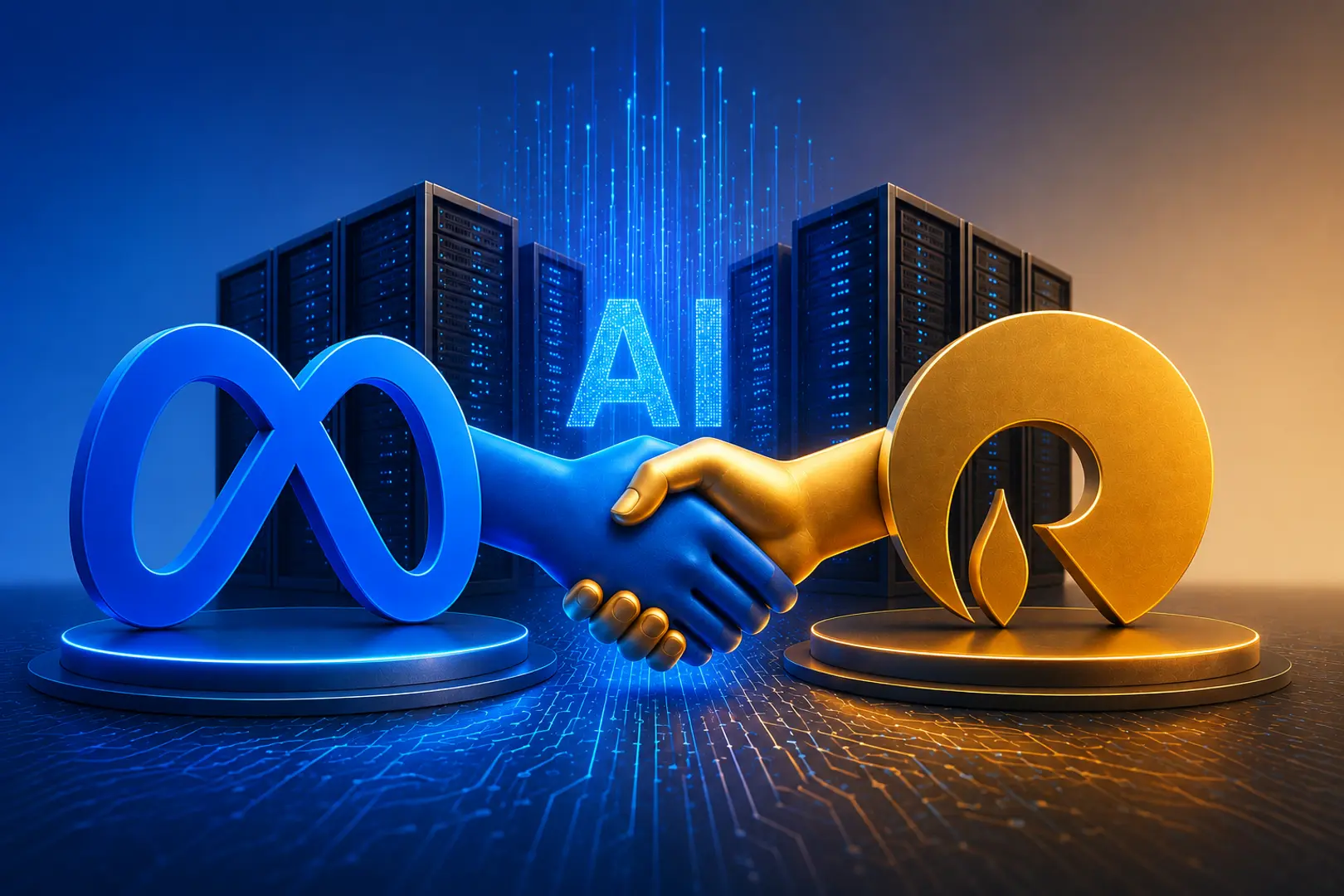

A new chapter in India’s AI race is taking shape. Meta and Reliance are aligning interests to build and scale AI infrastructure that serves developers, enterprises and everyday consumers across the country.
The idea is simple but ambitious: combine Reliance’s nationwide digital rails with Meta’s rapidly evolving AI stack. Reliance brings carrier-grade 4G/5G networks, fibre backbones and expanding data centre capacity.
Meta contributes foundation models such as the Llama family, orchestration tools and safety systems that allow Indian organisations to build AI features in local languages and at consumer scale.
What this collaboration could deliver
If executed well, the collaboration could standardise how Indian companies access compute, models and tooling. Hosting Llama variants in-country would reduce latency and better meet data-residency needs.
Fine-tuning for Indian languages and sector-specific tasks could help banks, retailers, hospitals and public agencies deploy assistants that understand regional context, code-mixed queries and regulatory guardrails.
On the network edge, Reliance’s footprint can push AI inference closer to users, improving response times for chat, vision and speech features inside popular apps. For small firms, curated model hubs and managed APIs could lower entry barriers, moving AI from pilot projects to production. Training pathways and certifications would help developers and system integrators build careers around these stacks.
Why India is pivotal right now
India’s digital public infrastructure and its vast base of mobile-first users make it a natural testbed for scalable AI.
Running models locally helps with costs and reliability during peak demand, while data-centre investments can be aligned with renewable power and efficient cooling to manage energy footprints. Clearer compliance with India’s data and content rules will also be easier when workloads remain onshore.
Openness, safety and a fast-moving competitive field
Meta’s emphasis on open or permissively licensed models, paired with transparent safety tooling, could stimulate a broader developer ecosystem. At the same time, the competitive field is moving quickly.
Industry coverage has highlighted new entrants refining coding and assistant capabilities, reinforcing the need for constant iteration on model quality, cost and reliability. In short, India’s AI stack will be shaped by how swiftly partners integrate advances while keeping systems safe and accountable.
What to watch next
Key signals to track include the mix of training versus inference capacity in Indian data centres, availability of optimised Llama checkpoints for major Indian languages, pricing in Rupees for managed APIs, and service-level assurances for enterprises.
Also watch for edge deployments across major metros, developer grants, and initiatives that help startups and public-sector teams adopt AI responsibly. If these pieces come together, the Meta–Reliance alignment could meaningfully lower the cost and complexity of building useful AI for India.