


AI can add $500-600B to India's GDP in key sectors: NITI Aayog
The NITI Aayog report identified financial services and manufacturing as the two sectors expected to contribute the most to this growth.

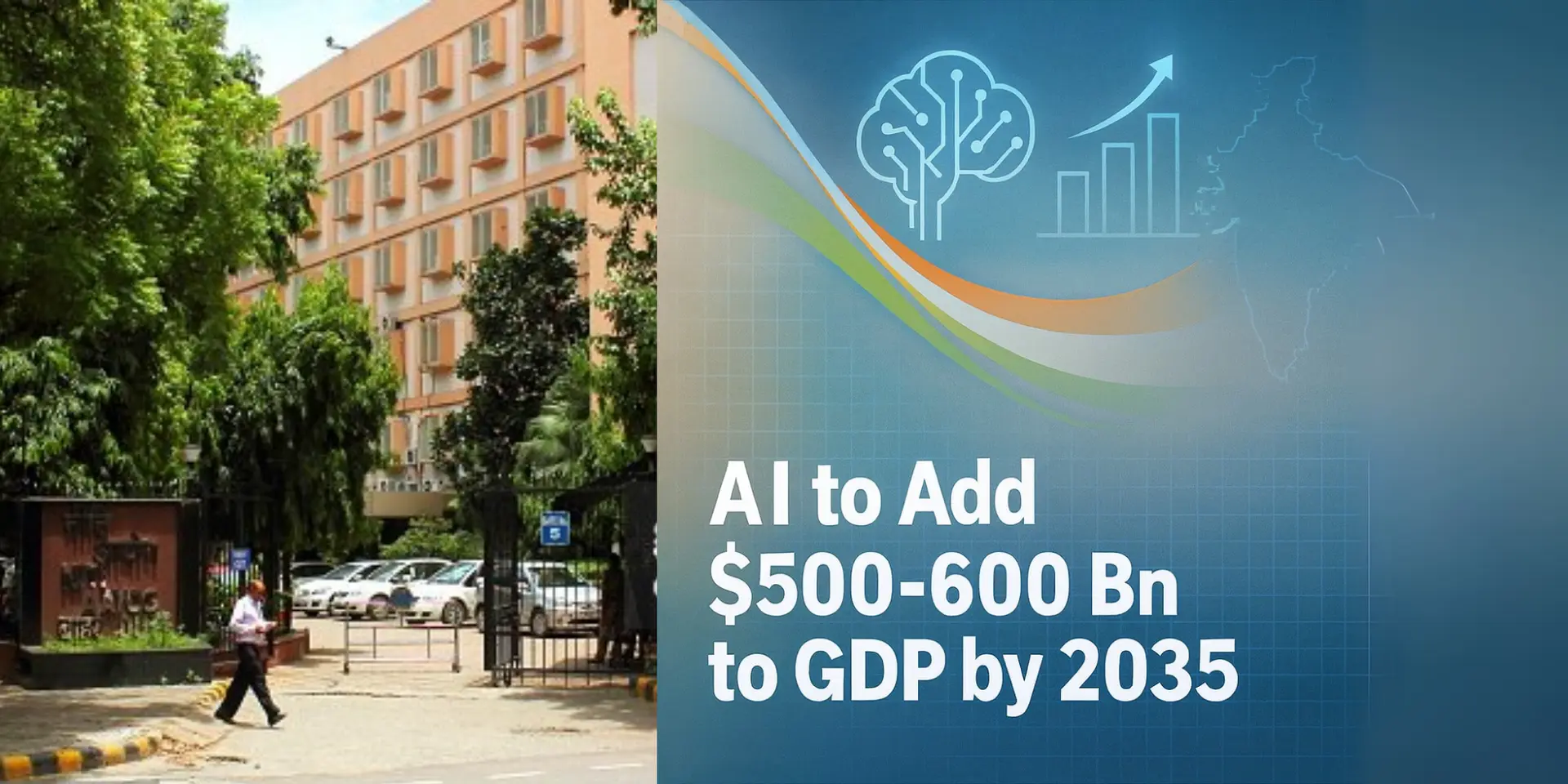

The government think tank NITI Aayog has stated in a new report that artificial intelligence (AI) could contribute between USD 500 billion and USD 600 billion to India’s gross domestic product (GDP) by 2035.
The findings are published in the organisation’s report titled “AI for Viksit Bharat: The Opportunity for Accelerated Economic Growth”, released in September 2025.
The report highlights that accelerated adoption of AI across industries could significantly boost India’s economic output. It identifies financial services and manufacturing as the two sectors expected to contribute the most to this growth.
Financial services and manufacturing
According to the report, financial services stand to gain from AI-enabled innovations in fraud detection, risk management, and personalised lending. The technology is projected to help reduce inefficiencies and improve customer access to financial products.
The manufacturing sector is also expected to see substantial gains, with AI-driven automation forecast to enhance production efficiency, streamline operations, and strengthen supply chains.
The report notes that in both financial services and manufacturing, AI could contribute up to one-quarter of sectoral GDP by 2035.
While these two areas are expected to be the largest beneficiaries, the report also points to other sectors such as healthcare, agriculture, and retail where AI has potential to drive productivity and innovation.
Conditions for economic impact
NITI Aayog emphasises that the projected economic contribution of AI will depend on the pace and scale of its adoption. The report calls for investment in digital and computing infrastructure to support advanced AI models and applications.
Workforce readiness is identified as another crucial factor. The report stresses the need for skilling and reskilling programmes to prepare workers for new opportunities created by AI, particularly in data analysis, AI development, and system management.
Without such measures, there is a risk of uneven distribution of benefits across the workforce.
Barriers and prerequisites
The report highlights several challenges that must be addressed for India to fully capture the AI opportunity.
These include:
- Expansion of AI adoption across industries.
- Development of adequate computing and cloud infrastructure.
- Establishment of data governance and privacy frameworks.
- Creation of industry-specific strategies to guide the integration of AI technologies.
The think tank underlines that achieving the projected gains will require coordinated efforts from government, private enterprises, and academic institutions.