



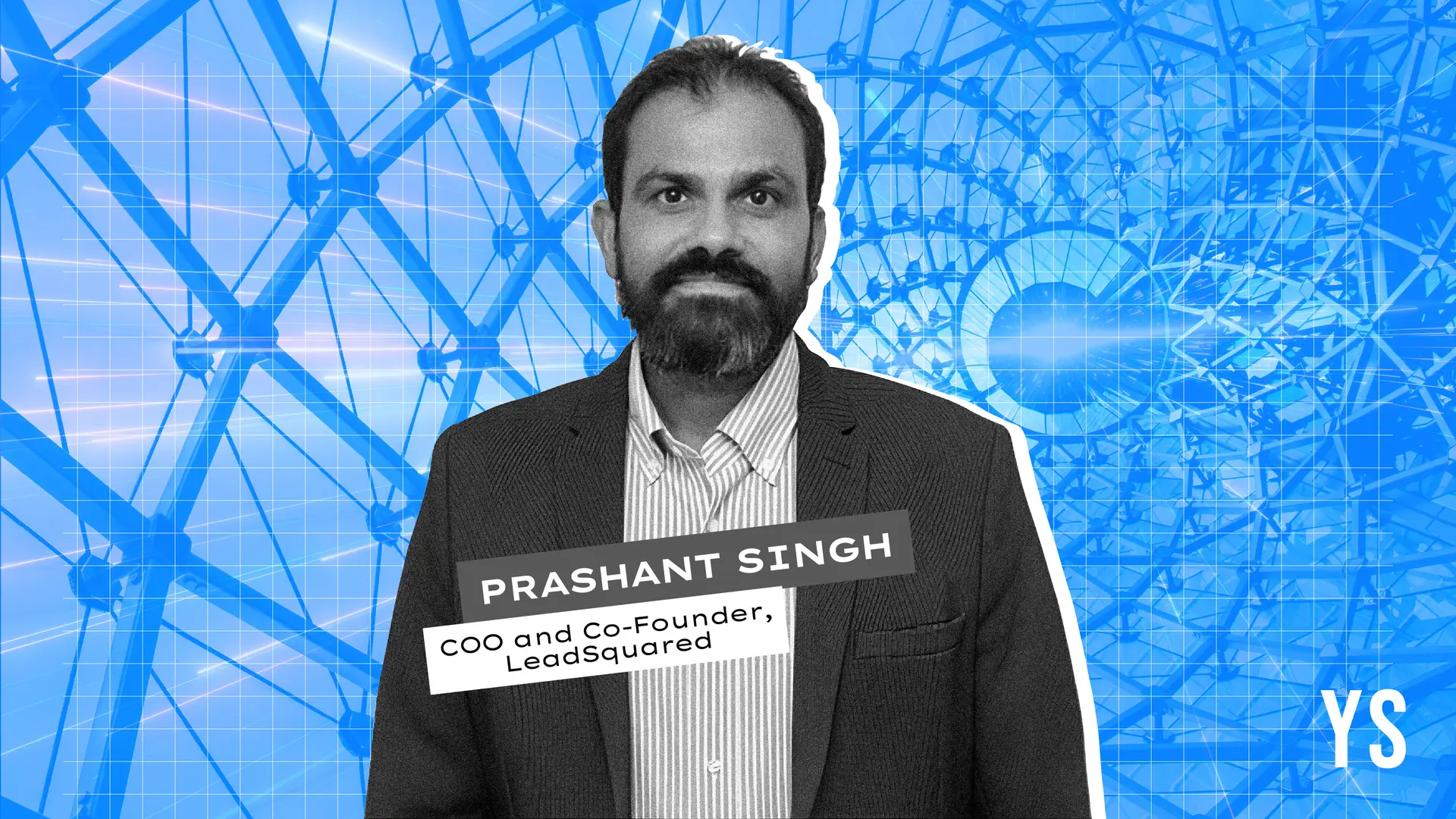
We are working towards becoming IPO ready in the next 12-18 months: LeadSquared’s Prashant Singh
In an exclusive conversation with YourStory, LeadSquared co-founder Prashant Singh explains the firm’s evolution from a marketing platform to a CRM powerhouse, and why the company is placing its bets on purpose-built AI over hype.


While some industry veterans warn of an “AI winter” threatening traditional SaaS models, Indian SaaS unicorn is charting a different course. Rather than seeing artificial intelligence (AI) as a threat, the company views it as a means to build sharper products and deliver more measurable outcomes.
“We are cognizant of the fact that we don’t have to use AI for the sake of AI. It’s not FOMO. It’s ultimately about what value you pass to the customers,” Prashant Singh, Co-founder and COO, LeadSquared, tells YourStory.
As several companies scramble to safeguard their businesses from AI disruption, LeadSquared is busy AI-powering theirs, betting that its purpose-built intelligence will separate winners from the merely surviving in the next wave of enterprise software.
So far, the strategy seems to be working. With IPO plans on the horizon and a clear path to profitability mapped out for the next 12-18 months, Singh’s contrarian bet on AI integration over AI anxiety may perhaps redefine how SaaS firms are perceiving the ongoing intelligence revolution.
Witnessing disruption in the software sector isn’t new for the 14-year-old company. The founder’s journey began with Protreans, a startup co-founded by Prashant with Nilesh Patel and Sudhakar Gorti. After that company's acquisition, the trio recognised a gap in how businesses handled sales execution and launched MarketXpander in 2011.
What started as a customised email marketing campaigns and lead management for small businesses eventually evolved into LeadSquared—a full-scale sales automation platform that today serves over 2,000 enterprises globally.
In an exclusive conversation with YourStory, Singh explains the firm’s evolution from a marketing platform to a CRM powerhouse, and why the company is placing its bets on purpose-built AI over hype.
Here are the edited excerpts from the interview:
YourStory [YS]: Take us back to the early days. How did LeadSquared come into existence?
Prashant Singh [PS]: LeadSquared was launched in 2013 as a marketing automation product. Our journey began with Proteans Software back in 2003. We scaled that company and eventually sold it to Symphony Services, which later became part of Samsung.
Before building LeadSquared, we spent a couple of years conducting thorough market research. We initially positioned it as marketing automation, but we quickly realised that most Indian customers saw it merely as an email tool.
Around 2013 to 2015, there were many consumer-facing companies, especially in fintech and edtech that were emerging in India. They were looking for lead management software that was simple and easy to use. LeadSquared fit that need really well. That’s when we transitioned into a lead and sales management platform, and eventually a full CRM. That was our first inflection point. The entire edtech ecosystem of India at the time was built on top of our platform.
But we were never just a one vertical player, because lead management and CRM are fundamentally horizontal offerings—edtech just happened to be one of the verticals we served. We knew that we had to cater to more verticals such as financial services, healthcare, and manufacturing, and that has served us well.
We were able to weather the storm created by the edtech meltdown. We were already diversified, which helped us survive the impact and continue growing despite the downturn. Today, we work with businesses that care about their brand, are selling to consumers, and are brand-conscious.
YS: How has AI integration fuelled LeadSquared’s product stack? What are the specific areas where you're seeing the most impact?
Prashant: We have integrated AI into our product ecosystem. The core areas where we see demand and acceptance are predicting the purchasing potential of a prospect. This is a fundamental and complex problem impacting top and bottom line for our customers, and we are running multiple early-stage projects in this direction.
Another impactful area where AI is improving our platform is in customer interactions and support. Our AI-powered Knowledge Base Bot can automatically respond to customer queries by pulling relevant information from a trained knowledge base, reducing interaction load by up to 60%.
Other features like Ticket Summarisation analyses conversations to tag issues, detect sentiment, and recommend next actions. Furthermore, Response Refinement maintains consistent tone across all agent communications.
For internal teams, our in-house AI assistant provides prompt assistance with various inquiries related to our products and services.
YS: Could you list a few core product offerings?
Prashant: We've built a suite of solutions that address different stages of the customer lifecycle.
Our current offering includes Lending Cloud and Loan Origination System, which streamlines the entire lending process of application to disbursement. The Service CRM handles post-sales operations. It automates service requests, tracks resolutions, which helps businesses enhance customer satisfaction.
Then there's FloStack, our automation engine that allows businesses to build complex, multi-step workflows easily.
YS: With so much AI hype in the market, how does the firm differentiate its AI strategy? Are you building from scratch or taking a different approach?
Prashant: We see AI adoption in three buckets: makers, shapers, and takers—it’s a lingo from the McKinsey framework. Makers build foundational AI models and takers simply consume APIs. We fall in the middle—we’re shapers. We adapt and fine-tune existing models for specific use cases like sales in healthcare or education, offering value add for our customers. We are cognizant of the fact that we don’t have to use AI for the sake of AI.. It’s not FOMO. It’s ultimately about what value you pass to the customers.
Our main aim is to make sales and service teams more efficient.
YS: How are you prioritising R&D? Are you looking at acquisitions?
Prashant: R&D is one area where companies like ours have to keep investing, because we’re a tech company, and you simply can’t take your eye off the technology.
R&D spending remains a priority, with a near-term focus on integrating AI to add customer value and executing our product roadmap. We’re also aiming to increase non-India revenue, especially by accelerating growth in other geographies, especially in the US. While we don’t have any major acquisitions planned, we’re open to opportunities that offer complementary products or market access.
YS: How are customers reacting to AI? Are they hesitant? Are you seeing changes in pricing models as AI gets embedded into SaaS?
Prashant: I’d say customers are more anxious than hesitant. They see the value, but they also understand that it may take some iterations to get it right. The general belief is that it is not just another tech fad that is going to fade away soon.. There is real value. Parallelly, as things become more mature, a lot of problems will be solved. We have seen the pace of change from ChatGPT to the models of today. Hallucinations, for instance, are a known risk, but the tech is improving fast. The leap from GPT-3.5 to today’s models has been huge in accuracy and reasoning.
Moreover, customers would be slightly willing to pay more. Most importantly, the shift is happening in terms of the way pricing is being done. We’re moving from pure licence-based pricing to hybrid models—combining licence price with transaction-based or outcome-based pricing.
Currently, we serve around 2,000 customers. About 1,500 are in India, and the remaining 500 are from other geographies, with most of them being in the US, serving healthcare and education as two key verticals. Some of our clients in the region include Healthy Young Minds Path Behavioural Health, Stepping Stones, and Posterity Health.
YS: How are you balancing growth and profitability?
Prashant: We’re on a clear growth path. At the same time, we’re focused on optimising costs and moving towards profitability.
Looking ahead to FY25 and FY26, we plan to further optimise costs. Internally, we’re also adopting AI to drive efficiency—essentially, delivering more in the same amount of time. That’s a key charter we’re driving. With AI, we can accelerate our engineering and product roadmaps, deliver more value to customers, and convert that into real revenue. On the cost side, we’re also working on optimising our hosting infrastructure and streamlining internal processes.
We are working towards becoming IPO ready in the next 12-18 months.
YS: What are your top key priorities for the next 2–3 years?
Prashant: While we’re already among the top three players in the CRM space in India, our focus now is three things—first, to continue our strong growth in the Indian market; second, to expand our international presence, especially in the US, and shift from our current 70:30 India-to-global revenue mix to a 50:50 split over the next two to three years.
We currently operate in five countries, and while 70% of our revenue still comes from India, the US is a growing market. Lastly, we are focusing on driving efficiency and profitability across all operations.
At the same time, we’re committed to staying ahead in the CRM space by meaningfully integrating AI into our offerings.
Edited by Megha Reddy