



Nvidia’s RTX Spark Wants to Turn Your Laptop Into a Personal AI Agent
Nvidia has unveiled RTX Spark, a new AI-focused chip platform for Windows laptops and desktops, taking direct aim at Intel and AMD in the emerging AI PC market.

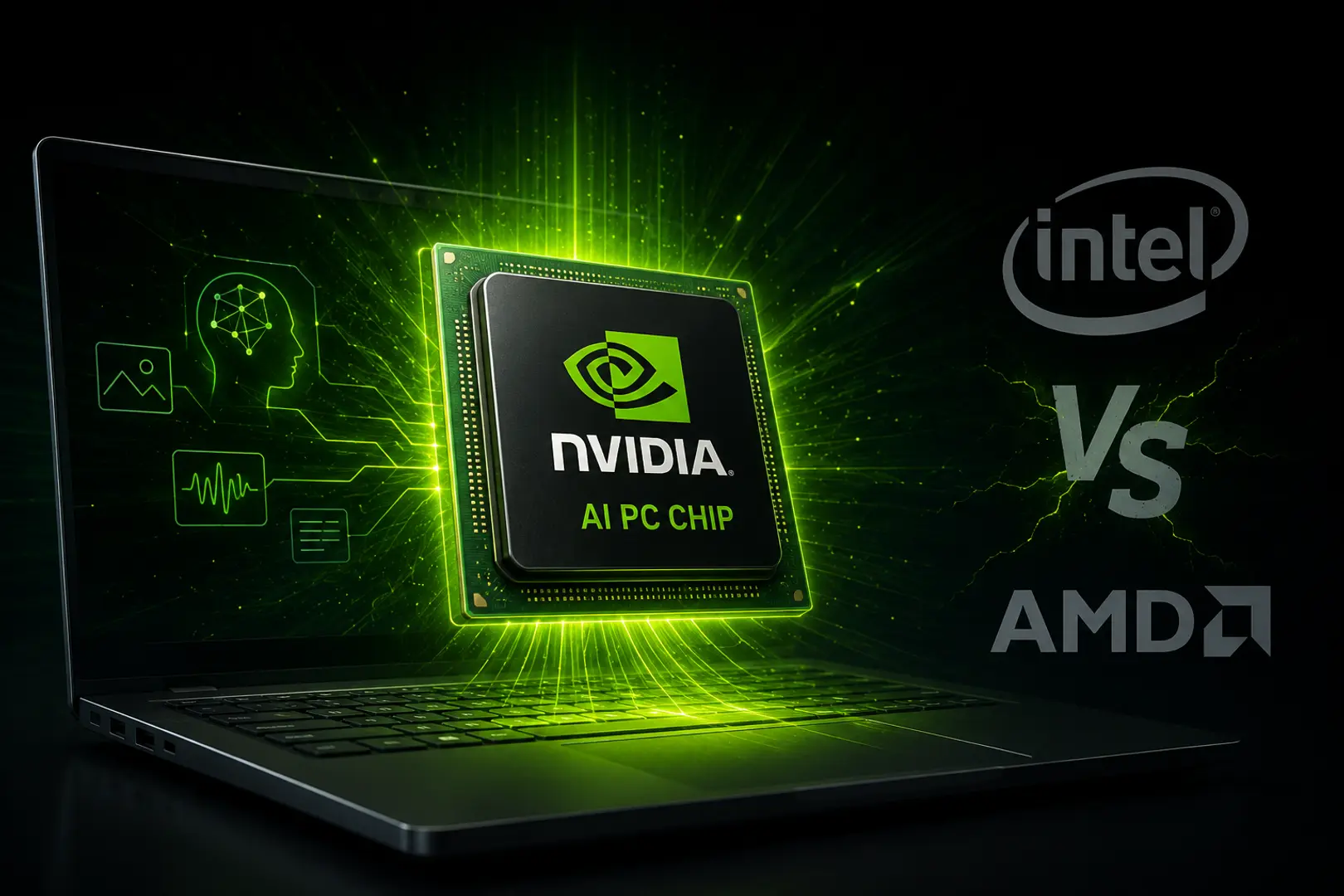

Nvidia is no longer content with powering the world's AI data centres. Now it wants a bigger slice of your laptop too. The chip giant has unveiled RTX Spark, a new AI-focused computing platform designed for next-generation Windows laptops and compact desktops.
Expected to arrive in devices from autumn 2026, the platform marks Nvidia's most direct challenge yet to long-time PC leaders Intel and AMD.
With partners including Dell, HP, Lenovo, Microsoft Surface, ASUS and MSI already on board, Nvidia is betting that the future of personal computing will revolve around AI-first experiences rather than traditional performance metrics alone.
Nvidia's biggest PC push yet
At the heart of RTX Spark is Nvidia's vision of what it calls the "personal AI agent" PC. The company believes future computers will run increasingly sophisticated AI models directly on-device rather than relying solely on cloud services. This could enable faster responses, better privacy, lower latency, and offline AI capabilities.
To support that vision, Nvidia has built RTX Spark around a highly integrated design that combines computing, graphics, and AI acceleration into a single platform. Unlike traditional PC architectures that rely on multiple chips working together, Spark is designed as a superchip, bringing key components onto a unified system.
The aim is simple: deliver high performance while maintaining the efficiency and battery life consumers expect from modern laptops.
How RTX Spark works
One of the platform's most notable features is its ARM-based architecture. Rather than using the x86 processors that have dominated personal computers for decades, Nvidia has opted for an ARM-based CPU paired with its latest graphics technology.
The platform also uses unified memory, allowing the CPU and GPU to access the same high-speed memory pool. Configurations can support up to 128GB of memory. For users, this means less time spent moving data between different system components and more efficient handling of demanding workloads such as video editing, 3D rendering, and AI processing.
Dedicated AI accelerators further enhance performance by handling machine learning tasks separately from the main processor. This allows AI-powered features to run more smoothly without slowing down the rest of the system.
What users can expect
For consumers, the benefits may appear in everyday applications. AI-assisted photo editing, real-time translation, speech transcription, content generation, and intelligent productivity tools could run locally on the device without requiring a constant internet connection.
Creative professionals may see improvements in video production, graphics work, and software development. Developers could also gain the ability to run and fine-tune smaller AI models directly on their laptops. Microsoft is already working with hardware partners to optimise Windows applications for these new AI-capable systems.

NVIDIA’s Huang says world will have ‘billions of agents’ as AI boom lifts fiscal results
The next battleground in computing
The first RTX Spark devices are expected to launch in autumn 2026, with Dell and HP likely among the earliest manufacturers to bring products to market. Pricing remains unknown, but early models are expected to target the premium segment.
The real test will come when independent benchmarks measure performance, battery life, thermals, and software compatibility. Windows on Arm has improved significantly in recent years, but application support remains an important factor for buyers.
Still, Nvidia's entry signals a broader shift in the PC industry. As AI becomes central to personal computing, chipmakers are racing to define the next generation of laptops. RTX Spark may not replace Intel and AMD overnight, but it has the potential to reshape the competitive landscape and redefine what users expect from an AI-powered PC.