



OpenAI’s GPT-Live aims to bring a new era for voice AI
GPT-Live uses full-hyphen duplex technology for fluid conversations. These models listen and respond simultaneously, handling interruptions and complex reasoning in the background to create a natural and responsive experience.

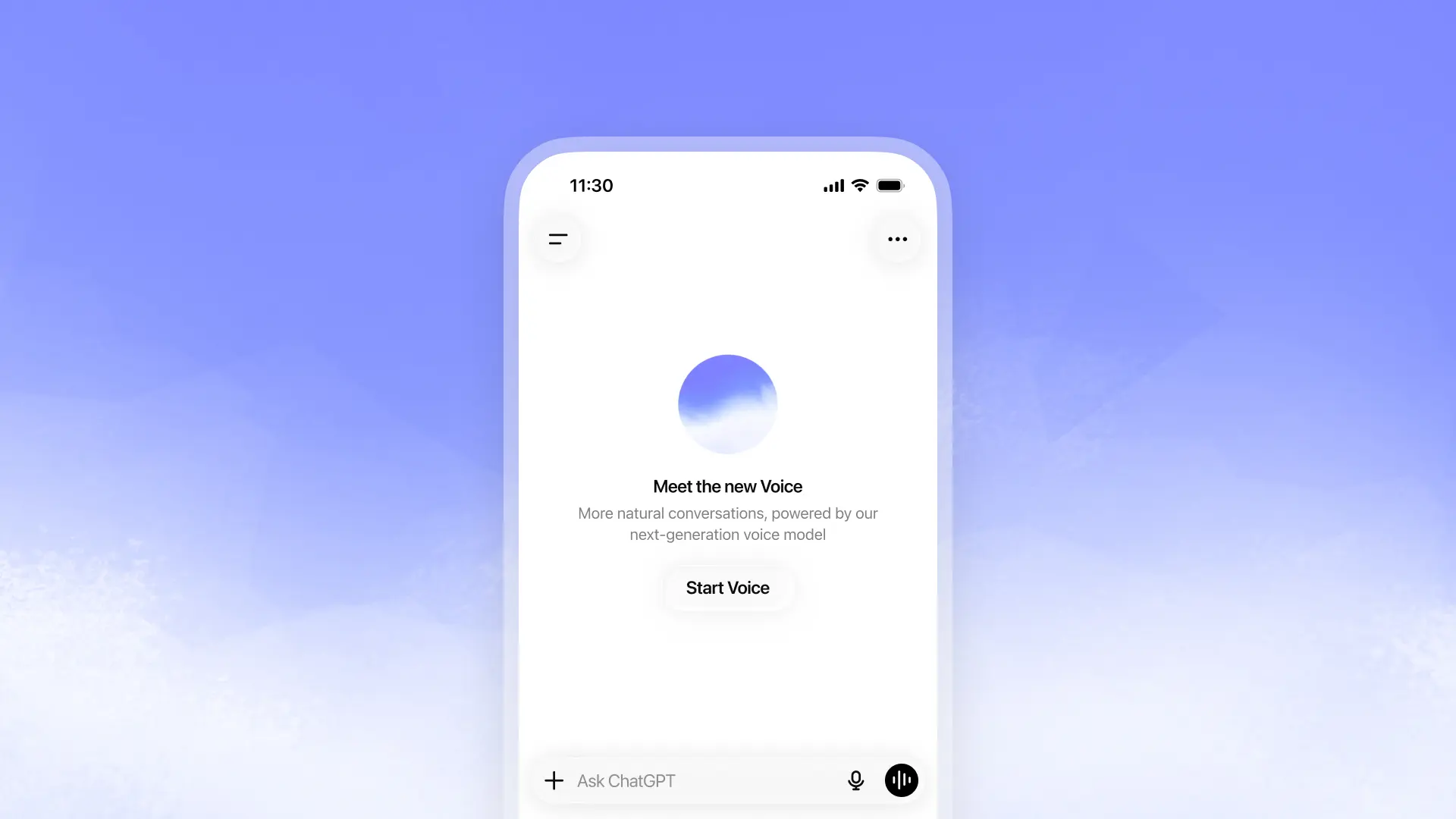

ChatGPT maker OpenAI has introduced GPT-Live, aiming to move away from the rigid back-and-forth of traditional voice assistants and toward something that feels fluid. At its core, GPT-Live represents a new generation of voice models designed to make talking to an AI feel more like a standard human interaction.
The system comes in two primary versions. GPT-Live-1 is the default model for paid subscribers, such as those on Plus or Pro plans, while GPT-Live-1 mini serves as the default for those using the free tier.
The defining characteristic of this technology is its full-duplex architecture. This means the system can listen and respond at the same time. This is a significant departure from older systems that required a user to stop speaking entirely before the machine could begin processing the information. Because it functions continuously, GPT-Live can handle pauses, respond to interruptions, and even pick up on changes in the pace of a conversation. It is designed to decide in real-time whether it should chime in or simply keep listening.
How the system works
The architectural shift in GPT-Live relies on two main changes. First, the model processes input while simultaneously generating output. This allows it to make interaction decisions many times every second. It can “active listen” by using phrases like “yeah” or “got it” to show it is following along, or it can stay quiet if the user clearly needs a moment to gather their thoughts.
Second, OpenAI has decoupled the immediate conversation from the deeper cognitive work. If a user asks a complex question that requires a web search or intense reasoning, GPT-Live delegates that specific task to a more powerful frontier model in the background, such as GPT-5.5. While the background model does the heavy lifting, GPT-Live can continue to speak with the user, maintaining the conversational flow instead of leaving them in silence. This approach allows the system to combine fast, natural responses with high-level intelligence.
Evaluating the experience
According to internal evaluations conducted by OpenAI, users have shown a strong preference for GPT-Live-1 and its mini counterpart over the previous advanced voice mode. These tests measured various factors like turn-taking, how natural the interaction felt, and the overall flow of conversations lasting between five and ten minutes.
Beyond just “feeling” more natural, GPT-Live-1 has shown technical improvements in reasoning. In a benchmark known as GPQA, which tests expert-level scientific knowledge in areas like biology and physics, the model performed significantly better than advanced voice mode.
It also showed gains in its ability to search the web for difficult-to-find information. For everyday users, this translates to an experience where they can talk to the AI during a commute or use it to practice a language, knowing the system is better at focusing on their voice and ignoring background traffic or nearby chatter.
Safety and technical safeguards
OpenAI has implemented several layers of protection, some of which are unique to the voice format. Because these conversations happen in real-time, the system has system-level safety integrations that check both what the user says and what the AI generates as it happens. If the system detects something potentially unsafe, it can steer the conversation away from that topic, play a safety message, or simply end the call.
The developers also used a process called red teaming, where internal and external experts try to break the model to find its weaknesses. They tested for risks such as impersonation, scams, and self-harm. One specific area of focus was emotional reliance, which refers to users forming an unhealthy bond with the AI. In some tests, GPT-Live-1 showed a slight regression in its safety score regarding emotional reliance compared to previous models, though OpenAI noted this was not a statistically significant change. To manage this, the company is conducting long-term monitoring to understand how users interact emotionally with the system over time.
Furthermore, the model is designed not to impersonate real people. It uses a set of nine predefined voices that have been remastered for this new system, and it has safeguards to prevent it from imitating a specific individual's voice. For younger users, there are additional protections, including parental controls and specific training to ensure the model behaves in an age-appropriate manner.
Looking ahead
While GPT-Live is currently rolling out to users on mobile and desktop platforms, the technology is still evolving. At launch, the model does not support video or screen-sharing capabilities, though OpenAI has stated it is working to introduce these features soon. Additionally, while the model is optimised for popular languages, it may still have a non-native accent or minor fluency gaps in certain dialects.
The broader vision for this technology is a world where collaborating with AI feels as fluid as working with another person. OpenAI suggests that, over time, this research will allow voice AI to handle increasingly complex and agentic work.