



Hydroponics for cattle: Shunya Agritech promises dairy farmers greater milk yields
By growing green fodder in climate-controlled environments, Shunya Agritech ensures cattle get proper nutrition and farmers get an increase in milk yields.

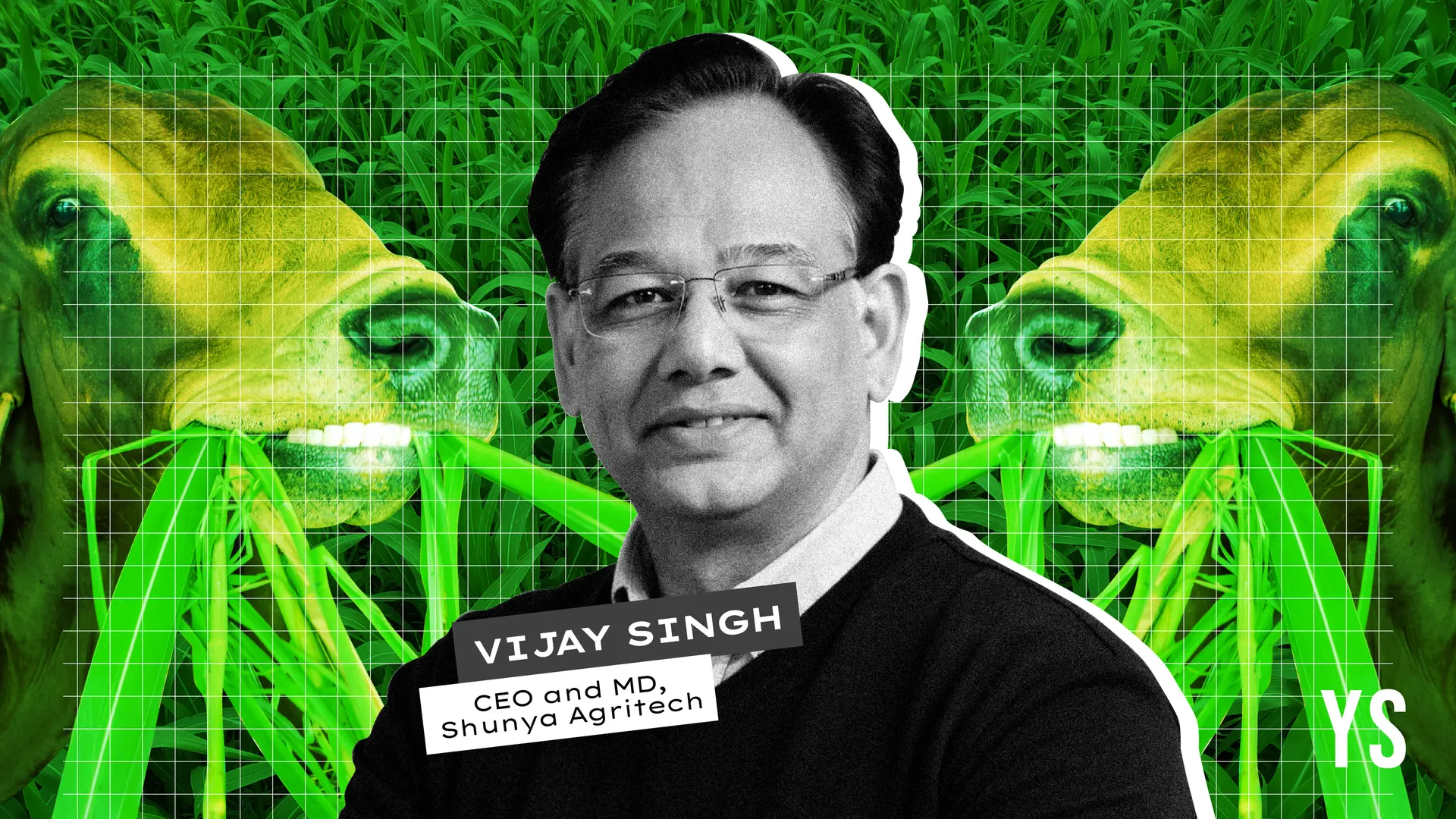

During the pandemic, Vijay Singh was spending time in the Indian countryside—away from the chaos in the cities—when he noticed a problem plaguing villagers working in the dairy sector—the lack of green fodder.
“I spent a while trying to figure out how big the problem was. After the pandemic, I travelled to about 15 states across the country, trying to understand our dairy practices, and realised this was a perpetual problem,” Singh tells YourStory.
In 2023, Singh founded Shunya Agritech, a startup that develops and delivers highly nutritious green fodder for cattle to small farmers. Apart from Singh, the CEO and managing director, the founding team comprises CTO Ritesh Raj Gupta, CGO Laxman Pai, COO Ritesh Dhawan, and CCO Jay Prakash Chhajer.
The startup is headquartered in Delhi and has about 25 employees in the Delhi-NCR region. It has an operation centre in Gurugram and cultivation units in cities including Kanpur, Agra, and Gurugram, and some other rural areas (each with seven employees).
Green fodder: Not an easy solution
The Indian dairy sector contributes 5% to the country’s GDP. Dairy farming plays a major role in a rural family’s income, contributing about 25-30%, according to three different studies.
“Every second rural household is in the business of dairying. But the problem with India is that, due to population pressure and unplanned infrastructure, most free grazing land for cattle has disappeared. We are also extremely underproductive. Indian livestock gives about four litres of milk a day when the world average is eight litres,” Singh says.
While there could be multiple reasons behind the underproduction, Singh believes the lack of nutrition is a major factor. A livestock’s diet typically consists of three components: dry fodder, commercial concentrates, and green fodder.
“Green fodder is what majorly contributes to the production of milk. But green fodder is not really available in India anymore, largely because of commercialisation and farmers only having 1-2 acres of land. So, the farmer mixes dry fodder with a lot of concentrates and whatever leafy vegetables he can find to substitute for green fodder. But that’s not good nutrition,” he explains.

The startup is attempting to solve this problem through what Singh calls a “Bharat-focused model,” as he says it’s hard to replicate global dairy farming models in India.
“India is the largest producer of milk in the world. But if you look at the US, for instance, it is very common for their farmers to be dealing with a few 100 cattle across 1,000 acres. Most farmers in India, meanwhile, have about three cattle on a two-acre plot,” the entrepreneur explains.
Shunya Agritech is developing green fodder in environment-controlled units. It grows the fodder through hydroponics, which allows for nutrient-rich feed, a faster growth cycle, and no wastage.
“As we grow it in a controlled environment, we can manage the parameters to maintain required conditions irrespective of the climate outside. The hydroponic method helps us use 1% of the water that is used in irrigating a field,” Singh says, adding that the startup is currently growing between 1 ton to 2.2 tons of green fodder per day per unit.
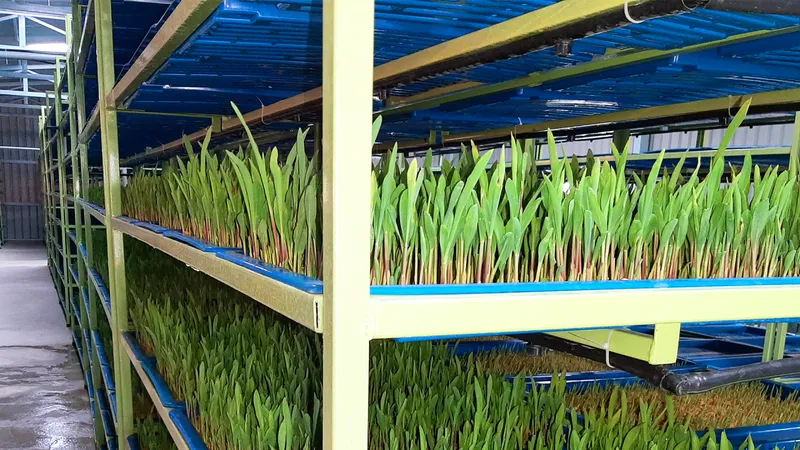
Green fodder grown using a hydroponic method at one of Shunya Agritech's units. Source: Shunya Agritech
Shunya’s Gurugram centre functions as the digital command hub. It has created a dashboard monitoring all units in real time, tracking elements like growth parameters, yields, and logistics across rural India. That data helps create a simulation of the physical operations, allowing the R&D team to conduct insightful analyses.
Streamlining operations and incorporating technology
Each Shunya unit services 25-30 villages around it. The startup operates on a B2B2C model. The company creates a retail partner, a Shunya Saarthi Centre (SSC), in a village it is servicing, and delivers its product there. A farmer can go to an SSC, pay, and collect the fodder. It’s also possible to get the fodder delivered to their farm for no additional fee.
Singh says farmers are usually cautious buyers. “They are not worried about the product. Our product is tangible; they can touch and feel that it’s much better than the fodder they are feeding to cattle. But they want to know whether they will earn more by selling more milk,” the CEO says.
According to the founder, farmers have observed an increase in milk production after 7-8 days of using Shunya’s hydroponic feed. More than 2,000 farmers have signed up for the daily subscription model (the startup did not disclose the rate).
Apart from providing access to fodder, the startup offers an app that caters to its farmer clients. The app—with over 1,000 downloads on Google Play Store—features peer-to-peer transactions, an AI-driven image-based support system to help identify disease, information regarding basic first-aid, and connections to nearby veterinarians.
The CEO reiterates that Shunya is a tech-first company and is completely digital. Every operation, including training people to manage the cultivation units, happens through its app.
“We use AI/ML tools to analyse data to predict the growth cycle of fodder. That information is then sent to the team at the units through the app. The person working at an SSC is on the app and can access information or communicate with the team at HQ at any time,” Singh says.
An overlooked segment in the sector
Singh says that the dairytech sector is underserved as compared to other areas in agritech.
“The sheer size of the population it impacts makes it a problem worth solving. While there is policy-level proactiveness shown by most government bodies to improve the productivity of the dairy industry, it needs smart solutions that can solve problems at scale,” he says.

The dairytech startup competes with Bengaluru-based Stellapps, Gurugram-based Mooofarm, and Jodhpur-based Krimanshi, among others. “While we compete with some players in adjacent spaces, none offer a full-stack model like ours in dairytech,” Singh says.
The startup has been selected to represent India at the INNOVA Europe Awards finale—a competition focused on promoting responsible innovation—in September 2025.
Shunya Agritech raised a pre-seed funding round of about $1 million in 2024. The startup plans to raise a seed round soon and expand into Gujarat, Maharashtra, and Bihar.
Edited by Kanishk Singh