



Bootstrapped and self-sustaining: How Aarthi Scans & Labs has scaled without external capital
Chennai-based Aarthi Scans & Labs has built a fairly large diagnostics network in the country—with over 70 diagnostic centres and 30 collection centres in 10 cities, a topline of Rs 305 crore, and an EBITDA of 27%.

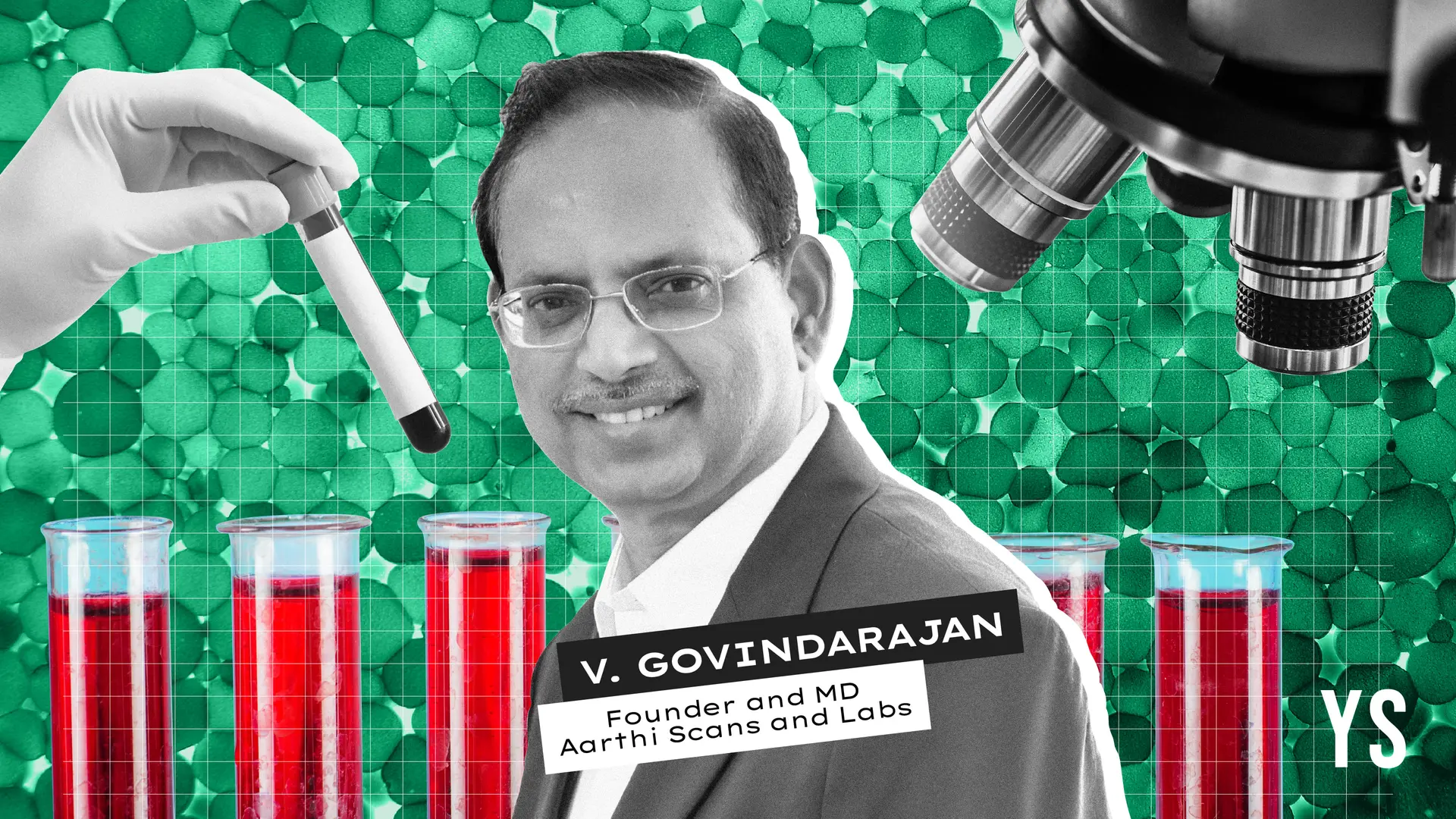

During the mid-eighties, in the small industrial town of Kovilpatti in Tamil Nadu, engineer-turned-entrepreneur V. Govindarajan and his doctor wife were running a small 20-bed polyclinic. The clinic offered basic outpatient care to not just the people of the town but also to those from other small towns and cities in the state, especially Tirunelveli and Nagercoil.
As they served these patients, they noticed that people often had to travel long distances from their hometown for MRIs and CT scans. “There was no CT or MRI scan centre in these regions,” recalls Govindarajan.
This glaring gap in healthcare infrastructure—particularly access to advanced diagnostic imaging—in the small towns of Tamil Nadu perturbed Govindarajan so much that he decided to do something about this.
However, it took him nearly 15 years to set up his first diagnostics centre in Tirunelveli.
“Though my hometown is Kovilpatti, I started the first diagnostics centre in Tirunelveli. That was a ₹5-crore investment. It went well,” says Govindarajan.
The first centre of Aarthi Scans and Labs, named after Govindarajan’s daughter, attracted people in droves as they were in dire need of diagnostic services such as X-rays, blood tests, and MRIs.
Govindarajan hit the sweet spot in Tirunelveli—incidentally a place known for its halwa—for this 8,000-sq ft centre established in 2000 set the blueprint for what was to come: a self-funded and profitable diagnostic network in the country.
Over the years, Aarthi has expanded to many cities in Tamil Nadu, including Madurai, Chennai, Thanjavur, and Tuticorin, and smaller towns such as Kovilpatti, Tenkasi, and Rajapalayam. The company also has a presence outside the state in Puducherry, Visakhapatnam, Trivandrum, Bengaluru, Hyderabad, Mumbai, Kolkata, Pune, and Ahmedabad.
Aarthi’s core services span radiology and pathology, offering what Govindarajan describes as an “integrated diagnostics” approach—combining different services, such as blood tests, scans, and genetic reports—to give a clearer and faster diagnosis.
Instead of looking at results separately, doctors work in tandem to understand the full picture and choose the best treatment, especially for complex diseases like cancer.
In a span of two-and-a-half decades, Aarthi, which is now headquartered in Chennai, has built a fairly large diagnostic network in the country—with over 70 diagnostics centres and 30 collection centres in 10 cities, a topline of Rs 305 crore, and an EBITDA of 27%.
Diagnostics centres are full-service labs that perform tests on-site, while collection centres gather samples and send them to a central lab. While diagnostics centres offer more services; collection points are smaller, cheaper, and easier to scale.
Tamil Nadu remains the company’s stronghold, housing 21 of the 70 centres and contributing nearly half of its overall revenue.
What’s important to note is, the company has achieved all this on its own, without raising external capital or relying on investor backing.
That said, it is not averse to raising external capital. In fact, it came close to raising external investment from Tata Capital Growth Fund, Tata Capital’s private equity fund, in 2022. However, the Rs 200-crore deal fell through at the last moment.
Govindarajan reveals, “There was some mismatch, so we didn’t agree to move forward.” Rather than viewing this as a missed opportunity, he sees it as a validation of his company's self-sufficient model that encourages expansion through own internal cash flows.
Evolution over the years
For the first 15 years, Aarthi’s growth was steady, but conservative—till 2015 it operated just 17 centres.
That changed around 2015 when Govindarajan’s son, daughter, and son-in-law, all qualified radiologists, joined the business. The next generation of leaders brought to the table domain expertise and fresh perspectives on how to steer the business forward.
“After they came in, we expanded at a higher speed in terms of opening centres and entering new regions. They accelerated expansion while maintaining the company’s core philosophy of sustainable growth,” explains Govindarajan.
When it comes to expansion, the company prefers to go deep into every market. Rather than spreading itself thin in many new cities, Aarthi opens multiple centres, almost simultaneously, helping the company create sufficient brand awareness in the market.
“Whenever we enter a new geography, we open three or four centres at a time,” notes Govindarajan. “For example, in 2021, we opened five diagnostics centres within six months in Mumbai.”
Apart from expanding its presence, Aarthi—under the next rung of leadership—is also exploring technology, especially AI, to be ahead of the curve.
Today, Govindarajan’s son Dr Arunkumar Govindarajan leads the company's artificial intelligence initiatives, implementing AI-powered tools for chest X-rays, CT brain scans, and calcium scoring—keeping the company technologically competitive despite its bootstrap approach.
Aarthi uses AI for preliminary reading of X-rays and CTs; 3D visualisation of kidneys, ureters, and stones; and brain volumetric analysis to detect the type of dementia a person has.
“We use AI to improve report quality, prioritise emergency cases which require immediate reports, and give new information to the clinician. All this is not possible without this technology,” says Govindarajan.

Focus on profitability
The most distinctive aspect of Aarthi’s strategy is its direct-to-patient approach, which has helped it stay profitable and sustainable through the years, without needing external capital.
While most diagnostic companies rely heavily on doctor recommendations, often paying huge referral fees that significantly increase expenses, Aarthi markets itself directly to customers— through good old newspaper ads and inserts and new-age tactics via social media.
“After the initial phase, word-of-mouth referrals from customers help us very much. In Chennai, Bangalore and Hyderabad where we have been for more than eight years, around 60% of the appointments are from word-of-mouth,” says Govindarajan.
“We don’t pay referral fees,” he adds firmly. “That discount is passed on to customers. Our rates are 50% lower than competitors.”
This pricing advantage has proven particularly effective with India’s price-sensitive consumers, allowing the company to maintain healthy margins while undercutting competition.
The diagnostics company also works out suitable financing arrangements with vendors, particularly equipment suppliers including Siemens, who offer up to 11 months of deferred payments. This helps the company conserve upfront capital, manage cash flows more efficiently, and accelerate the rollout of new diagnostics centres without immediate financial strain.
Selective acquisitions
While organic growth has been the primary driver of the company’s growth, Aarthi has also selectively pursued the inorganic route—acquiring existing diagnostics centres to establish a foothold in new markets.
In Hyderabad, it purchased five centres of a local chain called Megsan Diagnostics.
“The other five centres (of Megsan) were too close to our existing centres; so we didn't buy those,” says Govindarajan, demonstrating the careful consideration behind each acquisition.
Notably, all acquisitions are made based on asset value and turnover, rather than EBITDA multiples typically used in private equity deals.
Addressing talent shortage
Scaling a diagnostics business across multiple states presents unique challenges, particularly in maintaining quality and finding qualified personnel.
Aarthi is addressing these issues through its own radiology training programme, which helps build a talent pipeline from the ground up.
It runs a Bachelor of Science course in radiology in Chennai with 20 seats, affiliated to Tamil Nadu Dr MGR Medical University. The four-year course also includes a year of internship. It also runs a DNB radiology programme.
“Radiographers who can perform MRI scanning used to be a rare breed, even around five years back. Most radiographers reliably perform X-rays and CT scans, but MRI requires intense training on anatomy and physics. In our BSc radiography course, we train people on all three modalities: X-ray, CT, MRI.”
The internal training ensures a steady supply of qualified technicians and radiologists who understand the company’s procedures and standards. Graduates are then deployed across Aarthi’s centres nationwide, thus reducing dependence on external hiring while maintaining operational consistency.
Next phase of growth
The diagnostics market in the country is estimated at $13 billion, with players such as Dr Lal Path Labs, Thyrocare, and Metropolis Healthcare.
In this competitive market, Aarthi Scans & Labs is uniquely positioned as an integrated diagnostics player with a unique direct-to-patient model built on quality and trust, and a stronghold in southern and western India. Its debt-free balance sheet, consistent profitability, and sustainable growth model contrasts sharply with many venture-funded companies that prioritise market share and valuation over immediate profitability.
By maintaining lower overhead costs, avoiding referral fees, and reinvesting profits, Aarthi has built a resilient business model that can weather economic uncertainties without external support, and is poised for further growth, says Govindarajan.
“We’re expecting to grow 20% (in revenue) this year,” he adds.
From running a small clinic in a small town to spearheading a large chain of diagnostics centres across India, Govindarajan has come a long way. Under his able guidance and the next-gen’s purpose-driven ambition,
Aarthi is now readying itself for the next phase of growth.
Going forward, the company is looking to continue expanding into newer markets such as Lucknow and set up 30 centres in four years. It is also exploring new frontiers, including a potential public market listing and strategic investor participation—though Govindarajan emphasises that external funding remains “optional” rather than “necessary”.
The copy was updated.
Edited by Swetha Kannan