



Edtech firms keen to expand ties with US universities as they look beyond the lecture hall
As American universities grapple with tighter visa rules and uncertainty over international student enrolment on campus, Indian edtech platforms are keen to seize the opportunity and strengthen partnerships with these institutions.



Two months ago, Praneet Singh, a senior official of the Study Abroad programme of edtech firm upGrad, was at a conference organised by the National Association of Foreign Student Advisers in San Diego. He was among 8,000 educators from universities across the world when news broke out that US student visa appointments had been stalled until further notice.
There was palpable tension in the air, recalls Singh, Associate Vice President, Study Abroad, upGrad.
There were several questions on everyone’s mind: How will universities in the United States meet enrolment goals and plan annual budgets without international students? Can they preserve diversity in their cohorts if borders are shut? How will they manage the sentiment and expectations of students already enrolled?
Most importantly, can American universities offer alternative options to international students and not rely on physical enrolments alone? Singh believes they can—through online programme partnerships with edtech firms.
“Recent developments can push a lot of these universities and companies like us to find more innovative, adaptable solutions; alternative delivery models; and new revenue streams,” he notes, adding that this modality is something the edtech firm began exploring about five years ago, and it’s now gaining momentum amid rising uncertainty.
In recent times, several American universities—including Harvard, Northern University, Princeton and Columbia—have faced direct funding freezes or cuts. Many others are tightening budgets and limiting admissions amid the looming threat of shrinking federal support.
In such a scenario, Ashwin Damera, Co-founder and CEO of edtech platform Eruditus, too sees American universities ramping up their online programme portfolio, as online students bring in revenue without the hassles of immigration policies.
The US State Department issued 12,000 fewer F-1 student visas (22% drop) and 7,000 fewer J-1 exchange visitor visas (13% decline) in May 2025 compared to the year ago period, according to data from Student and Exchange Visitor Information System of the US Immigration and Customs Enforcement.
F-1 is a non-immigrant visa for international students pursuing full-time academic studies at accredited institutions in the US. J-1 is a non-immigrant visa for individuals participating in a wide variety of exchange visitor programmes in the US, including students, scholars, and professionals, focusing on cultural and educational exchange.
International student enrolment in the US fell by 11.3% between March 2024 and March 2025, dropping from 1.15 million to just over 1.02 million. According to estimates, based on an average cost of $30,000 per student for tuition and living expenses, this dip could potentially cost US institutions up to $4 billion in revenue over a year.
Even as US universities grapple with tighter visa rules and scrutiny and uncertainty over enrolling international students on campus, edtech platforms such as Eruditus, upGrad, Simplilearn, and Great Learning are keen to seize the opportunity and deepen existing ties with American universities and also establish new ones.
Through collaborations with overseas universities, edtech companies offer a slew of programmes delivered via both online and hybrid models.
Edtech platforms have spent years building partnerships with leading universities in America, and these relationships appear more valuable than ever as institutions look beyond the lecture hall to drive growth and strengthen their offerings.
For instance, upskilling platform upGrad offers MBA programmes with Northeastern and Drexel, while Eruditus offers fully online (recorded), live‑online, and blended executive education programmes with top US universities.
Eruditus’s affiliate programmes include Wharton’s management development and chief technology officer courses, MIT Sloan’s global executive academy, and Harvard Business School’s blended senior executive leadership programme.
“We are keen to create more courses that address talent deficit and skills gap. If we can do this in partnership with a high-quality university, even better,” says Damera.
In such partnerships, edtech firms provide digital infrastructure, marketing, student-recruitment expertise, programme administration, and institutional design for online delivery. Universities bring in accredited curricula, faculty expertise, brand reputation, and authority to confer recognised qualifications.
Upgrad’s Singh notes that American institutions are already rethinking their delivery models amid policy changes and shifting student priorities.
Students today increasingly prioritise flexibility, affordability, and relevance of courses to their career. They also seek strong industry affiliations and placement outcomes, and value global education without the hurdles of visas and relocation.
It’s still early days, but Singh says there has been “interest” from universities which are willing to learn more about online learner behaviour, course demands, strategic pricing, and region-specific course curation, as the last year or so has prompted them to reconsider how they operate.
He sees two trends in the offing: universities developing in-house online capabilities and/or expanding their online portfolio through trusted online programme management partnerships.
“Partners like Northeastern University, UMass Lowell, Touro University, and Edgewood University have steadily increased the number of programmes they run with us,” Singh remarks.
upGrad has partnered with around 50 US universities, offering nearly 250 programmes (online and hybrid) that span undergraduate and master’s degrees. It is looking to create more such programmes in association with American universities.
In the fiscal year ending March 2025, upGrad recorded a 30% increase in enrolments into US university programmes, compared to the previous fiscal. Healthcare and engineering are seeing growth, and there is strong demand for programmes in aerospace, aeronautics, robotics, and cloud technologies.
Meanwhile, professional learning company Great Learning has introduced a number of new programmes in the last six months, some with new partners and some with existing ones. They include certificate programmes in applied generative AI and AI for business strategy, and leadership programmes.
Simplilearn, a provider of online bootcamps and certification training, is actively talking to many top-tier universities, state universities, and Ivy League institutes for potential partnerships. It already works with Purdue University, UT Dallas, UC San Diego, Virginia Tech, and Cal Poly.
Krishna Kumar, Simplilearn’s Founder and CEO, says, “We are seeing a very high demand from top universities, with more than 5-6 partners onboarding in the next few quarters.”
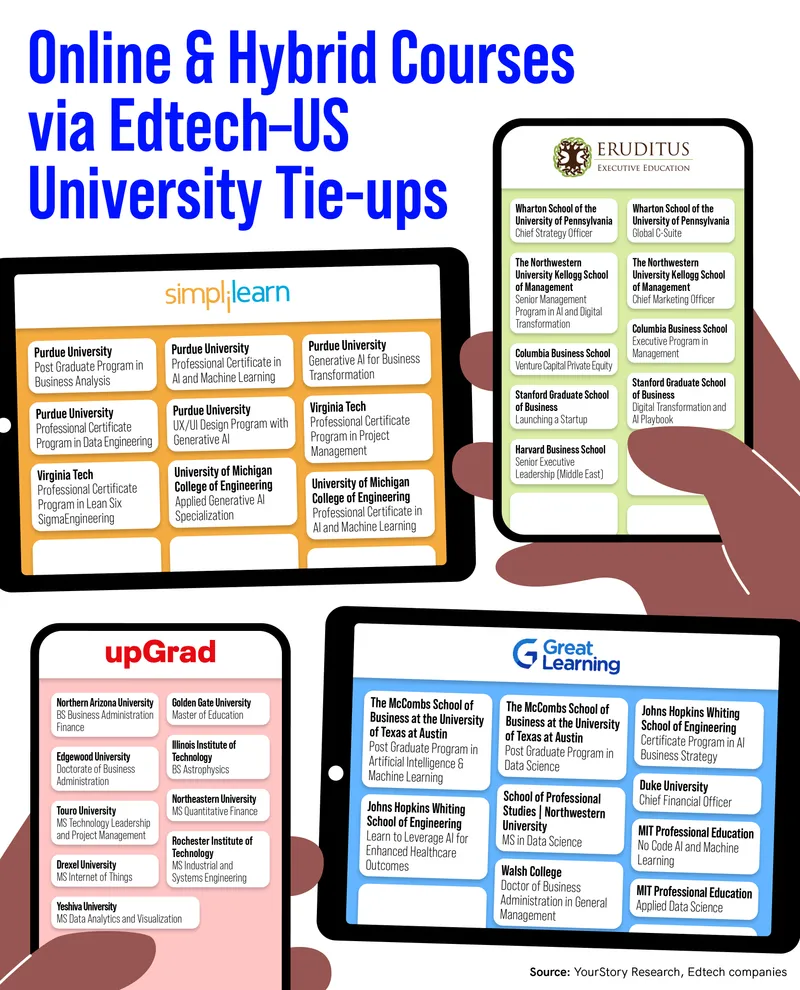
Infographic design: Nihar Apte
Win-win for both universities and edtech firms
What was once a reliable source of income—on-campus international enrolement—has now become uncertain, and perhaps even unreliable.
Industry observers believe that US universities cannot afford a decline in student enrolment, and must explore all ways to woo students from across the world.
This is where online and hybrid programmes come into play, as they help universities reach students where they are. In the case of hybrid courses, most of the coursework is delivered online, and students have to spend only a brief duration on campus.
These programmes offer an extra stream of income to universities, which can be channelled into research and other institutional priorities, points out Damera.
As schools become more open to different ways of diversifying their revenue, that will spell more opportunities for edtech players, he adds.
Online programme partnerships also allow institutions to deploy their resources more efficiently—the capital and staff needed to run one traditional programme can cover multiple online/hybrid courses.
According to Singh, the online partnership model has grown steadily over the past three years in terms of enrolment and reach. For instance, upGrad has enrolled about 5,000 students each for Golden Gate University and Edgewood College.
Singh remarks that universities are just beginning to recognise the immense growth potential of online programme partnerships. “We are just scratching the surface right now. The US is a huge market, with around 4,000 universities and colleges, and there is absolutely no limit to what can happen.”
Simplilearn’s Kumar says, “Our US university business accounts for 52% of overall revenues, and this figure has been growing steadily and is at 58% for the last few months. We have seen an uptick of 20-22% in enrolments for Jan’25-June’25 compared to the previous two quarters.”
In the past six months, Great Learning has recorded a 52% surge in enrolments for programmes offered in partnership with US universities in India. “This highlights the increasing demand for premium, globally recognised upskilling opportunities,” says Mohan Lakhamraju, Founder and CEO, Great Learning.
Shift in priorities
For a long time, education in the US was seen as a passport to prosperous living. The US was always seen as the land of opportunities, where one could get a job, an H-1B visa, a green card and “a nice life in California.”
“That’s the dream everybody was selling,” says a seasoned executive who is working with US universities. Now that dream is being “altered at every step,” he says.
Given the delay in issuance of visas and rising rejection rates, students are increasingly opting for online and hybrid courses, he adds.
“While endowments and other funding sources help, a decline in international enrolment would be a major challenge for all universities,” says the executive, who is helping universities create new revenue streams.
As priorities change, conversations have started to shift from ‘immigration’ to ‘skill development’.
US universities have begun to focus their outreach efforts on skill development. This could lead to more collaborations with online learning edtech firms, says the executive
In the midst of all this, universities are also gradually recognising that pricing plays an important role in wooing learners—and this is an edge the online medium offers.
“US schools, after a long period of rigidity, have come to terms with the fact that if they want to scale, they not only need to localise the context but must also pay close attention to pricing,” remarks Singh.
For instance, the fees for many of the online MBA courses that upGrad runs in collaboration with US universities is between $4,500 and $8,000. The same master’s degree pursued on campus in the US would cost around $40,000.
While all these developments point to a growing win-win partnership for edtech startups and US universities, the biggest gainers will be learners worldwide. They will have access to more quality courses—from university-backed online certifications to full degrees—without the headache of visas and the high costs of on‑campus education.
Long-term strategy or a short-term fix?
However, as edtech firms and universities strengthen their alliances, the big question is: is this a long-term strategy or a short-term fix?
Will these collaborations fade once the current policy challenges ease up? Or will the scale and reach of edtech partnerships prove too valuable to be abandoned midway?
All this depends on the ability of the partners to maintain academic rigour in the online medium. They also have to bring in adequate quality controls to ensure the curriculum is of high quality and updated to keep pace with evolving industry demands.
(Cover image and infographic designed by Nihar Apte)
Edited by Swetha Kannan