


Everything We Know About 3I/ATLAS: The New Visitor from Interstellar Space
A mysterious interstellar comet named 3I/ATLAS is hurtling toward our solar system — and it's unlike anything we've seen before. Scientists are preparing for a rare cosmic encounter that could unlock secrets of deep space. Read on to uncover what makes this visitor so extraordinary.

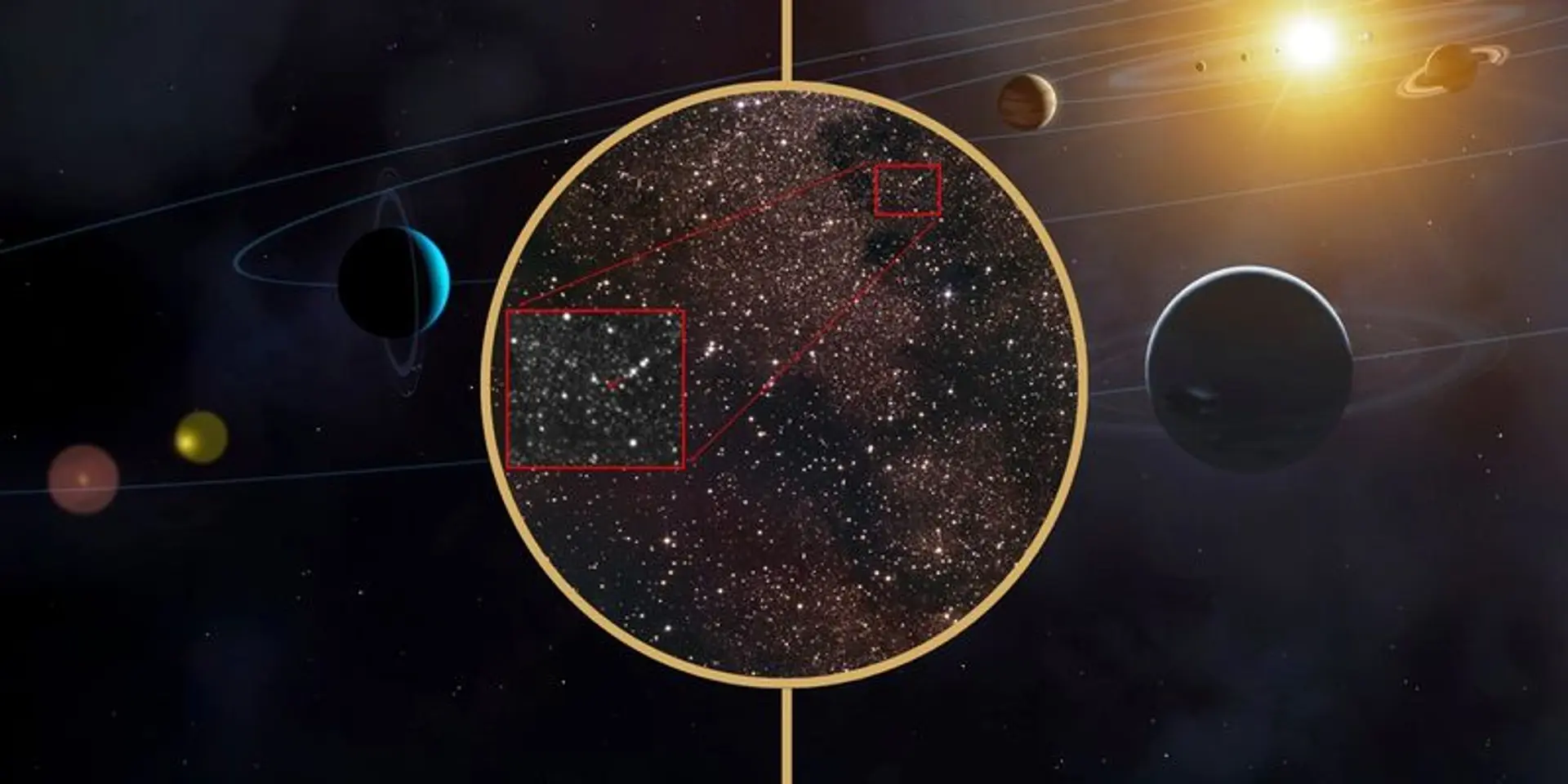

Space is vast and, at times, incomprehensible to the human mind. While we are familiar with our own cosmic neighborhood—the solar system—with its planets like Earth, Mars, and Jupiter, there’s an entirely different realm far beyond. This region, stretching across 18 billion kilometers from the Sun and beyond the heliopause, represents the cold void of interstellar space.
For a long time, humanity has only glimpsed the edges of this cosmic abyss through unmanned probes like Voyager 1 and 2, the only man-made objects to have crossed this boundary. In the vast expanse of interstellar space, we’ve had few encounters with objects venturing from this region into our solar system. That changed in 2017 with the arrival of the mysterious object 1I/ʻOumuamua, and again in 2019 with comet 2I/Borisov.
Now, after a brief respite, we are once again being visited by an interstellar traveler: comet 3I/ATLAS. This marks the third known interstellar object to enter our solar system, and scientists are eager to study this rare visitor as it makes its way through our cosmic neighborhood. Let’s dive into everything we know about 3I/ATLAS so far and explore why this comet is worth watching closely.
3I/ATLAS: The Interstellar Visitor
Discovery and Naming
The journey of 3I/ATLAS began on July 1, 2025, when the ATLAS (Asteroid Terrestrial-impact Last Alert System) survey telescope in Chile made the first detection of this object. The ATLAS project, which utilizes four telescopes located in Chile, South Africa, and Hawaii, is known for its ability to monitor the skies for moving objects that might pose a threat to Earth.
On the night of the discovery, the telescope in Rio Hurtado, Chile, captured images of an object moving toward our solar system. Initially identified as A11pl3Z, the object quickly gained the attention of the Minor Planet Centre (MPC) in Cambridge, Massachusetts, the official body responsible for tracking minor bodies in our solar system. Early observations revealed something remarkable: this object wasn’t from our solar system at all. It was an interstellar traveler, making its way from deep space toward our Sun.
Following further analysis, it was confirmed that 3I/ATLAS had originated from interstellar space, making it the third such object to visit our solar system. In recognition of its interstellar origin, the object was officially named 3I/ATLAS, with the "I" signifying its interstellar nature.
A Hyperbolic Trajectory and Record-Breaking Speed
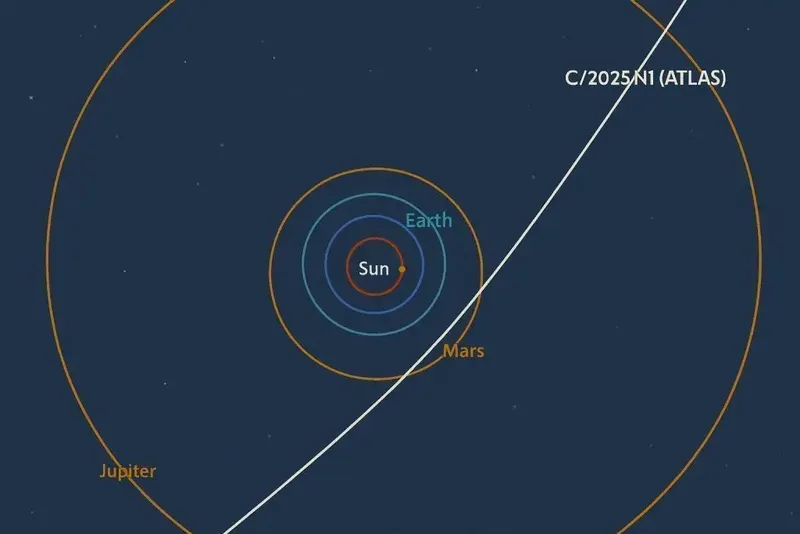
One of the most fascinating aspects of 3I/ATLAS is its hyperbolic trajectory. The object is on an eccentric orbit with an eccentricity value of around 6.0, meaning it is not bound by the Sun’s gravity in the same way as other objects in our solar system. Instead, it is merely passing through our solar system on a highly elongated path, never to return.
Its high velocity is equally astounding. Traveling at a speed of 58 km/s (about 208,800 km/h), 3I/ATLAS is the fastest interstellar object ever observed, breaking the records set by both ʻOumuamua and Borisov. For comparison, these earlier visitors had velocities of around 26 km/s and 32 km/s, respectively. At its current speed, 3I/ATLAS would cross the length of 580 football fields in just one second!
When Will 3I/ATLAS Pass Closest to the Sun?
3I/ATLAS will make its closest approach to the Sun on October 30, 2025. During this time, it will be at a distance of about 1.4 astronomical units (AU)—just inside the orbit of Mars. This close encounter offers a unique opportunity for astronomers to study the comet in greater detail, but it also means that the object is moving so quickly that it won’t stick around for long. After its closest approach, 3I/ATLAS will continue its journey outward into interstellar space, leaving our solar system behind.
Cometary Features: A Faint Coma and a Short Tail
The scientific community initially debated whether 3I/ATLAS was an asteroid or a comet. However, further observations revealed a faint coma—a diffuse cloud of gas and dust—surrounding the object, a hallmark of cometary activity. The coma is created when the Sun’s heat causes the comet’s ice to sublimate, producing gas and dust. This is a characteristic that is much more common in comets than in asteroids, and it solidified 3I/ATLAS’s classification as a comet.
In addition to the coma, 3I/ATLAS also has a short tail, which extends across just a few arcseconds. This tail, often lost among the coma in images, is another sign of the object’s cometary nature. It is worth noting that 3I/ATLAS is relatively faint at the moment, but as it approaches the Sun, its activity may increase, potentially leading to a more spectacular display.
Size and Composition: A Big, Red Visitor
Estimates suggest that the nucleus of 3I/ATLAS is around 10 kilometers in diameter. This makes it significantly larger than both ʻOumuamua (estimated to be about 0.8 km across) and Borisov (1–2 km in diameter). The size and brightness of 3I/ATLAS make it an exceptional object to study. Its reddish hue is consistent with the coloration seen in D-type asteroids, which are rich in carbon and typically found in the outer regions of the solar system. This similarity could provide important clues about the composition of objects from other star systems.
Why 3I/ATLAS Matters: Insights into the Universe
The arrival of 3I/ATLAS is not just an exciting event for astronomers, but it also offers a rare opportunity to learn more about the composition of interstellar objects. Given that objects like 3I/ATLAS have traveled for billions of years through space, they may hold clues about the conditions and materials present in other star systems. Understanding the differences between 3I/ATLAS and earlier interstellar visitors like ʻOumuamua and Borisov could help scientists piece together the puzzle of how objects form and evolve in different parts of the galaxy.
Some scientists have even speculated that 3I/ATLAS could offer insight into the possibility of life beyond Earth. While it’s far too early to make any definitive conclusions, the unique characteristics of these interstellar objects continue to fuel speculation about the nature of life in other parts of the universe.
Tracking 3I/ATLAS: How You Can Get Involved
For those eager to see 3I/ATLAS in action, there are numerous opportunities to observe the comet as it makes its way through the solar system. While the comet is still too faint to be seen with the naked eye, astronomers around the world are tracking its position, and it will be visible through telescopes as it nears the Sun. In fact, the JPL Horizons Website offers a handy tool for tracking 3I/ATLAS’s position in real-time, so anyone interested in its journey can follow along.
As 3I/ATLAS reaches its perihelion (closest approach) in October 2025, astronomers will gain even more data to analyze, making it an exciting time for space enthusiasts and scientists alike. Whether you have access to a telescope or not, the next few months promise to deliver new insights into this extraordinary cosmic visitor.
Conclusion: A Cosmic Mystery in the Making
3I/ATLAS’s rapid journey through the solar system is a reminder of how much there is still to discover in the vastness of space. As the third interstellar object to be observed, it provides valuable insights into the nature of objects from beyond our solar system. Whether you’re a professional astronomer or simply a space enthusiast, 3I/ATLAS offers a once-in-a-lifetime opportunity to observe and study a true interstellar visitor.
With more data expected in the coming months, the scientific community is excited to learn what this mysterious comet can teach us about the universe—and perhaps even the origins of life beyond Earth. Stay tuned, because this cosmic mystery is only beginning to unfold.