



Our focus is on building a strong brand identity, not just market share: River Mobility's Aravind Mani
Bengaluru-based automotive maker River Mobility is in no hurry to emerge as the biggest player in the EV ecosystem. Instead, the company is putting its head down and working on fine-tuning its fundamentals—steady expansion and scaling manufacturing capacity.

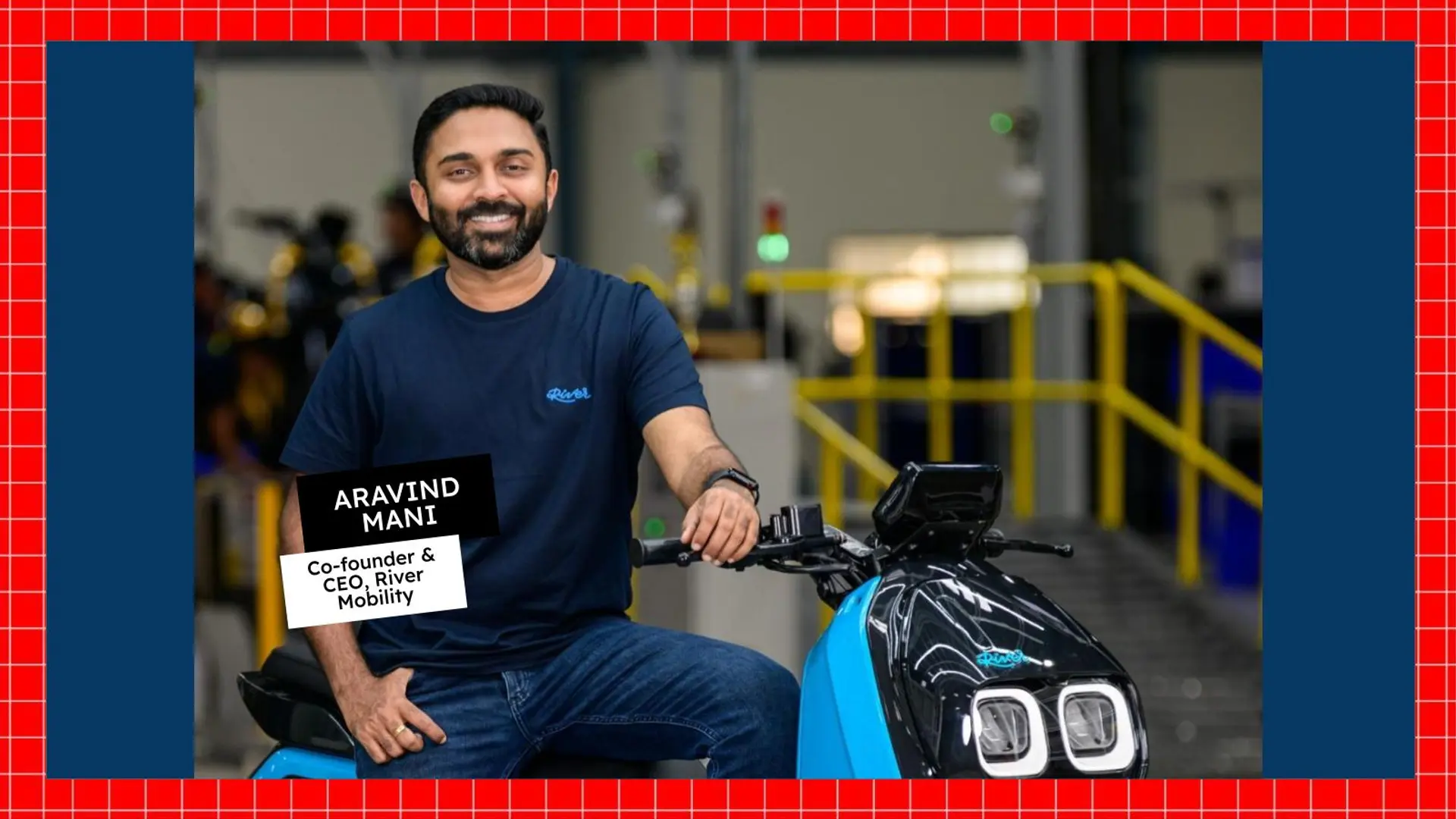

On Bengaluru streets, where electric scooters have become a preferred choice for families, working professionals, and gig workers, a new player is grabbing eyeballs. River Mobility’s debut vehicle, Indie, stands out with its duotone colours and distinctive side mounts that let riders load boxes and other utilities onto the vehicle with ease.
Founded in March 2021, the company began delivering its vehicles in October 2023. Since then, its growing offline presence across the country has helped the Bengaluru-based firm see a 2X jump in sales this year alone.
Co-founder and CEO Aravind Mani says the company has a target to sell 30,000 units this year on the back of its planned retail expansion and its upcoming stores in northern states.
Backed by Japanese auto giant Yamaha, River Mobility is exploring synergies from the strategic investment, with reports suggesting that Yamaha is looking to use River’s platform to roll out EVs in India.
In an interview with YourStory, Mani details out River’s steady rise, how it stands apart from original equipment manufacturers (OEMs) in the sector, its focus on being a single product company until next year, and more.
Edited excerpts:
YourStory [YS]: What inspired you to start River Mobility?
Aravind Mani [AM]: We started River in March 2021 after raising our first $2 million. Vipin, who spent a decade at Honda designing products, had always wanted to build an automotive company. During COVID-19, both of us quit our jobs, gave ourselves 9–12 months to raise capital, and decided to go for it when the funding came through. He’s the product guy and I’m more on the commercial side, and in just four years we’ve built strong momentum.
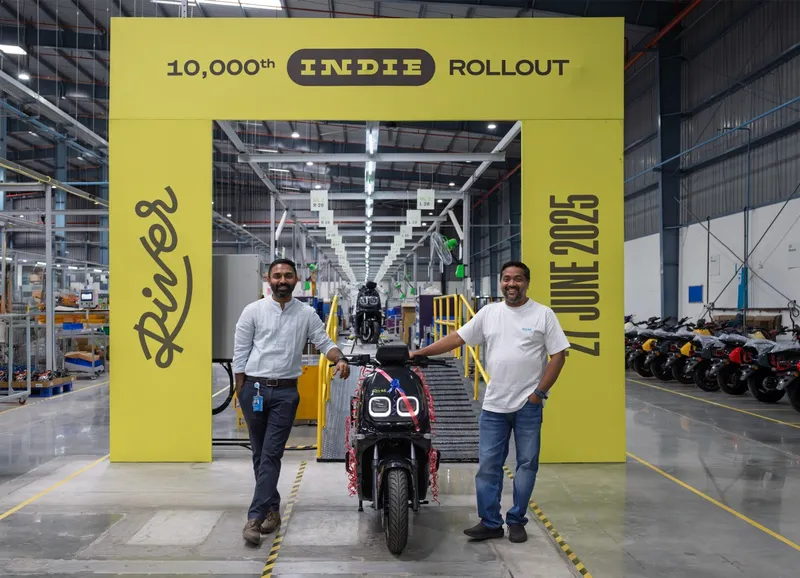
River Mobility co-founders, Aravind Mani (L) and Vipin George (R)
YS: Your sales have doubled this year, according to Vahan data. What’s driving that growth?
AM: We’ve grown step by step. The first 27 months were all about R&D—building prototypes, setting up our factory, and by October 2023, we sold our first scooter. Then we spent a year testing sales and service formats in just three cities. Once we figured that out, we scaled quickly—going from 3 stores to 28 across 20 cities in under a year. That’s what’s driven the growth. We’ve sold over 10,000 scooters since launch, and our run rate now is about 1,600–1,700 a month. Most of our stores—around 90%—are dealer-run.
YS: Have you noticed any new or rising use cases for your scooters?
AM: We see our scooters being used mainly for utility. It’s not so much gig workers—since the vehicle is on the pricier side—but more individual businessmen and carpenters, electricians, plumbers, farmers, and shop owners. Because the scooter is bigger, rugged, and stronger than regular ones, it really fits those practical, heavy-use cases.
YS: How are you looking at the rare magnet supply crisis—any short-term challenges for you as an OEM?
AM: The magnet supply crisis is real—India doesn’t yet have a local supply chain, so most magnets still come from China, and we do the motor assembly here. Suppliers are exploring three paths: using HRE-free magnets (with some performance trade-offs), finding non-China sources, or sourcing certain parts from China while keeping assembly localised. In the short term, it’s definitely a constraint, and the industry is still figuring out the best way forward.
YS: So, do you see any production interruptions because of the ongoing rare earth magnet crisis at River Mobility? What timeline do you see for this to get resolved?
AM: For River, it’s not an immediate issue since our volumes are still relatively small—about 2,000 vehicles a month—so we’re covered for the next few months. The real challenge will come as we scale, because higher volumes mean higher demand for magnets. If the crisis continues, it could impact us, but we expect the industry to have solutions in place by then.

YS: With the Indie already in the market, what other use cases or models are you exploring for the future?
AM: For now, Indie will remain our only model—we want it to firmly establish River as a brand. We’re in 20 cities today and plan to expand to about 80 outlets across 55–60 cities by March 2026. Once Indie has enough scale and credibility—built largely through word of mouth—we’ll look at introducing the next product, most likely around 2026–27.
YS: One big concern with EVs is the after-sales service. How are you approaching that?
AM: For us, service is non-negotiable. We don’t enter a city without a service centre, and every store has one within 3 km. Some even operate as full 3S facilities. That’s how we build trust—keeping customers happy so they spread the word, which is what drives our growth more than ads. Broadly, most of the bigger OEMs—who account for 60–70% of sales—are also focused on strong service, but it really comes down to each company’s priorities.
YS: What does your current production capacity look like?
AM: Our plant in Hoskote, near Kolar, Karnataka, can make 8,000 vehicles a month on two shifts—about 4,000 in one shift. Right now, we’re producing around 2,000, so about 25% capacity with 28 stores. We’ll hit 50% (4,000 a month) once we scale to about 80 stores by March–April 2026, and full capacity by the end of 2026 or early 2027 with 150–160 stores.
YS: With so many players in EVs—both big and new—how is River planning to keep up with the competition?
AM: We’re not chasing the top four, at least not in the next 2–3 years. Our focus is on building a strong brand identity and profitability, not just market share. Even selling 5,000 scooters a month is a sizable business—bigger than Vespa in India—and 10,000 a month is a Rs 2,000 crore business. The real goal is to carve out a niche and sustain it.
In EVs, just like in ICE, only a handful of players will dominate long term, and the rest will either consolidate or disappear. This isn’t a business you can run selling 200–300 vehicles in a couple of cities—it needs national scale and efficiency. That’s what we’re building towards.
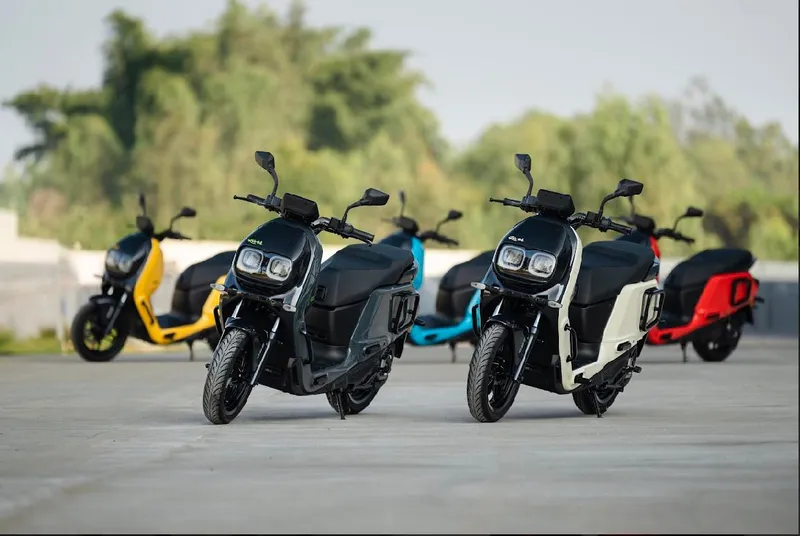
River Mobility’s Indie line of electric scooters
YS: How is River thinking about its path to profitability, especially given that losses have doubled over the last couple of years?
AM: Our path to profitability is tied to scale. At around 15,000–20,000 vehicles a month—which should take 2–3 years—we’ll hit profitability, even as we keep investing in infrastructure, technology, and products.
Expansion is steady, not aggressive: we added about 25 outlets in the last year (2–3 a month) and are now at 4–5 a month. The key is making sure every dealer is profitable before opening more in the same city. Right now, our per-store average is around 57 units, which keeps dealers healthy. For us, scaling has to be sustainable, not rushed.
YS: Could you share how you’re thinking about fundraising at this stage?
AM: We’ve raised four rounds in the last four years—about $70 million in total, including $40 million in 2024. That last round was sizable, and we’ll likely raise again later this year or early next.
In this business, fundraising is a continuous process—usually a round every year. That said, we’ve been disciplined, building a $30 million ARR on under $70 million raised, which is better than many capital-heavy sectors.
YS: Some of your peers have vertically integrated. How does River view this integration?
AM: We believe vertical integration is important in EVs—especially for core tech. At River, we design and control our own battery packs, BMS, vehicle control unit, and the full hardware-software stack that defines how the scooter rides, its range, and efficiency. That’s where our focus is: design, technology, and customer experience.
The one area we don’t plan to integrate is cells. It’s a scale-heavy, low-margin, commodity business tied to raw material mining and global supply dynamics. Instead of spreading ourselves thin, we’d rather double down on our strengths—building great products and experiences—while sourcing cells from specialists.
YS: Can you talk about the synergies from Yamaha’s investment in River and how that partnership will play out?
AM: For now, Yamaha’s investment in River is purely financial. We’re exploring possible synergies, but nothing concrete has materialised yet. They’re not a majority stakeholder, though they do hold a meaningful stake, and we work with them on River’s growth. At this stage, it’s not tied to any global Yamaha EV platform.
YS: There was a report that said that Yamaha was looking to launch its own EV using River’s platform…
AM: We’re in conversation with Yamaha, but nothing concrete yet. Once there’s clarity—like timelines or specific plans—we’ll be happy to share. For now, it remains at an exploratory stage.
YS: Is there any market trend you’re seeing right now that has really caught your attention?
AM: One big trend we’re seeing is that cheap EVs aren’t selling. In India, the best-selling car or two-wheeler is never the cheapest—it’s the one that balances value and quality. Some OEMs tried pushing lower-priced EVs at Rs 80–90K to drive volumes, but they didn’t take off, while the Activa still sells strongly at Rs 1 lakh.
It shows India is a value-conscious but quality-driven market. For B2C, customers won’t scale your business unless the product delivers real quality. That’s why a lot of the low-cost imports from China are finding traction only in B2B fleets, not with individual buyers.
Edited by Megha Reddy