



The Indian Genius Nobody Understands: Srinivasa Ramanujan
A poor Indian clerk’s letter stunned Cambridge with formulas still baffling mathematicians today. Discover the untold story of Srinivasa Ramanujan—the genius nobody understands.

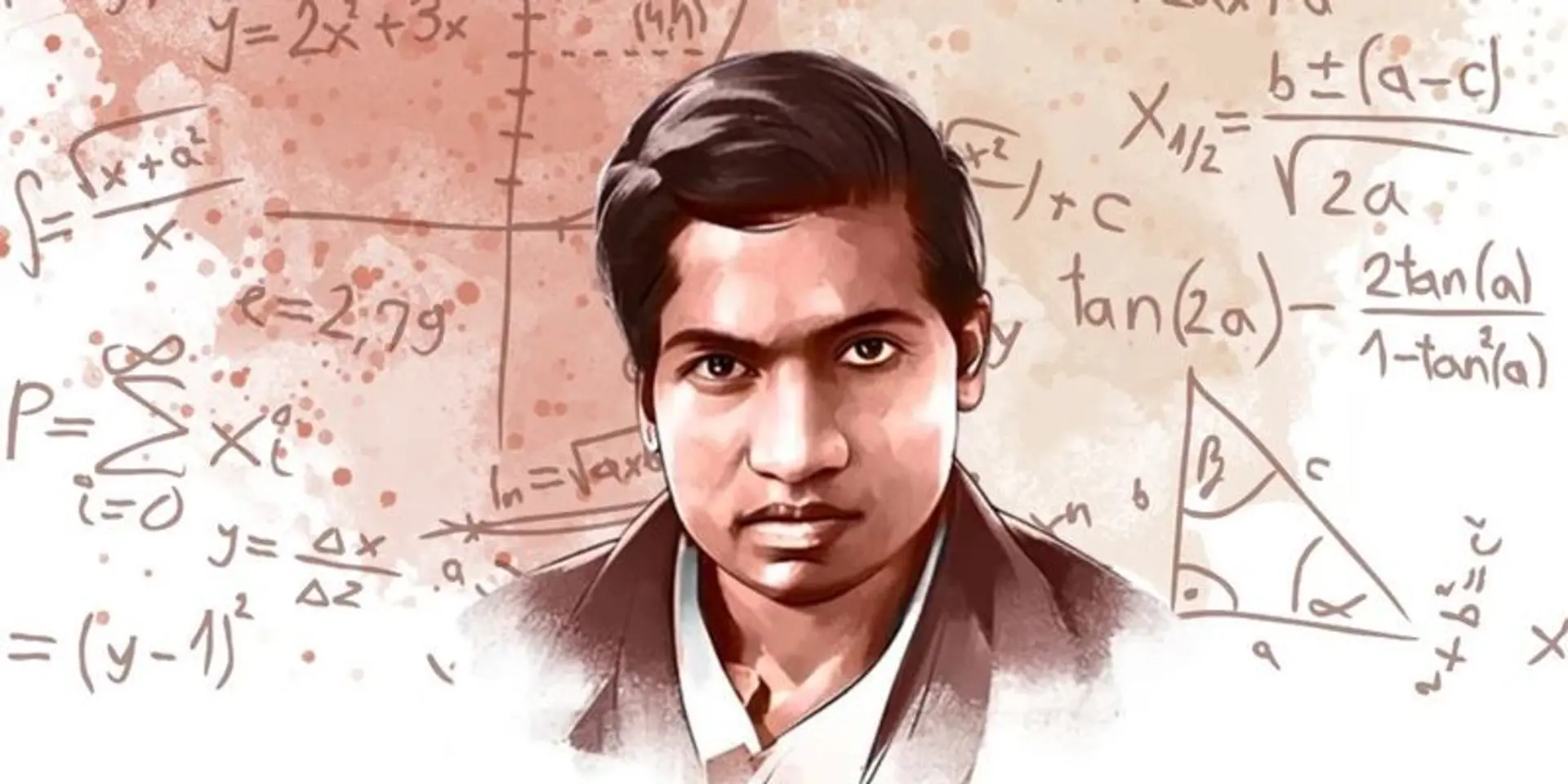

In January 1913, a young Indian clerk in Madras (now Chennai) mailed a thick letter to a famous British mathematician, G. H. Hardy, at Cambridge. The writer Srinivasa Ramanujan said he had no university degree.
But he enclosed page after page of formulas he’d discovered on his own, asking for feedback. Hardy almost tossed it aside. Then he began reading and realised the stranger might be a once-in-a-century mind. That letter changed both of their lives, and the direction of modern mathematics.
Why Ramanujan was different (and why that mattered)
Ramanujan grew up in South India in a religious, modest household. He loved numbers early, but he didn’t learn math the “Cambridge way.” At 16 he found a reference book basically 5,000 math results listed without detailed explanations. Most students used it to cram for exams. Ramanujan used it like a puzzle book: he taught himself to re-discover and extend results, filling notebooks with new identities and patterns.
This “intuition first, proof later” habit stayed with him, and is part of why people still call him mysterious. (Those notebooks—thousands of results—are still mined by mathematicians today.)
His family and faith mattered, too. As a devout Hindu, he initially refused to cross the ocean (a serious step in his community at the time). Only after his mother relented and Cambridge arranged support did he sail, reaching England in 1914.
Two opposites make history: Ramanujan and Hardy
Hardy loved strict, step-by-step proofs. Ramanujan trusted lightning-fast intuition and pattern sense. Put them in the same room and sparks flew—the productive kind. Hardy helped Ramanujan turn raw discoveries into publishable papers. Ramanujan, in turn, gave Hardy a torrent of new ideas.
Despite war-time shortages and poor health, Ramanujan’s talent shone. In May 1918 he was elected a Fellow of the Royal Society (FRS) one of the youngest ever and later that year became the first Indian Fellow of Trinity College, Cambridge. For a largely self-taught mathematician, these were astonishing milestones.
What did he actually discover? (Plain-English tour)
1) The “how many ways?” question (partitions)
Take the number 5. How many different ways can you write it as a sum of positive whole numbers, ignoring order?
- 5
- 4+1
- 3+2
- 3+1+1
- 2+2+1
- 2+1+1+1
- 1+1+1+1+1
There are 7 ways, so we write p(5) = 7. This “partition function” p(n) explodes as n grows. Ramanujan and Hardy showed how fast it grows and found shocking patterns. For example, whenever a number is 4 more than a multiple of 5 (like 9, 14, 19…), the number of its partitions is a multiple of 5. Similar “mod 7” and “mod 11” patterns hold too. These are called Ramanujan’s congruences, and they’re still a big deal in number theory.
Why this matters: partitions connect to modern topics from cryptography to physics, because they’re about counting possibilities—something computers and scientists care deeply about.
2) Pi, computed at high speed
Everyone knows π, but calculating it to many digits is hard. Some classic formulas require millions of steps to get a few correct digits. Ramanujan wrote down “wildly efficient” formulas that gave accurate digits of π almost immediately. Decades later, Ramanujan-style series inspired algorithms used to set world records for digits of π on modern computers. In 2025 language: a 1910s brain created content that still scales on 21st-century cloud.
3) 1729: the “boring” taxi that wasn’t
Hardy once visited Ramanujan in the hospital and mentioned his taxi number, 1729, calling it dull. Ramanujan replied it was very interesting: the smallest number that can be written as the sum of two cubes in two different ways—
1^3+12^3=1729=9^3+10^3
That story became legend; 1729 is now nicknamed the Hardy–Ramanujan number or the original “taxicab number.”
4) When infinity plays tricks
You might have seen the viral claim 1+2+3+⋯=−1/12 Ramanujan handled such “divergent series” with methods that, when interpreted carefully, agree with advanced tools used in modern math and theoretical physics. No, it’s not normal addition—think of it as a sophisticated way of assigning a meaningful value to an otherwise runaway sum. This shows how far ahead his instincts were.
5) The final puzzle: mock theta functions
In January 1920, near the end of his life, Ramanujan wrote to Hardy about a “new kind” of functions—mock theta functions listing examples but not full proofs. For decades, mathematicians struggled to understand them. Only with 20th- and 21st-century tools did their meaning become clear, connecting to deep areas like modular forms and even black-hole physics. The full set of late-life notes was long thought lost until a dramatic rediscovery in 1976 known as Ramanujan’s “Lost Notebook.” It contained over 600 results written on loose sheets more treasure from his final year.
The cost of genius
Life in England during World War I was tough. Food was rationed, the weather was brutal for someone from tropical South India, and Ramanujan kept strict dietary rules. He fell seriously ill and spent months in hospitals and nursing homes. Yet even while sick, he kept working and was honoured by the Royal Society.
He returned to India in 1919 and died on 26 April 1920, aged just 32. The loss still stings because so much more seemed possible.
Why people still say “nobody understands him”
He saw the answer first. Ramanujan often wrote down the destination before the road existed. Building the “road” (the formal proof) sometimes took decades and new theories. That’s why his work can feel mystical—because it leaps ahead of the standard playbook and then challenges everyone else to catch up.
His notes keep paying dividends. The 1976 Lost Notebook sparked a wave of modern research. Think of it like finding a hard-drive full of brilliant prototypes some complete, many sketches—but all pointing to powerful ideas. Mathematicians are still turning those sketches into finished theorems.
His ideas scale with computing. From π-digit records to algorithms and q-series, Ramanujan-type formulas are perfect for the age of GPUs and distributed computing. Old ideas, new hardware, huge wins.
Ramanujan in five friendly facts
- The letter that shook Cambridge (1913): A self-taught clerk mails formulas to an English giant; the giant is stunned.
- FRS at 30 (1918): Elected Fellow of the Royal Society despite illness; later, the first Indian Fellow of Trinity College.
- 1729, the famous taxi: Smallest number that’s the sum of two cubes two ways (1³+12³ and 9³+10³).
- Partitions with patterns: Surprising “mod 5, 7, 11” regularities in how numbers split.
- A notebook found in 1976: 600+ late-life results rediscovered in Cambridge’s Wren Library.
Easy ways to feel his genius (try these at home)
- Play with partitions: Pick a number like 10. List all the ways to write it as a sum (order doesn’t matter). Notice how quickly the count grows. Then check numbers like 9, 14, 19… and look up whether p(n) is divisible by 5—Ramanujan predicted that pattern.
- Spotting “interesting” numbers: Search for the next number after 1729 that’s a sum of two cubes in two different ways. (Hint: it’s much larger—this is why 1729 is special.)
- Read the letter: Skim a translation of Ramanujan’s original letter to Hardy to see the tone humble, direct, and dazzling.