



AI is a translator and facilitator in product development, says Kissflow CPO
At DevSparks Chennai 2025, Kissflow CPO Dinesh Varadharajan said AI removes translation gaps and repetitive tasks, but people must provide judgement, clarity, and problem-solving.


Artificial intelligence (AI) is already reshaping how products are built. It speeds up the dull, repetitive work and helps teams to move from idea to usable result much faster. Crucially, AI does not replace human judgement.
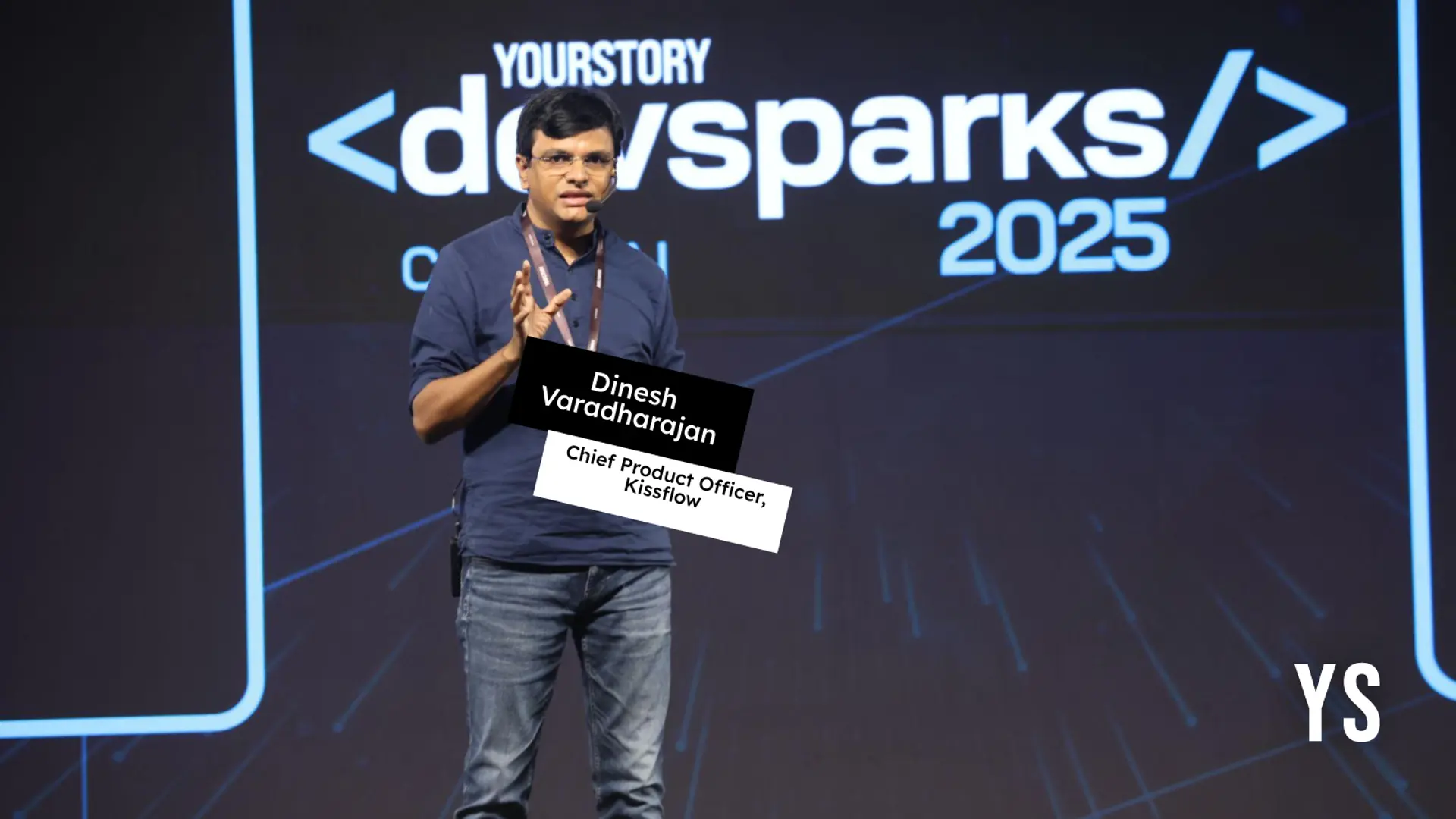
“There is always you working with AI. AI is just a translator, it’s not a creator,” said Dinesh Varadharajan, Chief Product Officer of Kissflow, during a session at DevSparks Chennai 2025, YourStory’s event focused on the developer ecosystem.
That means AI can assemble prototypes, draft code, and even put together presentations, but people must still choose the direction, design the system and check the result.
This change is practical as well as technical. Teams at Kissflow are experimenting with new ways of working and noting what works and what does not, said Varadharajan. “All of these are experimental in nature,” he said, which is a useful reminder that there is no single perfect recipe yet.
When teams use AI well, they can iterate quickly. When they rely on AI without clear intent, the result becomes fragile. As he explained, “If you know what you want, it can actually create it for you.” That is the promise and the responsibility in equal measure.
Blurring boundaries, changing skills
The familiar assembly line of product development is breaking down. In the old model, a product manager writes a specification, designers produce mockups, front-end developers convert those mockups into code and backend developers link up the logic and data. Each handover adds delay and room for misunderstanding.
Varadharajan described the result simply and sharply when he said, “The problem is in the process itself.”
To fix that, teams are shifting focus. Product managers are building working prototypes instead of long documents. Designers are producing frontend components that are closer to shipping code. Developers are being encouraged to think like full-stack engineers who understand system design and non-functional concerns such as scalability and reliability. Quality assurance moves more towards automated tests and fewer repetitive manual checks.
This shift is not about ditching craft or skill. It is about changing priorities. People often identify themselves by the tools they use, and that can get in the way of solving problems.
As Varadharajan observed, “People take so much pride in the tool they use more than the skill they possess.” The practical result is that specialists broaden into problem solvers rather than tool operators.
“AI will not take the job, but it changes the job description,” he added. That change affects hiring, training and career paths. People who can define problems clearly and orchestrate solutions with AI will be in demand.

Faster iteration, customer-centred approach
Perhaps the most important outcome is speed of learning. Rapid prototyping and early releases let teams test ideas with real users sooner. Instead of waiting months to get a feature into customers’ hands, teams can show a simple, working version within days. That feeds a healthier feedback loop.
Listening to customers matters, but not in the literal way some teams take it. “When you listen to the customer, listen to the problem, not a solution,” notes Varadharajan.
Customers often describe a quick fix they think will help. It is the job of the product team to understand the underlying need and propose the right approach. AI helps to test possibilities at low cost, but people must interpret customer feedback and guide the next steps, he said.
There are practical caveats. Code generated by AI can be well documented, but it can also be opaque if teams do not enforce consistent design and coding practices. New engineers need predictable, maintainable code, so organisations must define philosophies and standards to keep the product manageable over time.
Varadharajan gave a concrete example from a hackathon, where teams produced 70% of a feature in three days but then faced weeks of organisational checks before release. When the unnecessary steps were removed and AI was used sensibly, the time to production fell dramatically.
As he recalled, “They said we want it in 15 days. Go back and kill all the processes that are not needed.” That pressure to simplify is what allows prototypes to become live features quickly.
What to expect as this change unfolds
This is not a small tweak to existing workflows. “We are talking about exponential change,” he said. The implication is that small, incremental adjustments will not be enough. Organisations will need to rewire processes, retrain staff and accept that job roles will evolve.
At the same time, the human role becomes clearer and more important. AI handles translation and repetition. People provide intent, judgement, and context. They shape the problems, design the systems and make the decisions that a machine cannot.
Varadharajan notes, “If you know what you want and if you know how to design systems, you will be able to get the output in a matter of hours.” That combination makes development faster and more focused without removing the need for skilled teams.
He stressed a pragmatic view of the future, urged teams to use AI to accelerate routine work while spending more time on problem definition and system design, and asked organisations to remove needless processes.

Edited by Megha Reddy