



How Satellite Night Lights Reveal Bihar’s Economic Growth Story
Satellite night lights reveal Bihar’s economic growth, with Patna, Muzaffarpur, Vaishali, Gaya, and Begusarai leading the state’s transformation.

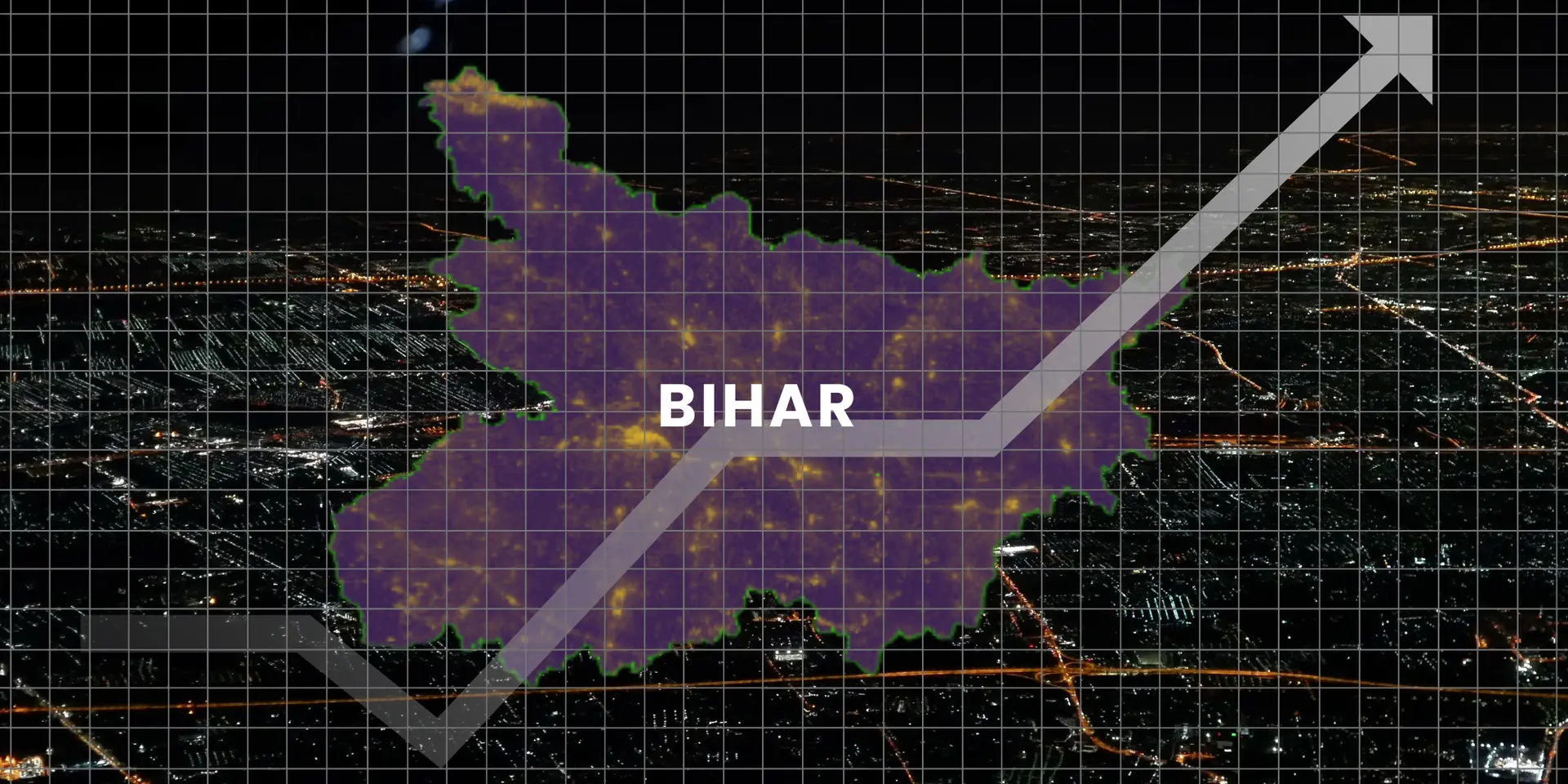

Bihar, once dismissed as a laggard in industrial development, is now drawing attention for an unconventional but globally recognised measure of progress: night-time satellite lights.
A recent study by the Department of Industries, Bihar, in collaboration with the Asian Development Research Institute (ADRI), shows how satellite imagery of night-time light intensity (NTL) is being used to track economic activity, poverty reduction, and urbanisation across the state.
Measuring Growth Through Light
For decades, electricity coverage and industrial presence in Bihar were minimal, leaving many districts in what researchers called a "dark zone." Today, however, satellite images from 2017 to 2023 reveal a rapid surge in luminosity across the state. Night-time lights, economists argue, act as a reliable proxy for GDP growth, consumption patterns, and economic vibrancy—especially in areas where conventional data is scarce or delayed.
The study found that Patna, Vaishali, Muzaffarpur, Gaya, and Begusarai recorded the fastest growth in illumination, while Arwal, Jehanabad, Jamui, Banka, and Madhubani emerged as promising new centres of economic activity.
Key Sectors Driving Growth
The findings underline how Bihar’s growth is being driven by a mix of traditional and modern sectors. Blocks such as Bihta, Sonepur, Mushahari, and Bidupur showed significant increases in light intensity, linked to expansion in:
- Construction and real estate: New housing and commercial spaces contributed to rising luminosity.
- Agriculture and food processing: Bihar’s shift towards agri-based industries has illuminated previously rural pockets.
- Transportation and logistics: Better connectivity has supported night-time economic activity.
- Healthcare and education: Growth in private healthcare facilities and educational hubs is reflected in light density.
- Small businesses and retail: The role of unorganised and SME segments remains pivotal in generating new jobs.
Prerequisites For Sustained Growth
While rising luminosity signals economic momentum, the report highlights conditions that must be sustained:
- Reliable electricity supply to rural and semi-urban areas.
- Investment in transportation and warehousing infrastructure.
- Support for SMEs and agri-based industries through credit and subsidies.
- Encouragement of start-ups, especially in IT/ITeS and e-commerce
Barriers to Inclusive Growth
The study also pointed to barriers that could slow progress. It highlighted uneven regional growth, with some districts still far less illuminated than others. A heavy dependence on informal sectors was noted, as much of the activity continues to come from unorganised businesses. Concerns were also raised about job quality, since high employment growth in SMEs and start-ups often brings instability. Moreover, an urban-rural divide persists, with major gains concentrated in Patna and tier-2 districts.

A New Development Narrative
The most striking finding is that Bihar’s economic rise is being captured from space. Patna recorded a 531% increase in night-time illumination, while districts once deemed economically stagnant—like Arwal and Jamui—showed unprecedented jumps in luminosity. Experts note that more than 51% of employment in Patna is now driven by start-ups, while Muzaffarpur, Begusarai, and Gaya are emerging as hubs of innovation.
Night-time light studies, widely used by global institutions, are now offering Bihar a new narrative: a state steadily moving from "darkness" to becoming one of India’s fastest-growing regional economies.