



How a Bengaluru startup is reimagining customer conversations with AI
With partnerships with Meta and Google, and a new push into voice AI, Engati is betting big on turning digital campaigns into dialogue-led sales engines.


When people click on an online ad, they are usually taken to a static landing page filled with text and menus. Most of them just drop off without finding what they need. set out to solve this problem by replacing static pages with conversational AI agents that guide users, answer questions, and handle objections, turning interest into real sales.
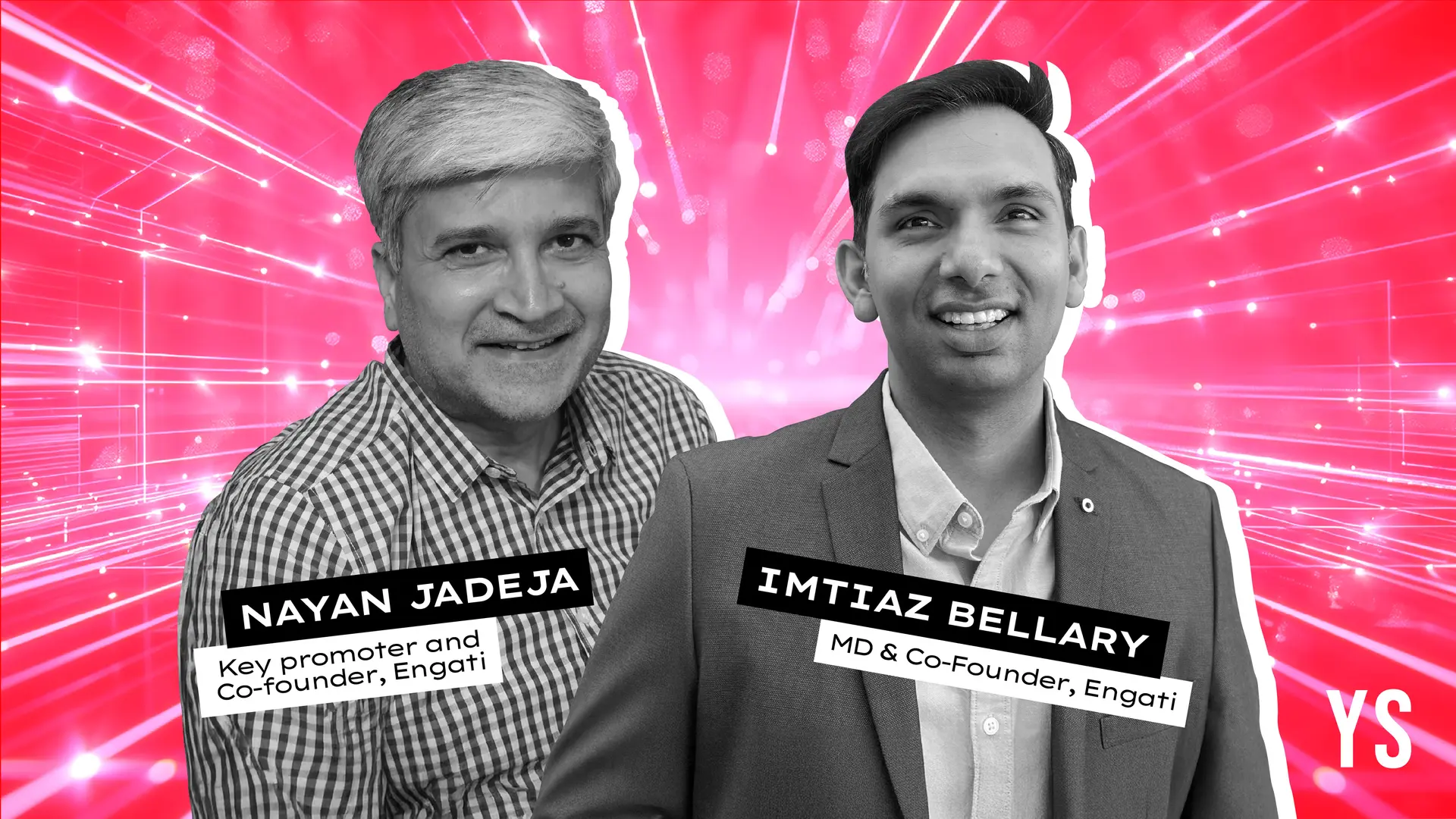
Following the recognition of the need for conversational AI, Engati was founded in Bengaluru in 2021, led by Imtiaz Bellary and Nayan Jadeja. “We turn digital campaigns into conversations that help brands convert interest into sales,” Bellary says.
Bellary, an IIM Kozhikode graduate, began as a founding engineer at SaaS startup MaaS360, which was acquired by IBM. After a stint at Hindustan Unilever, he rejoined MaaS360 in 2015 and worked at IBM until 2018. He started exploring conversational engagement as AI and chatbots gained momentum, which led to the launch of Engati in January 2021 after COVID-19 delays.
Building for conversations, not clicks
The core problem Engati set out to solve was the lack of easy-to-build, multilingual chatbots for businesses. It began as a no-code/low-code platform that allowed companies to create and deploy chatbots across web, mobile, and messaging apps.
Bellary and his team soon realised that businesses wanted more. “Although it was a low-code, no-code platform, many people wanted us to build it for them,” he says. Over time, the company pivoted toward custom AI sales agents that handle not just conversations, but also customer acquisition, qualification, and objection handling processes.
Engati’s main product is Agentic AI, built for high-value sectors like real estate, automobiles, education, healthcare, hospitality, and financial services. It also offers Flow AI for automated customer journeys and Gen AI for general conversations. These tools connect with WhatsApp, Instagram, and Google RCS to help brands capture leads and turn them into customers.
In July, Engati partnered with Meta to launch WhatsApp Voice, allowing businesses to talk to users in local languages anytime. Early results showed strong gains, with conversions improving 1.24× through voice plus text and up to 4× on WhatsApp. The company also recently piloted these WhatsApp Voice agents, reporting up to 24% higher conversions for clients such as Amity Online, Bellary says.
Customers and traction
Engati is working with 850 B2B active clients, of which about 100 are large enterprise customers. Clients include UpGrad, Amity University Online, Aster Hospitals, Dr Agarwal’s Eye Hospital, PhysicsWallah, Edelweiss Mutual Fund, Bandhan Life, and Hyatt Hotels, among others.
“Working with Engati has been seamless. Their team brings unmatched responsiveness and solutioning depth, while the platform offers the flexibility and reliability we need to drive our AI-led customer engagement goals,” says Gaurang T, Head Digital Marketing and E-sales, Royal Sundaram General Insurance, one of Engati’s clients.
Early adoption also came from the Middle East, where Engati worked with government agencies like the Federal Electricity and Water Authority of Dubai. “This is our first customer through a partner in Dubai,” Bellary tells YourStory.
Engati operates across India and the Middle East, with some deployments in the US, Europe, and South Africa. It employs around 60 people, with a 25-member tech team and a 15-member solutions team that works closely with clients. “We are very focused on goal-based outcomes,” says Bellary. “If the goal is to improve conversions, we work with you to achieve that. That is how we differentiate.”

Revenue and business model
Engati follows a SaaS subscription model. “We charge a subscription fee, along with a usage fee per active user engaging with the AI agent,” Bellary says. For enterprise customers, annual pricing starts at Rs 4 lakh per year, with an additional Rs 2 per monthly active user.
This model gives Engati steady recurring revenue while scaling with client usage. The company is completely bootstrapped; it has managed this growth without external funding so far. “We are comfortable for now, but will consider raising funds next year,” Bellary says.
Competition and differentiation
In the crowded conversational AI market, Engati faces competition from companies like Yellow.ai and Sarvam.ai, but Bellary believes their specific focus gives Engati an edge. “Most product companies are focused only on enablement. We are focused on making acquisitions and revenue better,” he says.
The company’s vertical expertise in healthcare, education, and financial services has helped it fine-tune its AI models for real-world use cases.
Unlike others, Engati builds small domain-specific language models in-house, customised for customer needs. Its Agentic AI stack is developed internally, using open-source frameworks that the team has customised for acquisition-focused use cases. Engati also keeps the platform flexible by integrating with external LLMs like OpenAI and Google’s Gemini, as well as speech models from ElevenLabs, depending on client preference.
Like many Indian SaaS startups, Engati first faced scepticism. “Customers here often expect things for free or with some jugaad,” Bellary says. To build trust, the team offered small POCs before full deployments. Another challenge was the lack of value placed on intellectual property, which meant Engati had to prove its edge through results.

Market and the road ahead
According to the Grand View Research Report, the global conversational AI market was estimated to be around $11.6 billion in 2024, and is on track to grow to approximately $14.3 billion in 2025, with forecasts projecting it to reach $41.4 billion by 2030, a compound annual growth rate of about 23.7%. “Our share right now is less than 1%,” Bellary says. “But in the next two to three years, we aim to increase that to 2–3%.”
Partnerships are central to Engati’s growth story. After joining hands with Meta and launching its collaboration with Google on September 1, the company is now preparing to work with Microsoft.
Engati is also planning to expand beyond India, with the Middle East, the US, and Western Europe as its primary targets. “We have built a pipeline of 200- 250 enterprise customers in India and are replicating the same in Dubai and Saudi Arabia,” Bellary says.