



How increasing tax on addictions works in other countries but not in India?
India’s sin taxes on alcohol and tobacco haven’t curbed addictions—instead, spending has soared. Discover why global tax models succeed but India’s fails, and what needs to change.

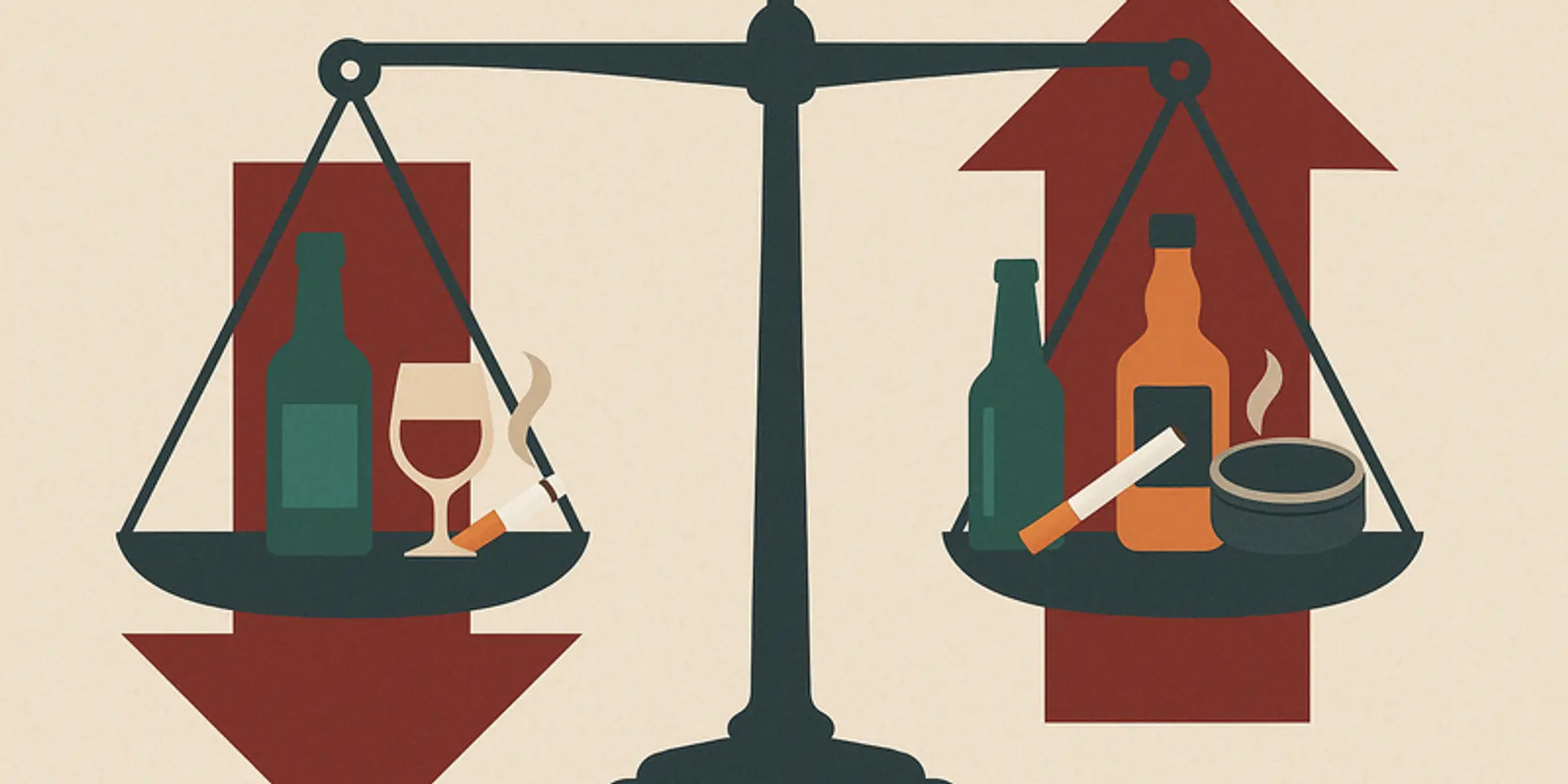

India followed the classic “sin-tax” playbook—raise prices steeply on alcohol and tobacco to curb use. Yet a decade later, households are spending more on these products. Fresh consumption-expenditure data show that monthly per-person spending on paan, tobacco & intoxicants has climbed to Rs 143 in rural India and Rs 157 in urban India, with budget shares rising to 3.79% (rural) and 2.43% (urban)—up from 2011–12 levels. In fact, on average, Indians now spend more on intoxicants than on education per capita.
Why does the same tax lever that helped countries like Australia and the Philippines move the needle falter in India? The short answer: loopholes, substitution, and a giant informal market—all compounded by state revenue incentives.
What “works” abroad: high tax + airtight design + ring-fenced health spends
Australia pairs frequent excise hikes with plain packaging and tough enforcement. Daily smoking among 14+ has fallen to 8.3% (2022–23)—a modern low—with “too expensive” cited widely as a quit reason. That’s taxes doing their job.
The Philippines’ 2012 Sin Tax Reform simplified tiers, pushed up excise on tobacco and alcohol, and earmarked revenue for universal health coverage, leading to big budget gains and measurable drops in smoking. Multiple assessments show prevalence fell after the reform, while health budgets swelled. That’s design plus destination (of funds).
The principle: make products less affordable in real terms, close evasion doors, and reinvest proceeds in cessation and public health.
India’s reality check: why heavy taxation hasn’t hit the habit
1) Tax design leaves escape hatches
- Not meeting the WHO’s tax-share bar. WHO recommends that taxes account for at least 75% of the retail price of tobacco. India falls short overall, and the gap is stark for products popular with the poor.
- Bidi exception weakens impact. Research shows many bidis escape full duty; under GST, some duty-exempt bidis effectively face pennies per pack in tax, inviting down-trading from costlier cigarettes.
- Fragmented alcohol regime. Alcohol taxation is state-controlled and fiscally precious: state excise is the third-largest own-tax source, averaging ~13–14% of states’ own tax revenue. This dependence makes sweeping, health-first price hikes politically tough.
2) People don’t just quit; they switch
When one product gets pricey, consumers pivot to another: cigarettes → bidis or smokeless tobacco; IMFL/beer → country liquor. Indian studies show price elasticities vary (bidis and SLT are more price-responsive than cigarettes), and cross-price effects confirm substitution. Net effect: tax a single product hard, and consumption migrates, not disappears.
3) A vast unrecorded/illicit market soaks up demand
- Alcohol: A large share of consumption is unrecorded (home-brewed/illicit), diluting tax policy impact and sometimes causing tragic safety incidents. Global evidence pegs unrecorded alcohol at ~one-quarter of consumption, with India’s share historically much higher.
- Tobacco: Industry claims of huge illicit cigarette shares are contested. Independent retail-pack studies in Indian cities estimate ~3% illicit share—far lower than lobby figures—yet any leakage still blunts tax effects. Bottom line: enforcement and track-and-trace matter as much as rates.
4) Affordability hasn’t fallen enough, especially for the better-off
Addiction has low price elasticity. For alcohol in India, estimates range from about –0.14 (spirits) to –0.44 (country liquor)—so consumption drops less than prices rise. As incomes rise, products can remain affordable despite tax increases, unless taxes escalate and are indexed to income/inflation.
The data behind the spend: a few grounding facts
- Budget shares rising: HCES 2022–23 shows bigger slices of household budgets going to paan, tobacco & intoxicants versus 2011–12, in both rural and urban India. Rural/urban monthly spend: Rs 143/ Rs 157 per person.
- WHO’s 75% rule: India’s tobacco taxes don’t yet hit the WHO-recommended share of retail price; for some forms like bidis, the gap is striking.
- States rely on alcohol excise: On average, alcohol excise contributes ~13–14% of states’ own tax revenue—creating a tension between health and revenue goals.
So, what would make sin taxes bite in India?
- Go product-neutral and close differentials: Tax all tobacco forms (cigarettes, bidis, SLT) at health-aligned levels to prevent switching. For tobacco, move toward a uniform, specific excise (not length- or filter-based) that’s indexed to inflation and income growth.
- Lift the tax share to WHO’s benchmark—and keep lifting: Restructure to ensure ≥75% of the retail price is tax for every tobacco product. For alcohol, peg floor prices/excises to minimum unit pricing logic to curb ultra-cheap, high-risk products.
- Shrink the shadow market: Implement robust track-and-trace, tighten border checks, and standardise pack-level tax verification across states. (Taxes without enforcement just invite arbitrage.)
- Ring-fence revenue for treatment & prevention: Hypothecate a visible share of tobacco/alcohol taxes to cessation services, de-addiction, and risk-communication—the Philippines’ experience shows earmarking builds public support and health impact.
- Tackle affordability head-on: Index excises annually to inflation + income growth so products become less affordable over time. Pair with plain packaging, advertising bans, and cessation access, so price is one of several aligned nudges.
- Mind the states’ fiscal bind: For alcohol, offer compensatory grants or shared health-earmarking so states can sustain higher taxes without fearing revenue shocks. Evidence suggests price alone won’t move alcohol use much; combine with availability controls, DUI enforcement, and targeted harm-reduction.
The bottom line
Taxes can be effective—but only when designed carefully and enforced rigorously. India’s current system leaves too many loopholes, with cheaper substitutes and informal channels readily available, making consumers more likely to switch products rather than quit altogether. The solution lies in making all sin goods uniformly expensive, cutting off the shadow market, and using the revenue to support quitting programs. That’s how the same strategy that succeeds abroad can finally work here too.