



From clinics to farms: How Indian startups are putting AI to work where it matters the most
In the run-up to TechSparks 2025, where AI takes centre-stage, we look at how Indian startups are democratising AI access in the country, marking a presence in everyday realities.

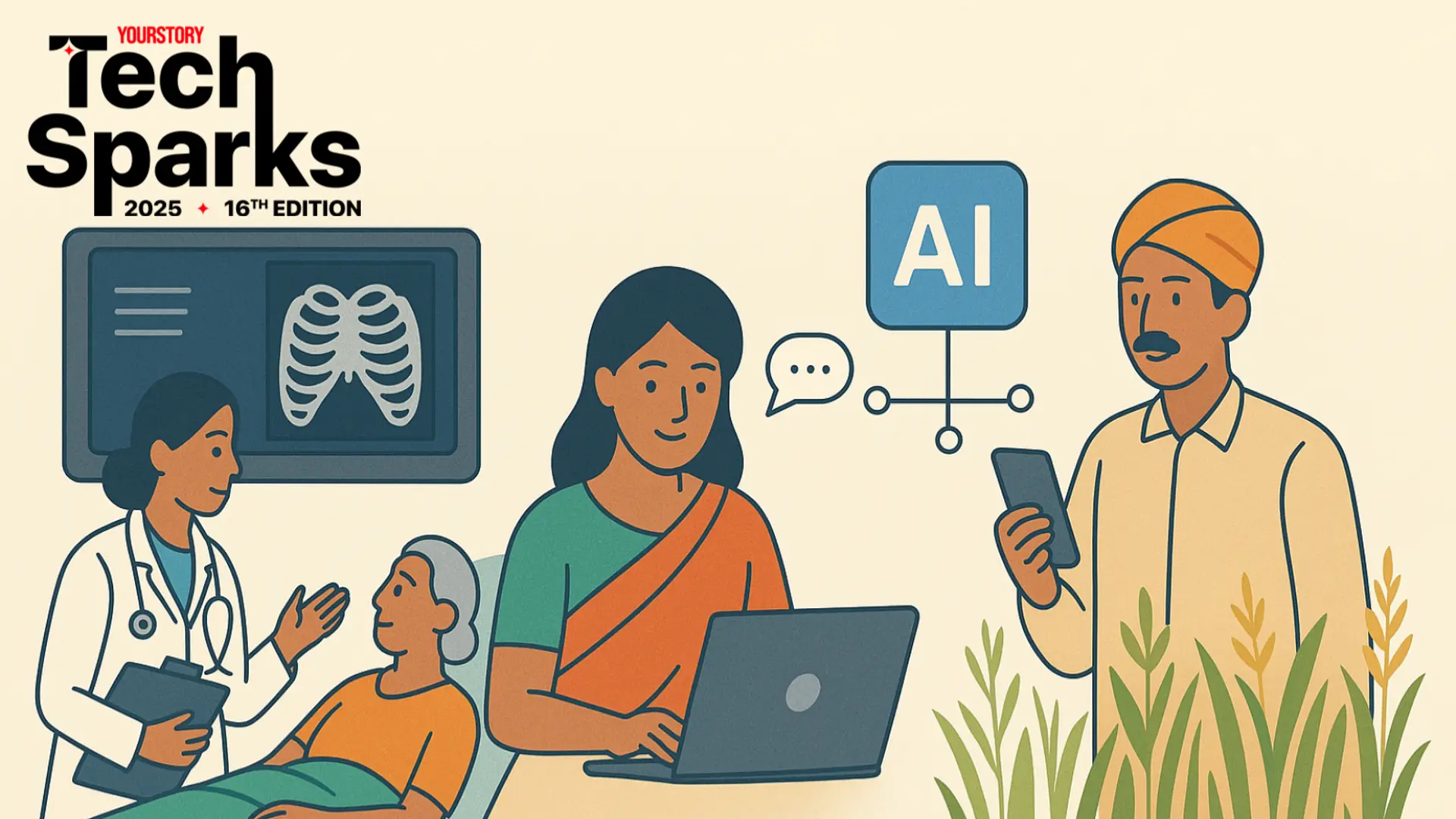

Beyond valuations and the global LLM (large language model) race, AI is making its presence felt in the quieter corners of the country: in an overworked clinic with no radiologist, and among farmers who need timely crop advice and rural communities who earn a fair income by annotating datasets.
Democratising AI is not about building bigger resource-intensive models but is about ensuring technology aids people in their own language, even on low-end devices, thus helping them earn a livelihood. This approach offers an inclusive and practical vision for AI, ensuring applications tailored to serve under-served communities.
AI is expected to play a central role in India achieving a $10-trillion economy by 2030, potentially adding $1.5 trillion to the country’s GDP and powering the domestic market beyond $17 billion by 2027. The true test along this journey will be AI’s ability to spread beyond boardrooms and labs to the people who need it the most.
The upcoming edition of TechSparks, YourStory’s flagship tech-startup conference, will turn the spotlight on the transformations AI promises to bring. In the run-up to TechSparks 2025, themed ‘India 2030: Powered by AI’, we look at five startups showing what that AI democratisation looks like on the ground.
Qure.ai: Diagnostics where radiologists are scarce
India accounts for a significant portion of the world’s tuberculosis cases, yet the country has very few radiologists. Qure.ai steps in to address this gap. The startup uses deep learning to interpret chest X-rays and CT scans for TB, lung cancer, stroke, and other conditions.
Its algorithms, cited in international guidance on AI-assisted screening, have screened over 12 million patients across more than 100 countries. In India, Qure’s qXR tool supports the National TB Elimination Programme, flagging suspected TB in minutes and reducing diagnostic delays. Mobile van deployments take this capability to rural and underserved regions, bypassing the shortage of specialists.
Beyond TB, Qure’s qER algorithm also helps emergency rooms triage stroke and head injury cases, enabling faster treatment decisions.
By extending scarce diagnostic capacity into resource-poor settings, Qure.ai illustrates how AI can be a true force multiplier for public health, and not just a tool for urban hospitals.
KissanAI: Giving farmers a voice in the AI era
About 45% of India’s workforce is engaged in agriculture, yet most farmers operate on small plots of less than two hectares with limited access to expert advice. For many, even basic information related to weather or markets arrives too late or in a language they cannot comprehend.
KissanAI addresses this gap with a voice-first AI assistant that delivers farm advice in local languages, allowing farmers to make queries in their language rather than rely on English-based apps.
Built on LLMs tuned for agriculture, the platform provides timely guidance on sowing, pest management, fertiliser use, and pricing, tailored to the farmer’s crop and region. Its design for low-literacy users and low-end devices makes it especially relevant in rural India, where smartphone penetration outpaces digital literacy.
By putting conversational AI directly into farmers’ hands, KissanAI democratises access to agronomic expertise once concentrated in research institutes and agri-businesses.
Karya: Democratising AI through fair-wage data work
Most of the world’s AI models are trained on English-language data, leaving large segments of India under-represented in training data. Karya is trying to fix this imbalance by employing rural Indians to create and annotate multilingual data, including audio clips and text translations, across India’s diverse languages.
Crucially, it pays them up to 20 times the local minimum wage, turning data work into a dignified livelihood. With more than 50,000 workers engaged across 24 states, Karya’s datasets are now used by global tech firms to train their language models.
Karya’s contribution to democratisation is twofold: it makes AI more representative of Indian voices and ensures that marginalised communities earn a share in the economic value of building it.
CoRover: bringing AI assistants to billions of citizens
In India, the true barrier to AI adoption is often not a lack of awareness, but a lack of adequate infrastructure. A significant portion of the country's population still relies on entry-level devices with limited processing power. Furthermore, despite rapid growth in internet access, rural broadband and last-mile connectivity remain patchy for millions.
CoRover’s BharatGPT tackles this challenge head-on by offering conversational AI that can operate offline on low-end devices, an innovation in a space dominated by cloud-reliant models. Supporting over a dozen Indian languages, it has been integrated into citizen-facing services at massive scale. Its chatbot for Indian Railways alone serves millions of passengers daily, while deployments in banking and government services have powered over a billion user interactions.
By designing for the lowest common denominator of infrastructure rather than the highest, CoRover extends AI access from urban professionals to everyday citizens across India.
Sarvam AI: building India-centric foundation models
The debate over AI sovereignty is no longer abstract. Most used LLMs are developed in the United States or China, trained primarily in English, and accessed through expensive cloud APIs.
Sarvam AI, founded by ex-Microsoft researchers, is among the first Indian startups attempting to change this by building India-first foundational models. It offers a different path: India-first, India-hosted, and India-affordable. It was selected under the IndiaAI Mission and granted substantial GPU compute and support to develop a sovereign LLM. Sarvam is now building a family of multilingual models, including ‘Large’ for complex tasks, ‘Small’ for real-time apps, and ‘Edge’ for on-device use, tuned for voice and reasoning across multiple Indian languages.
With plans to open-source its sovereign models, Sarvam aims to make India’s AI both accessible and relevant for its users, many of whom speak little or no English.
The wider ecosystem
Beyond these five, there are many Indian startups pushing AI into everyday contexts. For instance, Reverie builds the language infrastructure that underpins digital services in local languages. Uniphore, Yellow.ai, Haptik and Gnani.ai have scaled conversational AI in customer service, making automation accessible across industries.
In healthcare, SigTuple applies AI to laboratory diagnostics. Entri makes education and job preparation available in vernacular languages, and Toonsutra is exploring AI-driven storytelling for younger audiences.
Together, these ventures, and many more, fill vital gaps, showing that democratising AI in India is less about one breakthrough and more about a constellation of concerted efforts across languages, sectors and geographies.
Learn about more such efforts at TechSparks 2025, where builders, researchers, regulators, and investors come together to chart India’s AI future.
Edited by Swetha Kannan