



Fintech execs at GFF say India’s next payments challenge is reliability, not scale
PhonePe’s Sameer Nigam and Razorpay’s Shashank Kumar said India’s payments system must function like an electricity grid — always on, resilient, and affordable — backed by rigorous testing, surplus capacity, and complete control over infrastructure.

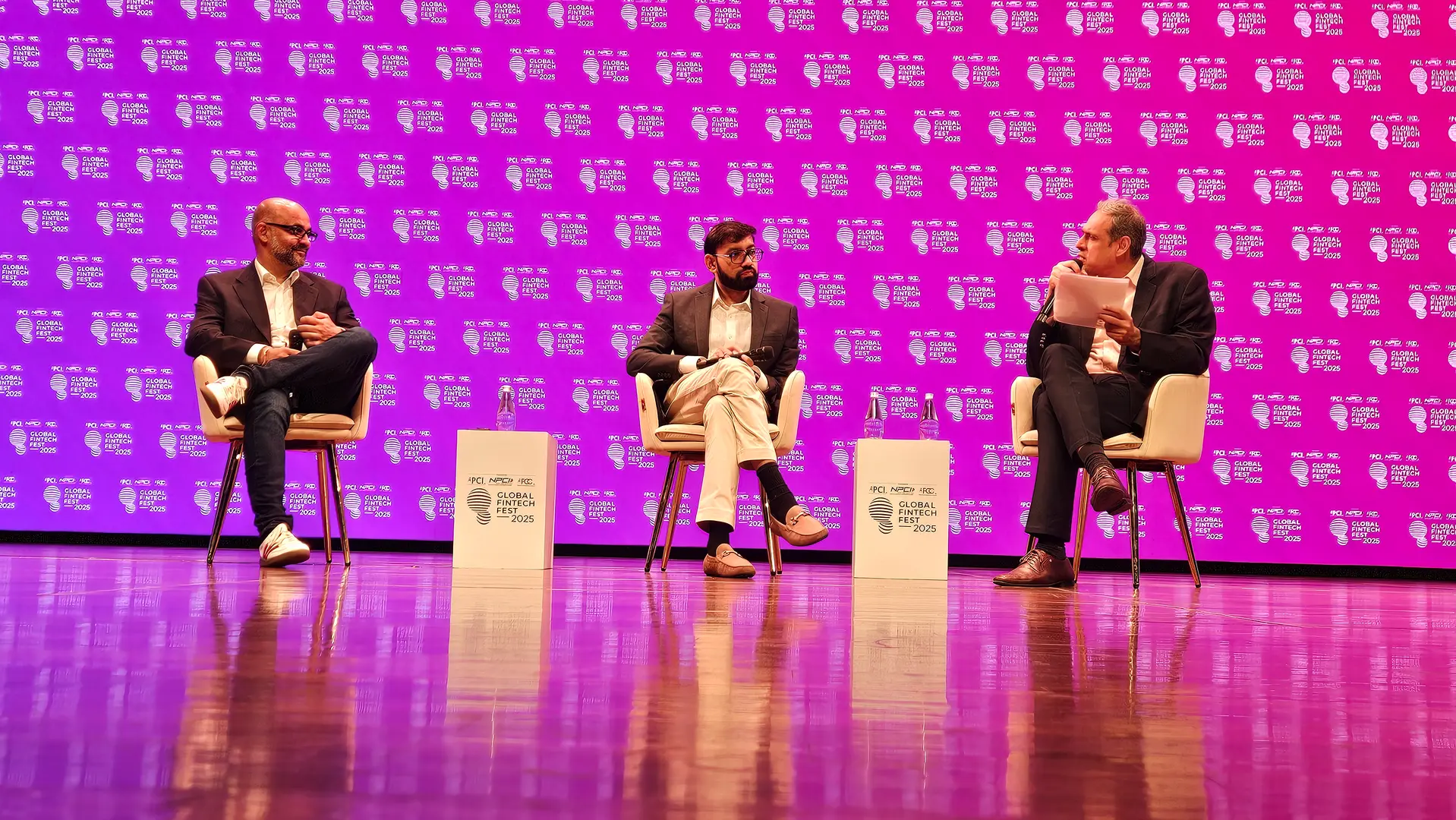

As digital payments become a daily habit across India, the country’s fintech leaders say the real challenge is no longer adoption or scale, but reliability. In a system now processing more than 18 billion transactions a month, payments have to function with the dependability of electricity or water — always on, always available.
At a panel titled “Always-On India: Keeping the World’s Largest Payments System Running at Scale” at the Global Fintech Festival in Mumbai, PhonePe CEO Sameer Nigam, Razorpay co-founder Shashank Kumar, and Nitin Mishra from the National Payments Corporation of India (NPCI) discussed how India’s payments infrastructure has evolved into one of the world’s most resilient real-time networks — and how it must keep adapting to sustain that reliability.
Nigam said the guiding philosophy at PhonePe was to treat payments as a public-scale utility. “We built and managed our own data centres from day one,” he said. “It’s easy to rely on cloud services, but if you want industrial-strength infrastructure, you need complete control. Payments are now utilities — people expect them never to go down.”
He explained that PhonePe’s approach to scale involves a shared architecture: multiple business lines — from lending and insurance to brokerage — all operate on the same underlying infrastructure, with accounting, compliance, and security layers reused across divisions. “You can scale one accounting stack with local variations rather than rebuild it every time,” he said, adding that real-time data systems near the edge have become critical for speed and stability.
Razorpay’s Kumar said the company’s focus was on continuous evolution — improving capacity and resilience even as the system handles rising volumes. “It’s like changing parts of a plane while it’s in flight,” he said. “We test for every scenario — bringing components down, simulating attacks, checking how the system behaves. Five years ago, our uptime was 99.3%. Today, it’s above four times. The platform can’t go down for more than a few minutes a year.”
Both founders agreed that outages are inevitable in such complex systems, but the key lies in preparedness and learning. “You can make a thousand mistakes once, but you can’t repeat the same mistake twice,” Nigam said. Rapid detection and isolation, he added, are essential to prevent small issues from escalating into full-scale failures.
Kumar said operational discipline and clear communication during incidents are equally important. “If something breaks, the customer should immediately know which payment option is affected,” he said. “Transparency preserves trust.”
Managing unpredictable transaction spikes — triggered by e-commerce sales or government announcements — also remains a critical challenge. Nigam said that at current volumes, even a 20% surge means handling an additional 70 million transactions a day. “At population scale, you can’t compromise on surplus capacity,” he said. “If payments fail at peak, you lose the trust that took years to build.”
Kumar added that availability always outweighs cost considerations. “There’s never a scenario where you optimise cost at the expense of uptime,” he said, pointing out that India consistently operates some of the world’s most efficient, low-cost digital infrastructures. “The challenge is to keep innovating for an emerging economy — to run world-class systems at Indian cost levels.”
Looking ahead, Nigam said India’s digital public infrastructure (DPI) model — which underpins UPI, Aadhaar, and other systems — has captured global attention, but replication elsewhere will depend on local economic and regulatory realities. “UPI-like networks may not work in purely capitalist markets where zero-cost transactions break business models,” he said. “But India’s experience shows what’s possible when innovation and public policy move together.”
Both leaders agreed that India’s payments grid has become too deeply embedded in everyday life to fail. The goal, they said, is no longer just enabling billions of payments — but ensuring every single one succeeds, instantly and without interruption.
Edited by Jyoti Narayan