



How Weya AI is reimagining enterprise customer support through voice-first AI agents
The startup’s voice-first AI agents remember conversations, follow up across channels, and help banks close leads faster.

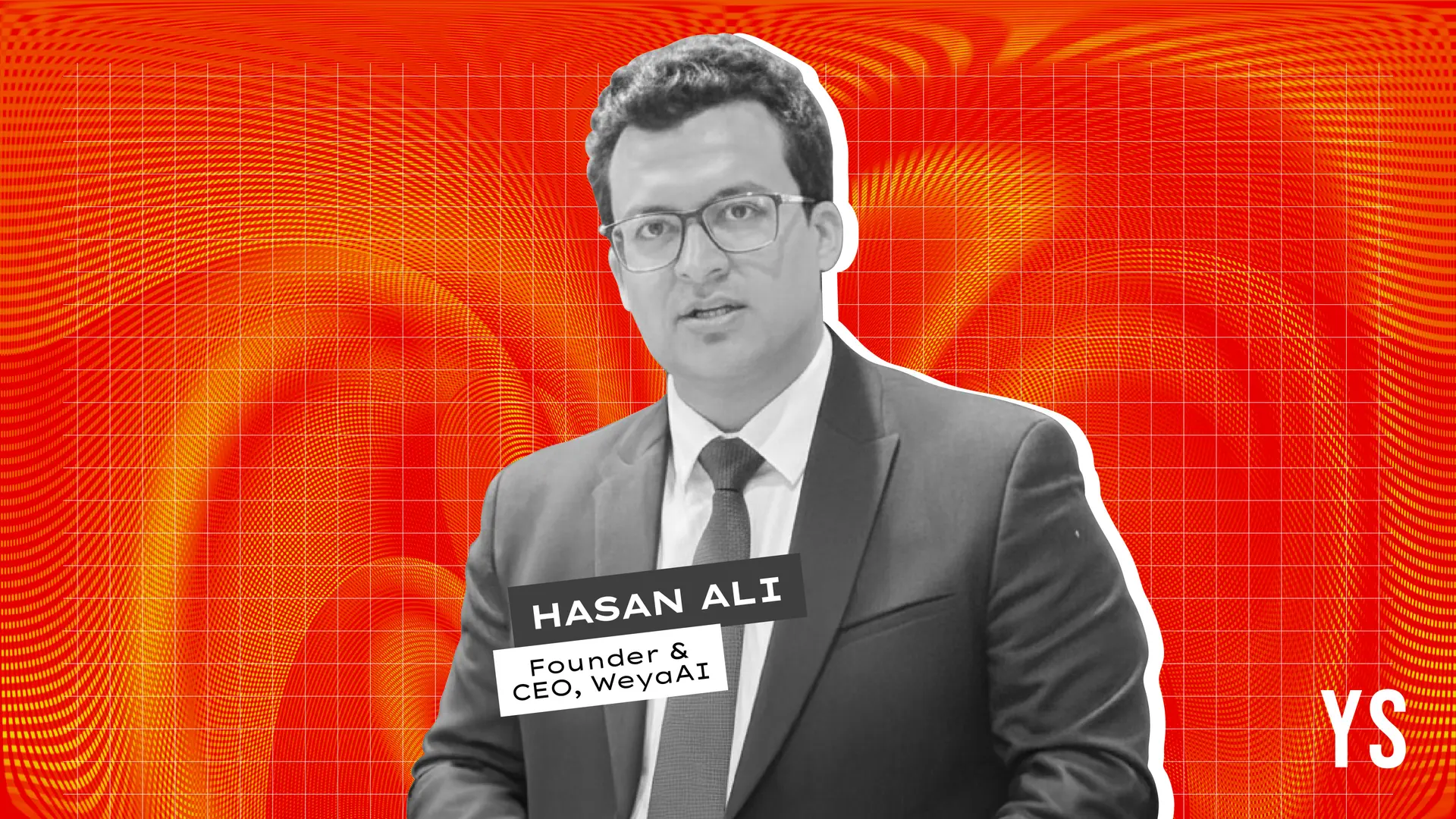

Imagine calling your bank’s customer care line and, instead of waiting endlessly on hold, an AI instantly answers your query, recalls your last conversation, and even follows up on WhatsApp if the line drops. This is what Weya AI, a Noida-based conversational AI startup, is building today.
Founded in December 2024 by Hasan Ali, Founder and CEO, along with his college friends, Atul Singh and Himanshu Tiwari, WeyaAI developed intelligent, memory-driven agents that handle customer interactions across voice, WhatsApp, and email.
“We wanted to create an AI that behaves like a human, one that remembers your preferences and conversations,” says Ali. “If you call your bank today and it gets disconnected, you have to explain your problem again. Our AI remembers the context, continues the conversation, and personalises every interaction.”
Before starting Weya AI, Ali ran Pulp Vision, an AI consultancy founded in 2018, where he says he built and sold AI products for global clients. In 2022, the venture was acquired by a Brazilian company. That experience gave him a clear understanding of how AI can solve real business problems and how to build technology that works at scale.
The idea for Weya AI came when Ali was at a gym. His friend, who worked in an electricity department, complained about endless calls from people asking when power would return. That’s when Ali thought, what if AI could handle those calls like a human? What started as a casual thought soon grew into an enterprise AI platform now transforming customer support and lead management for large industries.
Powering the BFSI ecosystem
Weya AI focuses mainly on the BFSI sector, serving banks, NBFCs, and fintechs where customer communication is crucial. In under a year, it has partnered with major clients like Kotak Mahindra Bank, TVS Motors, and Cars24 Australia, and is now looking to expand globally.
The startup onboarded Rupee112, a Gurugram-based NBFC, as its first client in its first month. “We only had an early version then, but they believed in us and stayed,” says Ali. The success of that pilot helped Weya AI win more BFSI clients.
Banks often miss leads due to slow follow-ups. “If a loan query isn’t answered quickly, the chance is gone,” Ali says.
Weya connects directly with clients’ CRMs to make real-time calls and follow-ups. Its memory layer remembers past interactions across calls, WhatsApp, or email. The platform currently supports 10 Indian languages and 26 global languages for clients in the UAE, Australia, Indonesia, and the US.
Building a homegrown conversational AI stack
Unlike many AI startups that depend on external APIs, Weya AI has built its technology completely in-house. Its proprietary stack includes SLMs (Small Language Models) fine-tuned for BFSI use cases and TTS (text-to-speech) systems that enable natural, human-like conversations.
“Large language models are too generic for banking. We build smaller, faster models for BFSI, ensuring accuracy and reliability,” Ali says.
The platform’s memory layer keeps conversations seamless across calls, WhatsApp, and email, enabling what Weya calls a “truly omnichannel conversation,” which Ali says is the “heart of our technology".

Business model and growth
Weya AI follows a SaaS-based B2B model, offering two pricing options: pay-as-you-go, where clients are billed per usage minute, and enterprise plans, which combine a one-time setup cost with a monthly subscription. On average, enterprise clients typically spend Rs 3-4 lakh per month, with top-tier clients paying up to Rs 25 lakh.
In just 10 months of operation, Ali claimed that the startup is 100% month-on-month growth, backed by a mix of Indian and international clients. Weya’s partnership with ISON, a Dubai-based call centre network, is helping it automate frontline calls in the MENA region (Middle East and North Africa), reducing human workload by up to 80%.
The 11-member team, all based in Noida, plans to open a Mumbai office by February 2026 to stay closer to its BFSI clients.

Competing through vertical focus
The conversational AI market is heating up, with global players like Decagon (US), Lori Keet (Australia), and India’s Gnani AI exploring similar territory. Waya says its focus remains laser-sharp.
“Most global competitors serve all sectors. We focus deeply on BFSI to solve problems others miss and be the preferred AI partner for banks,” says Ali.
Ali believes the biggest challenges have been earning trust by making the AI feel reliable enough for banks to depend on, and convincing big clients to adopt it through proof and consistent results. “Getting Kotak Bank onboard was one of our toughest challenges,” Ali adds. “Banks are sceptical, and rightfully so. Building trust takes proof, not promises.”
Funding and future plans
Weya AI is completely bootstrapped, having raised a friends-and-family round of about Rs 60 lakh earlier this year. The company is now in talks to raise its first round by December 2025 to strengthen its presence across APAC (Asia-Pacific) and the Middle East.
“Most investors we speak with see the potential in enterprise-grade AI that’s not just smart but stable,” Ali says. “We’ve proven early traction; now it’s about scaling globally.”
On the product front, it’s gearing up to launch ‘Workflows’, an automation suite designed to handle end-to-end banking use cases, from onboarding and verification to post-loan support.
According to the Dimension Market Research report, the agentic AI market is estimated to be worth around $7 billion in 2025 and is expected to grow rapidly to over $93 billion by 2032, with a CAGR of about 44.6%. Riding this wave, Weya plans to triple its current $500,000 global pipeline over the next six months, adding new BFSI clients in Southeast Asia and expanding into mid-market financial institutions in Australia.
Edited by Affirunisa Kankudti