



How can India build its own global smartphone brand? Madhav Sheth of Ai+ Smartphone breaks it down
In this Prime Venture Partners Podcast episode, host Amit Somani sits down with Madhav Sheth, CEO Ai+ Smartphone and Founder of Nxtquantum Shift Technologies, the visionary who turned Realme into a $15B global brand. He is now on a mission to build India’s next-generation smartphone company.

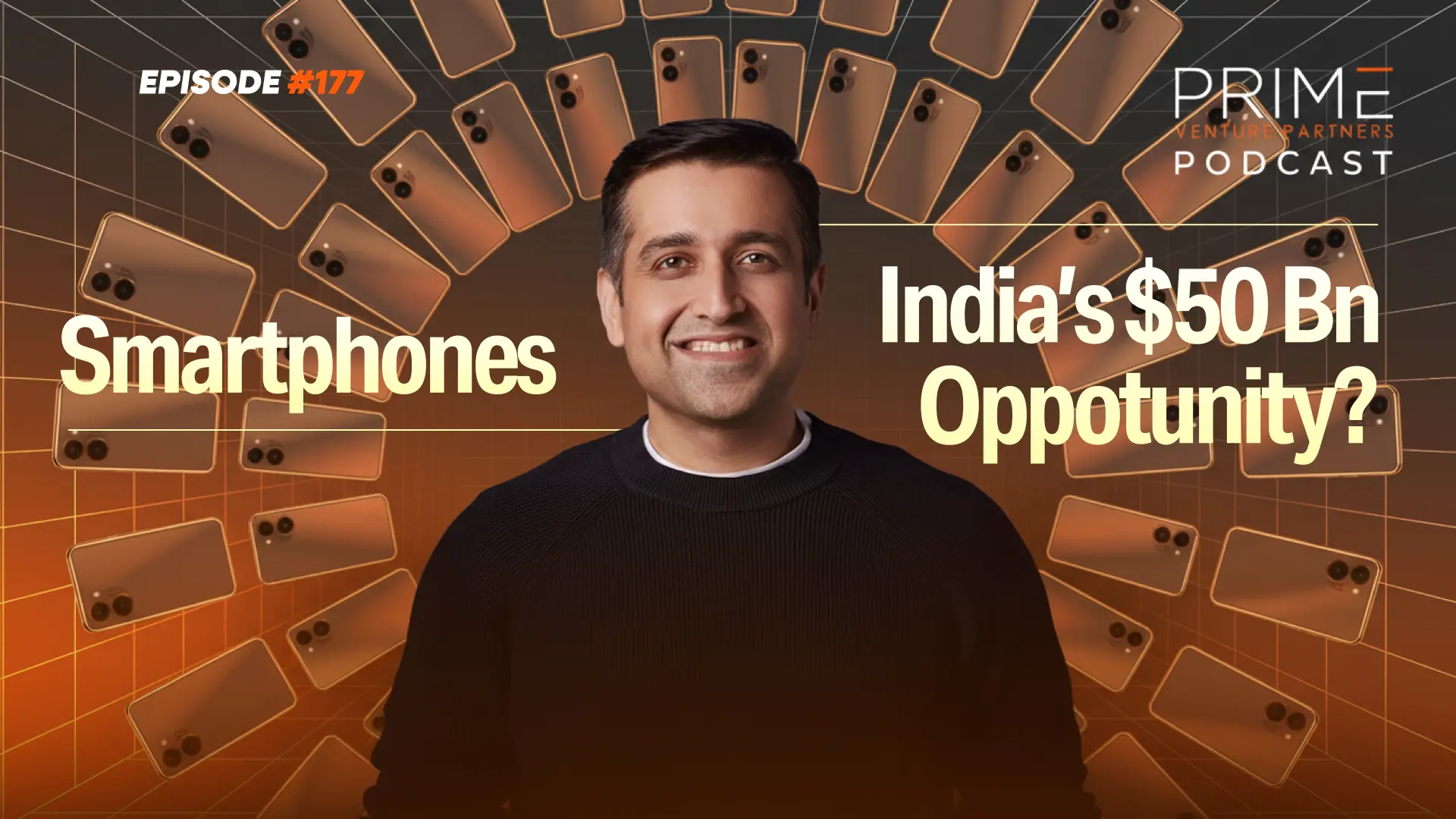

This episode goes beyond product talk. It’s about what it takes to build scale in a market dominated by global giants, and how India can finally create a world-class smartphone brand of its own.
From humble beginnings to India’s smartphone leader
“I’ve grown up in a very humble background, my dad was a banker with strong value systems around finance,” recalls Madhav Sheth, CEO Ai+ Smartphone and Founder of Nxtquantum Shift Technologies.
“I’ve always been a tech enthusiast, and I’ve been in the mobile industry for more than two and a half decades.”
Sheth began his journey in the late 1990s selling prepaid recharges and feature phones. That ground-level understanding became foundational when he later helped build Realme from scratch: from naming to brand creation and scaling it to a $15-billion brand in just three and a half years.
In 2023, Sheth left Realme to start something of his own. The trigger was simple: “Eighty per cent of the industry is dominated by Chinese smartphone brands. Out of a $45 billion–50 billion market, Indian brands have less than 0.5% share. There’s a huge digital divide, we still add about 50 million 2G users every year. If India wants to be a digital economy, we can’t leave those users behind.”
The misunderstood Indian consumer
According to Sheth, the biggest misread by global brands is how they perceive the Indian market. “India has the youngest population in the world,” he says. “The average age is 27 to 29 compared to 40 in China and 49 in Japan. That means our consumers are the most demanding consumers in the world.”
But this demand doesn’t mean cheap products. “Indian consumers are value conscious, not price conscious. They want the best device at the right price, not the cheapest one. Many global brands don’t understand that.”
He illustrates this with a simple example: “A gamer who wanted 120 fps used to spend ₹25,000. Now, they can get that experience for ₹10,000–₹15,000. They’ll buy that device because it delivers value. They don’t care about specs alone, they care about the outcome.”
Why did Indian brands disappear?
In one of the podcast’s most candid segments, Sheth explained why the homegrown mobile revolution fizzled out after the Micromax–Lava wave. “The Indian brands never invested in R&D,” he says. “They were white-labelling products from China. They didn’t think of design as a core competency; they treated R&D as a cost centre rather than an investment centre.”
Meanwhile, the Android market became a duopoly: “Leaving Apple aside, there’s Samsung and then the BBK Group - Oppo, Vivo, OnePlus, Realme, iQOO. They control around 60% of the market,” Sheth saya. “It’s more like a monopoly. The consumer thinks they’re buying from different brands, but they’re all using the same supply chain and just changing the back panel and channel.”
Building Next Quantum: Hardware meets transparency
With Next Quantum, Sheth is applying those lessons.
The company’s mission rests on three pillars:
1) Democratisation of hardware: Affordable devices to bridge the 2G–5G gap
2) Transparency in data: Showing users what apps access which hardware
3) Privacy by design: Keeping consumer data stored in India
He elaborates, “If you don’t own the OS or the cloud, you don’t own the phone. Your phone is your bank, your ID, your classroom but it runs on systems we don’t control. India’s digital reliance on foreign infrastructure is the biggest disconnect we need to fix.”
The company’s patented transparency dashboard tells users exactly which app is using what data. “We found nearly 30 types of telemetric data that apps collect unnecessarily. We want to educate consumers before the government even enforces regulation,” he explains.
Privacy, convenience, and trust
Om whether Indian consumers truly care about data privacy, Sheth offers a nuanced view. “Honestly, most consumers aren’t bothered until something goes wrong. But the awareness is rising, especially in Tier II and III towns because that’s where the Chinese fintech app scandals hit hardest.”
He refers to the 2021 loan-app crisis that led to suicides and public outrage. “Those cases showed how unethical data use can destroy lives. That’s why we’re building trust through education and transparency,” he says. “But we can’t compromise on convenience. If privacy hurts usability, users will reject it. So we’re ensuring privacy without taking away convenience.”
The next decade: India’s smartphone sovereignty
Looking ahead, Sheth sees India’s smartphone and AI evolution as intertwined. “AI shouldn’t be a marketing jargon, it has to make devices more convenient. But the big question is: will Indians pay subscription fees for AI features? India has always been a market of freebies. So we must find ways to democratise AI without making it expensive.”
He also underscores a broader national mission: “All the world’s great software was built by Indians. Now it’s time to build both the hardware and software in India. The next five years can define whether we remain a consumption market or become a creation market.”
Key takeaway for founders
- Build for India’s "value-conscious, not price-conscious” mindset.
- Treat R&D as an investment, not a cost.
- Bridge affordability with innovation, not subsidy.
- Win trust through transparency; convenience is table stakes.
- Don’t sell AI; sell what AI enables.
As Sheth puts it, “If India wants to be a digital economy, we have to make sure the next 50 million users move from 2G to smartphones.”
Timestamps:
00:00 – Introduction
03:00 – Building Realme: From idea to global brand
04:15 – The white space in India’s smartphone market
06:20 – Understanding Indian consumers: From price to value
08:10 – Scaling through value, not volume
10:00 – The Future: Hardware + Software + AI
12:00 – Why India missed the smartphone opportunity
14:10 – Inside BBK Group: Oppo, Vivo, OnePlus & Realme
16:55 – What killed Indian smartphone brands
19:05 – Inside the smartphone monopoly
20:35 – Building NextQ: Madhav Sheth’s new mission
23:00 – Leadership lessons & founder mindset
25:30 – Advice for India’s next-gen tech founders
Edited by Swetha Kannan