


India’s second digital revolution: From access to intelligence
At TechSparks 2025, leaders from Nothing, Indus Appstore, Zoho, and Pocket FM unpacked how AI is turning India’s billion-user digital ecosystem into a global benchmark for intelligent, human-first experiences.

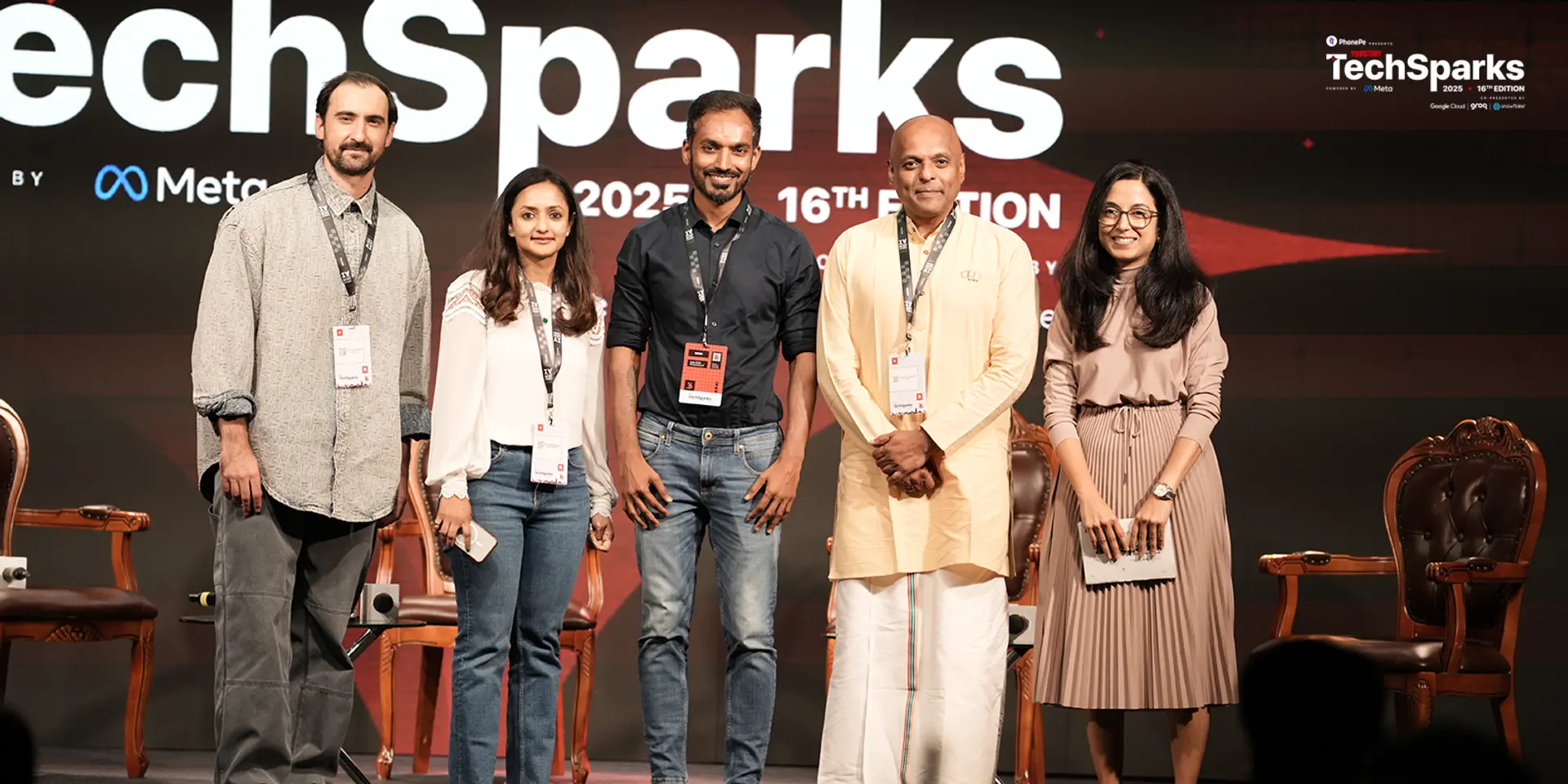

India’s first digital revolution began when affordable mobile data put information and entertainment in the hands of more than a billion people. Today, as AI begins shaping everyday experiences, the country is entering a second revolution, one where access becomes intelligent, personal, and contextual. This shift framed the conversation during a panel discussion, ‘AI, Access, Ambition: How India Builds the Future of Global Apps’, at TechSparks 2025.
Moderated by Sangeeta Bavi, COO of YourStory, the panel brought together Akis Evangelidis, Co-founder and President, India, Nothing; Priya Narasimhan, CBO, Indus Appstore; Rajendran Dandapani, Director of Technology, Zoho Corp; and Umesh Bude, CTO, Pocket Entertainment. Each of them is shaping how India builds for its billion-user digital landscape, and how those ideas now influence global product thinking.
From access to intelligence
Bavi set the tone by recalling how India’s digital journey began with affordability and access. “That was the first revolution,” she said. “Now, access itself is becoming intelligent.” She framed the discussion with a simple question: How are India’s builders turning intelligence into everyday impact?
Picking up that thought, Evangelidis explained how Nothing sees AI as a tool to reimagine interaction. “Since the first iPhone, the way we engage with technology hasn’t really changed,” he said. “AI is helping us move toward systems that understand people, not just the gestures they make.”
For him, the next big shift lies in anticipation, not instruction. “The data is already out there,” he said. “AI can connect it so experiences become effortless, like knowing when your flight is delayed, when you should leave for the airport, or where you paused your audiobook.” He added that the future extends beyond screens, relying on signals from audio products, glasses, and a broader IoT ecosystem.
Drawing from his time in London, he described how AI can track where attention shifts when listening to an audiobook on a walk, and resume from where you left off the next time you go on the same walk.
Breaking language barriers through contextual AI
Turning to India’s multilingual reality, Narasimhan outlined how the Indus Appstore, a Made for India response to the country's diverse app needs, uses AI to remove friction in discovery and access. The app store is present on more than 100 million devices and includes an AI voice assistant trained in around 12 Indian languages and tuned for local accents.
“Typing Indian scripts on phones is difficult, so voice reduces friction and creates access,” she said. Personalization, she added, must reflect context. “What matters in Karnataka isn’t what matters in Maharashtra. AI helps us surface content that aligns with those cultural moments.”
She highlighted a striking imbalance: only 3% of Indian developers feature among the half-million apps on Google Play in India, despite contributing roughly 10% of downloads. “We want to enable the Indian developer ecosystem with simplified discovery, tools, and visibility so they can contribute more to the global ecosystem,” she said. “AI is an enabler of access, representation, and growth.”
Indus is built to meet India’s need for a platform that truly reflects its diversity of languages, users, and entrepreneurial energy. One design choice made that clear: when Indus Appstore removed English as the default language, more than 42% of users chose regional languages, and retention for those users doubled. “Let the user decide,” she said.
Storytelling at scale without losing the human voice
From access to creativity, Bude explained how Pocket Entertainment uses AI as an assistant that strengthens storytelling rather than replacing it. “We fundamentally believe storytelling will remain a human endeavor, but AI can accelerate it,” he said.
Pocket FM’s writer co-pilot helps authors expand scenes, refine detail, and maintain consistency across stories that often run 300–400 hours long. “Writers define the arc and the characters,” he said. “AI helps them keep pace, making sure episodes stay engaging.” Their in-house models have adapted more than 10,000 stories for different contexts, reducing cycles from weeks or months to hours.
Since Pocket FM is consumed during commutes or multitasking, AI-driven recommendations help match stories to listening patterns, improving engagement and discovery.
Making intelligence invisible
Representing the enterprise side, Dandapani discussed Zoho’s long-standing approach to AI, subtle, functional, and grounded in trust. Zoho introduced intelligence through Zia long before the current wave, focusing on small features that remove friction rather than advertise themselves.
“Rather than one needle-moving moment, we and our customers consistently find that the little things matter,” he said. In Zoho People, conversational queries like “How many leave days do I have?” or “Can I combine that with upcoming holidays?” feel intuitive because AI works quietly behind the scenes.
Zoho remains cautious about deployment. “We haven’t allowed generative AI into production yet. We use it internally for prototyping, trying a 100 ideas before choosing one,” he said. The caution is rooted in a simple principle: “We deal with sacred customer data. We cannot allow probabilistic decisions and hallucinations.”
He also highlighted the gap between consumer AI and enterprise AI. “In consumer environments, shared learning works. In enterprise systems, data cannot cross boundaries.” Zoho’s AI is built as a zero-knowledge engine—trained only on each customer’s data.
He pointed to a growing challenge across India. “In our rural offices, brilliant people struggle to express prompts in English,” he said. “That’s the new digital divide.”
Building from India, with India, for the world
The conversation shifted to India’s growing strength as a product development hub. Evangelidis noted how Make in India efforts have strengthened engineering and manufacturing capabilities. “It’s no longer just about assembly,” he said. “India has the talent to design, develop, and scale.”
Nothing is acting on that confidence by moving its CMF sub-brand’s headquarters and manufacturing to India. He also recalled how early user involvement shaped Nothing OS. Through a crowdfunding round, the company allowed users to elect a board observer, who came from India, and their feedback helped refine the product.
For Narasimhan, empowering Indian developers is core to the mission. Their developer-first, fair-market approach aims to give Indian builders a strong and sustainable alternative for driving local innovation.
Dandapani, meanwhile, highlighted the importance of staying human-first. “AI is co-intelligence that amplifies human potential,” he said. “We’d rather take the time to build it right and ensure that no one loses their job.”
Looking ahead: India’s global edge
As the session closed, Evangelidis shared two reflections from building in India: “If you can succeed with Indian users, you can succeed anywhere. And whatever you give to India, India gives back twice.”
Bavi wrapped up the session with a simple thought: “AI opens imagination, access creates inclusion, and ambition drives impact.”
With a billion connected users and open platforms like UPI, ONDC, and Bhashini deepening reach, India’s second digital revolution is no longer about catching up; it’s about setting global benchmarks for intelligent, inclusive digital products.
