



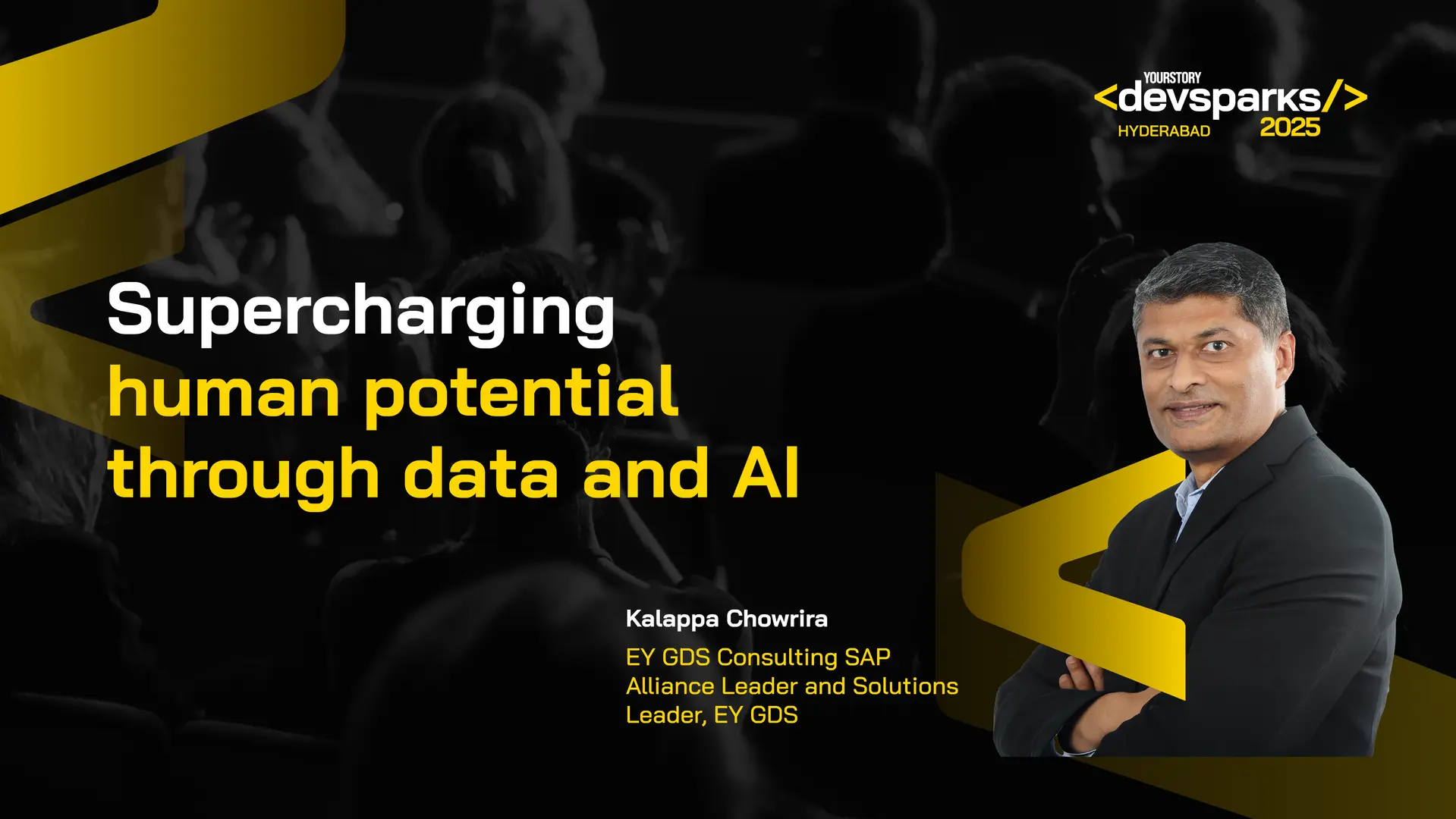
AI beyond adoption: Kalappa Chowrira, EY Global Delivery Services Consulting SAP Alliance Leader and Solutions Leader shares insights on human–machine
At DevSparks Hyderabad 2025, Kalappa Chowrira, EY Global Delivery Services Consulting SAP Alliance Leader and Solutions Leader, explained why moving beyond AI adoption into strategic transformation is key to empowering people, redefining roles, and building trust in human–machine collaboration.


Artificial intelligence is no longer just about efficiency or automation. The conversation has shifted from “Will AI replace us?” to “How can AI empower us to do more?”
Whether it’s streamlining business operations, accelerating decision-making, or helping developers build smarter, faster, and better, AI is increasingly becoming the backbone of modern innovation.
This shift in perspective is exactly what the recently concluded Hyderabad edition of DevSparks 2025, YourStory’s flagship event for the developer ecosystem, set out to explore.
With its theme Supercharging Human Potential Through Data and AI, the event underscored how technology can amplify human capability rather than diminish it, and how India’s one million developers can play a pivotal role in shaping this future.
In a fireside chat, Kalappa Chowrira, EY GDS Consulting SAP Alliance Leader and Solutions Leader, explored how businesses can move beyond surface-level AI adoption and instead drive true strategic transformation.
From adoption to transformation
Chowrira began by drawing a sharp distinction between companies that adopt AI and those that use it to enable strategic transformation. “If you just put in point solutions, you’ll never get real impact,” he explained. “The strategic part is about asking: what are clients looking for, and what are your people looking for?" If you can marry those two very well, that’s when you move from adoption to transformation.
Chowrira shared an example from EY’s SAP practice, which he leads across 4,000 professionals worldwide. Two years ago, it was estimated that his five-year growth plan will need 10,500–11,000 employees to meet revenue targets. After redoing the plan six months ago, factoring in the power of AI-driven solutions, the number dropped to 8,000–8,500. “The outcomes were the same, but we could reach them faster, better, and more efficiently. That’s what happens when AI becomes part of strategy, not just operations.”
Blurring the lines between roles
Another theme of the session was how AI copilots and platforms are blurring traditional job roles. In the past, developers and business analysts often worked in silos. Today, copilots help developers understand business impacts while enabling analysts to test solutions directly through low-code and no-code platforms.
According to Chowrira, “We’re moving away from people-based services to platform-based services. Copilots enable developers not only to code, but also to understand the business. Similarly, a business analyst doesn’t always need to depend on a developer to check what’s possible. Those lines are blurring, and that’s the big difference AI is creating.”
Chowrira also cautioned developers not to rest on existing knowledge: “Don’t sit on what you know. Enhance it. Learn to work with AI tools. Blur those lines between roles.”
Leadership in the age of AI
For future tech leaders, the message was clear: AI is no longer optional; leaders must harness it to make smarter, faster decisions.
Chowrira noted, “Today, AI is enabling us to deliver implementations in 12–14 months instead of 18 months. Leaders can’t just think about how it was always done. They need to think about what AI makes possible. If you don’t experiment, you’ll become a relic.”
He emphasized that failure is part of the journey, adding, “But if you don’t try, you’ll never discover new ways of doing things.”
Accountability remains one of the biggest barriers to AI adoption. Chowrira explained that human oversight is non-negotiable. “Intelligence and recommendations can come from AI, but the final accountability must always rest with humans. That’s how you overcome the fear of AI.”
Building an AI-first workforce
Chowrira also outlined how EY is redefining its hiring and training strategies for an AI-first world.
- AI literacy is now mandatory. “In interviews, we now ask: Have you used AI to enhance your role? That question wasn’t even on the table a year ago; now it’s non-negotiable.”
- Training has evolved. Entry-level hires no longer start by coding from scratch. “We expect them to use AI platforms to get the first 50–60% of their code and then enhance it.”
- Prompt engineering matters. “When people ask me what’s the best branch of engineering today, I tell them, prompt engineering. If you can master that, life in professional services gets so much easier.”
The verdict: AI is not here to sideline humans but to empower them, helping businesses achieve outcomes faster while giving people the tools to focus on higher-value work.
Chowrira summed up, “AI is going to enhance, not replace. Success lies not in treating it as a shiny add-on, but in weaving it into the very fabric of your organization.”
For developers everywhere, it’s a reminder that the real opportunity lies in using AI not just to build faster, but to create smarter, more impactful solutions for the world.