




Microsoft
View Brand PublisherMicrosoft partners with private sector, foundations and IGO to navigate AI adoption challenges for India's nonprofit sector
Experts from UNDP, SBI Foundation, and CSRBOX share practical strategies to build AI readiness and digital resilience across India’s nonprofit ecosystem.

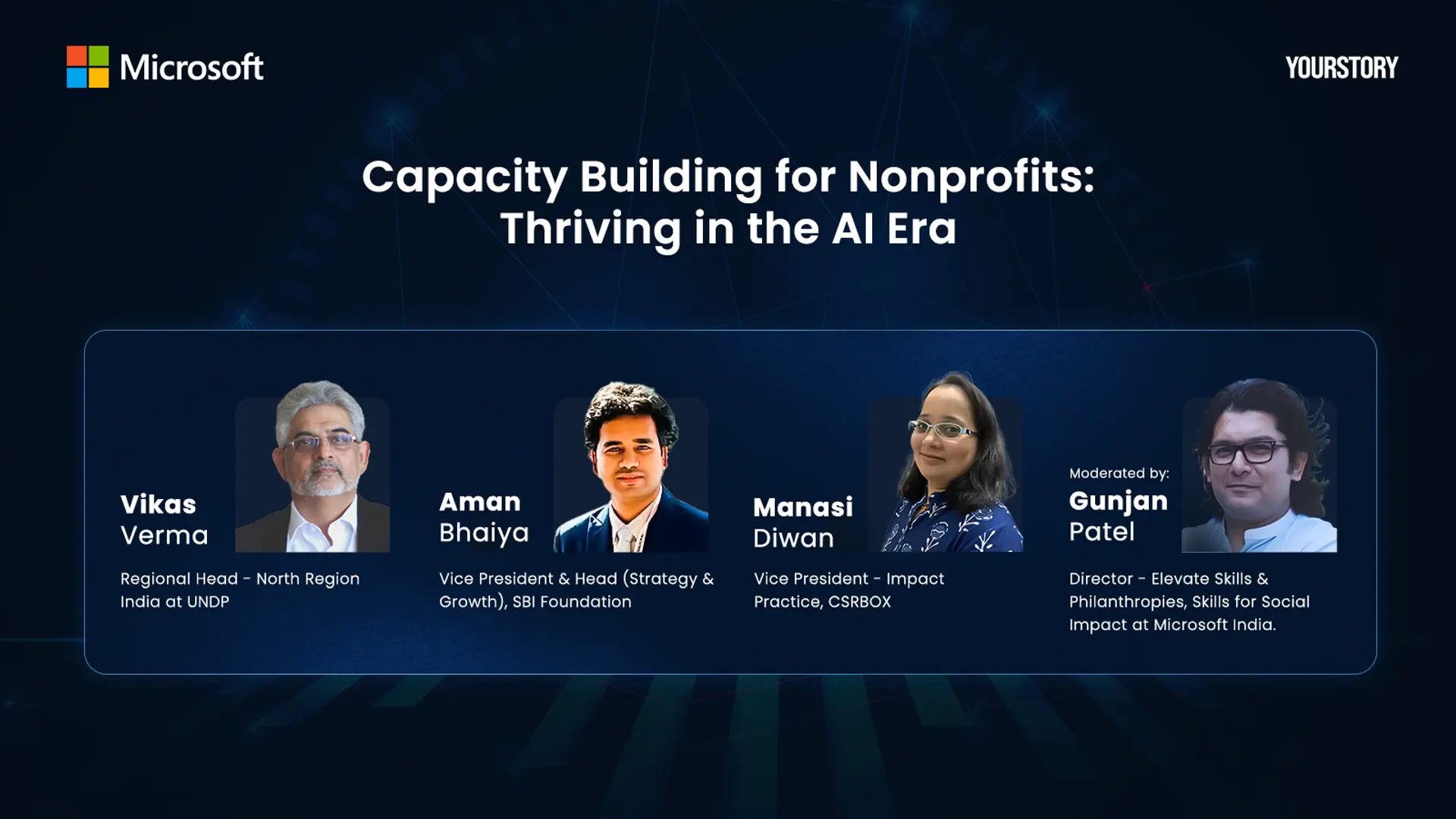

As artificial intelligence reshapes industries, economies & communities globally, India's nonprofit sector stands at a critical juncture. While AI promises unprecedented opportunities for scaling social impact & providing the path to adoption remains fraught with challenges, from financial constraints to digital literacy gaps. A recent webinar hosted by YourStory in partnership with Microsoft brought together leading voices from the development ecosystem to address these hurdles head-on.
The session titled "Empowering Nonprofits for the AI Era," convened experts from UNDP India, SBI Foundation, and CSRBOX to explore how nonprofits can effectively harness AI and digital tools. Moderated by Gunjan Patel, Director of Elevate Skills & Philanthropies at Microsoft India, the discussion revealed both the immense potential and practical barriers facing organizations working at the grassroots level.
The ground reality: Understanding nonprofit challenges
Vikas Verma, Regional Head for North India at UNDP, painted a sobering picture of the obstacles nonprofits face. With 83% of NGOs in India struggling to cover basic overheads like staff salaries and rent, financial instability remains their biggest challenge. Beyond funding concerns, organizations grapple with inconsistent data collection, high volunteer turnover, and limited IT infrastructure, particularly in remote areas where even smartphones face connectivity issues.
"NGOs can ensure fairness and transparency through AI adoption, but challenges remain around bias and ethics," Verma noted, highlighting the delicate balance between technological advancement and protecting marginalized communities. He emphasized that AI systems must be carefully designed to avoid perpetuating existing inequalities in underserved populations.
Technology as a selection criterion
Aman Bhaiya, Vice President and Head of Strategy & Growth at SBI Foundation, offered a funder's perspective. His foundation has made technology adoption a core evaluation criterion when selecting grant recipients, recognizing that data-driven operations directly correlate with impact efficiency.
"We have seen that NGOs delivering higher impact are those that are very, very pro-tech," Bhaiya revealed, citing examples like Khan Academy's AI-powered adaptive learning tool Khanmigo, piloted across Punjab's education system. The foundation also funded Dosing Labs, which uses AI to monitor patient vitals through mobile devices, a solution that proved critical during COVID-19 when healthcare workers faced infection risks.
Bhaiya emphasized that resistance to technology stems from a misconception: "There is some kind of resistance in the social sector, basically leveraging human touch, empathy as a factor. AI will not replace the human touch or ground reach, but will kind of amplify their insights and strengths."
Customization over one-size-fits-all
Manasi Diwan, Vice President of Impact Practice at CSRBOX, stressed the importance of tailored capacity building. Rather than generic training programs, her organization focuses on role-specific skill development, like teaching monitoring teams data visualization, field teams mobile data collection tools, and communications teams AI-driven storytelling techniques.
"When we start building a house, we don't really focus on the rooftops or solar panels first, but on the foundation and small wins," Diwan explained, advocating for incremental adoption starting with basic digital hygiene like cloud storage before advancing to sophisticated dashboards and predictive analytics.
Her team recently created a real-time impact dashboard for a BFSI skilling project, resulting in a fivefold increase in funding within one year, as donors could witness transformation in real-time.
The partnership imperative
A recurring theme throughout the discussion was the need for collaborative solutions. Drawing parallels to India's UPI success story, where government, industry, and banks created a seamless digital payment ecosystem, panelists called for similar partnerships in the social sector.
Bhaiya proposed an ambitious vision: "Can Microsoft or other tech giants take the lead on creation? Can organizations like SBI, UNDP come from the donor side, and can players like CSRBOX come in the center, and we create something like an entire suite of solutions for the nonprofit world, which is as simple as UPI?"
The consensus was clear: open-source, user-friendly tools developed through strategic partnerships could level the playing field for smaller nonprofits that lack resources for expensive cloud services and software licenses.
Looking ahead
As the webinar concluded, one message resonated strongly: AI adoption in the nonprofit sector isn't about replacing human compassion with algorithms, but about freeing up resources to focus on what truly matters: meaningful community engagement and lasting social change. With Microsoft's upcoming capacity-building initiative for nonprofits in the AI and digital economy, and growing commitment from foundations and impact organizations, India's social sector may finally have the support ecosystem it needs to thrive in the digital age.