



NVIDIA’s Vishal Dhupar envisions 'Mumbai as the finance capital with intelligence' by 2028
Mumbai will blend finance with intelligence, says Vishal Dhupar, MD, NVIDIA South Asia, driven by AI factories and population-scale innovation.

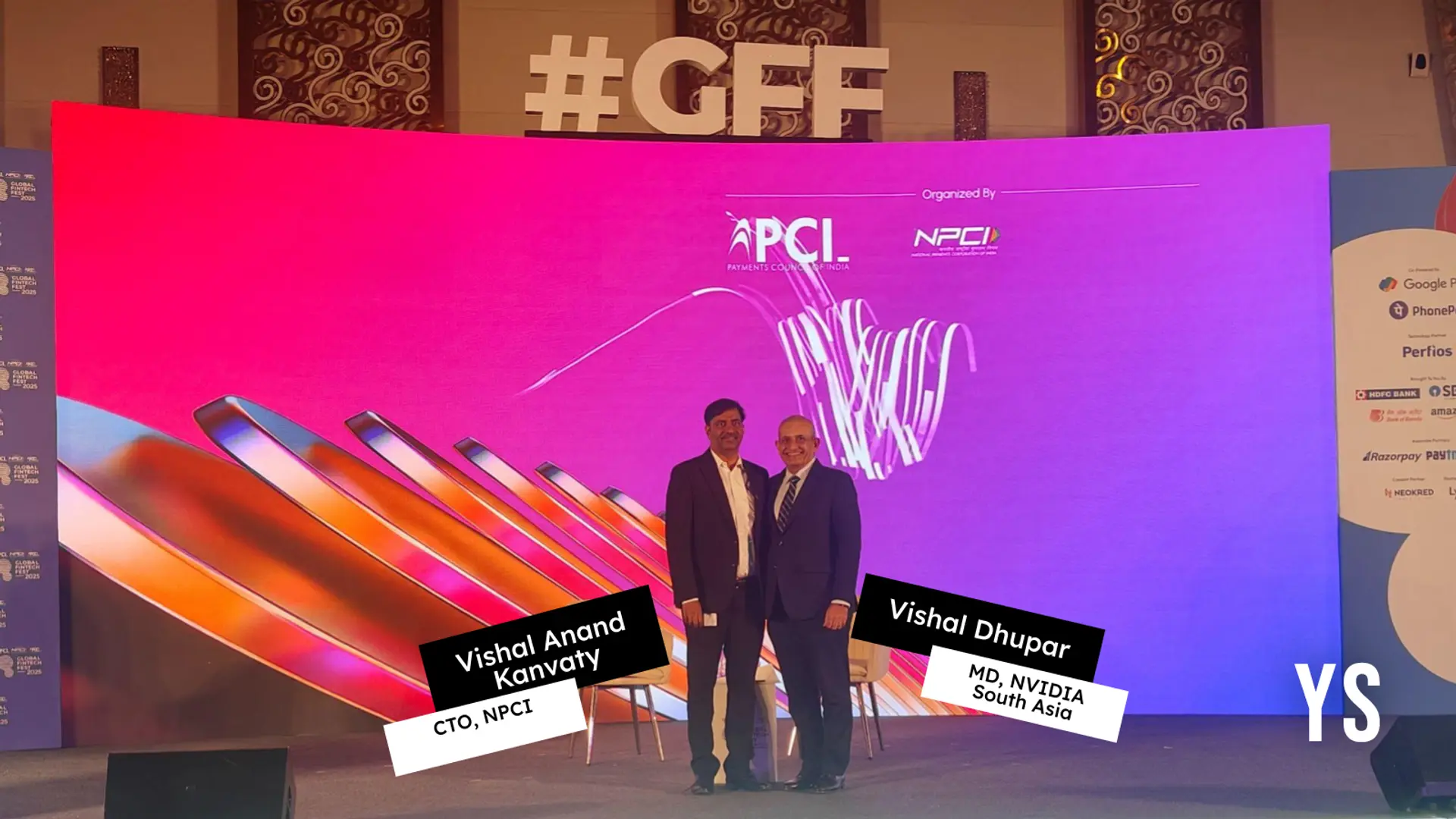

Imagine a Mumbai where financial grit meets a layer of machine intelligence, making the city more than just a hub of traders. That is how Vishal Dhupar, MD, NVIDIA South Asia, envisions Mumbai five years from now.
“In 2028, we will be calling Mumbai the finance capital with intelligence, rather than just the finance capital. I’m quite certain about it,” said Dhupar, speaking during a fireside chat at the 6th Global Fintech Fest (GFF) in Mumbai.
“Let’s build for India in India and build in India for the globe. Let’s make each one of us proud by truly making India the global fintech capital and let Mumbai be intelligent Mumbai,” he added.
Dhupar emphasised that transformation begins with culture because technology on its own cannot drive meaningful change. Too many organisations, he noted, focus on marginal gains, asking whether a model can be improved by 10% or 20%, and in doing so they miss the real opportunity. The true value, he said, lies in reimagining work at scale. For that to happen, every CEO and founder must understand the entire data pipeline: how data comes in, how it is wrangled, managed and applied.
He also highlighted the concept of an AI factory. “An AI factory is a factory where raw material comes in and a finished good goes out, and you make money. It translates into currency,” said Dhupar. The idea reframes technology as production rather than overhead and signals a shift in how boards should view investment.
Dhupar explained that treating technology as capital rather than cost changes how organisations invest and scale. In the past, computing was seen as a cost for storing and retrieving information, but now, he said, it must be viewed as capital expenditure. This shift, he added, will only happen when the board and CEO understand its strategic importance and commit to it as a core investment that enables true enterprise-scale deployment.
He said that people often underestimate the lifecycle needs of digital systems. Just as companies hire, train and monitor human employees, they must onboard, govern and iterate their digital counterparts.
“IT will soon be HR for digital species. So this is a cultural shift, and that’s what we need to get used to,” remarked Dhupar.
The growth of generative AI is a major trend shaping business and technology, with global investment and adoption rates accelerating across nearly every industry.
Generative AI, he noted, will be ubiquitous in two ways. Behind the scenes, it will be invisible, quietly embedding itself into risk assessment, compliance checks and credit models. Multiple systems will operate semi-autonomously and provide continuous feedback to decision makers.
At the same time, generative AI will be highly visible to individuals. Many people will carry advisors in their pockets on their smartphones, companions that will help with personal finance, learning and daily choices. These will be practical, context-aware and scaled to a billion users.
“I definitely know that in 2028 India is going to be talking about population-scale applications. I also know India will be at the zenith of use cases,” he said confidently.
The GFF 2025 opened to a packed audience at the Jio World Centre in Mumbai on Tuesday, bringing together regulators, investors, and innovators to explore how AI is reshaping the global financial landscape.
Edited by Affirunisa Kankudti