



How UP is redefining India’s export story, one craft at a time
A roundtable discussion on the sidelines of the UP International Trade Show 2025 revealed the remarkable transformation of Uttar Pradesh's industrial landscape.

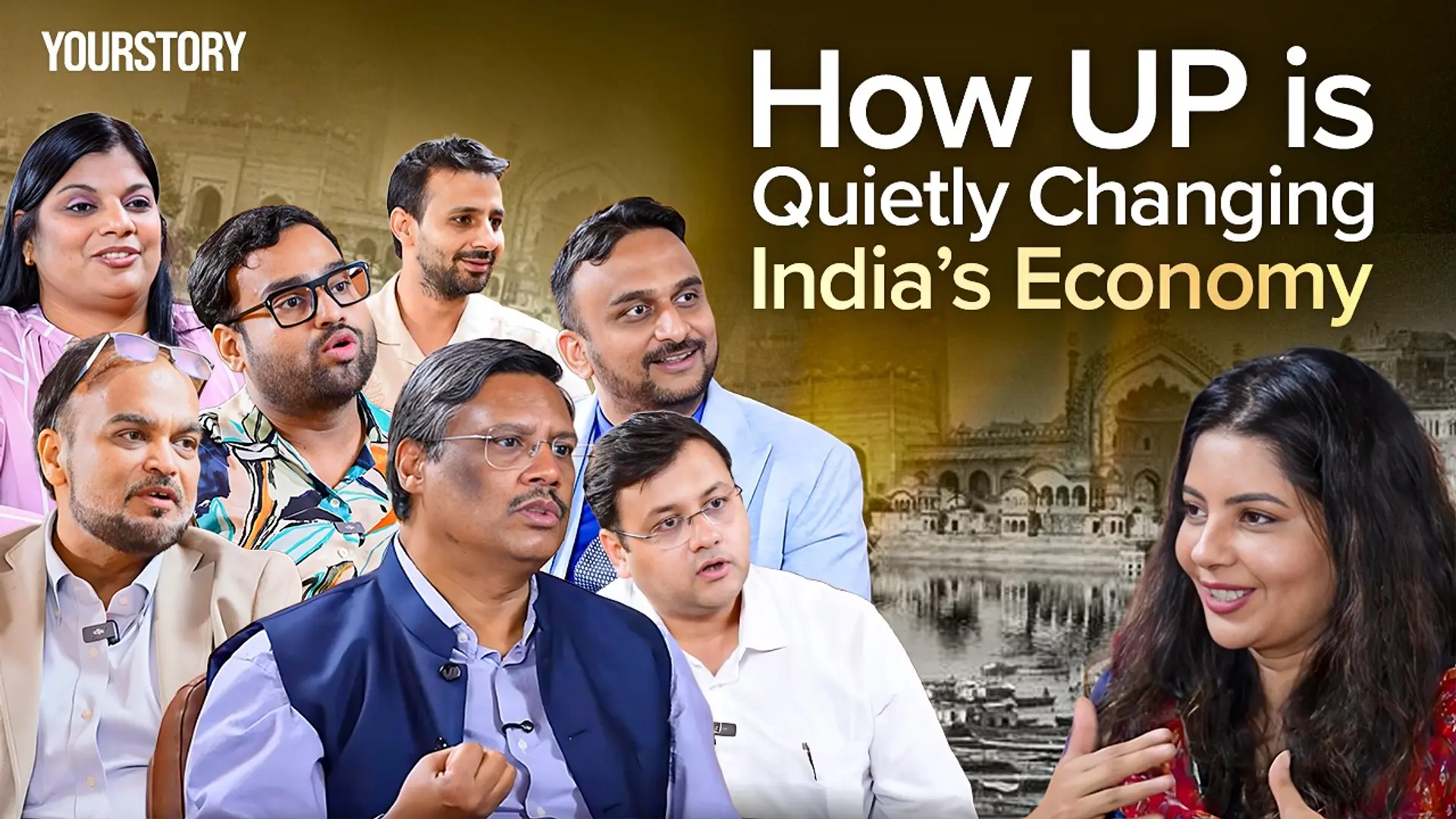

The UP International Trade Show 2025 (UPITS), a flagship B2B and B2C initiative of the Uttar Pradesh government, brought together industries, startups, exporters, and business leaders to showcase innovations, forge partnerships, and unlock new market opportunities across India and the world.
Uttar Pradesh is steadily emerging as a manufacturing powerhouse, with entrepreneurs taking their crafts from village workshops to global markets.
This transformation was highlighted in a roundtable hosted by Shradha Sharma, Founder and CEO, YourStory, which featured successful homegrown founders and Alok Kumar, Additional Chief Secretary, Government of Uttar Pradesh.
From workshops to international markets
Rohini Omar, Founder of ADA Creations in Kanpur, started her journey 14 years ago after transitioning from conventional jobs in banking, insurance, and telecom to establish her ethnic wear business in 2014.
"I never thought I would get such a wonderful platform where I could connect with more than 25 B2B international buyers and sign more than 15 MOUs," she said, reflecting on her experience at IPTS.
ADA’s specialisation in traditional embroidery work, like zardozi and resham embroidery, has found new markets globally and provided employment opportunities to women.
Nitesh Agarwal's journey with Triveni Chikan Arts proves that authentic Indian craftsmanship always finds demand globally. Started in 2005, the company now exports to more than 40 countries across all seven continents, with offices in Singapore and France.
"We have nearly 450 artisans working with us in Lucknow. When we exhibit in Europe, people understand the potential and workmanship of our craft,” Agarwal said.
The company is now opening its own stores in Europe, taking the traditional chikan embroidery directly to French consumers.
While traditional crafts capture headlines, companies like AK Industrial Fabrics, spanning 110 years in textiles and 45 years in technical textiles, are riding the wave of changing consumer preferences.
"Traditional textiles are bleeding, but technical textiles are emerging," noted Sidharth Kedia, a fifth-generation entrepreneur. "India contributes almost 15% of global technical textiles—a $28 billion market growing at 11% annually,” he shared.
The company’s products, such as tents, tarps, and outdoor fabrics, align perfectly with the growing camping and outdoor recreation trend, both domestically and internationally.
“Earlier, buyers avoided coming to cities like Kanpur or Lucknow, forcing manufacturers to travel to Mumbai and New Delhi for meetings. Today, the scenario has completely reversed, with international buyers actively seeking out UP-based manufacturers. We are also exhibiting for the first time in UPITS,” he added.
Eight years ago, when Chetan Khandelwal entered the copper products market with Divine Copper, he identified a challenge that was a barrier to market expansion.
"When I entered this business, I saw that people liked the products but were frustrated when they turned black," Khandelwal explained. This turned out to be a barrier to market expansion.
He travelled to Germany, Dubai, and Singapore to attend international exhibitions and study coating technologies. Khandelwal developed innovative approaches, including lacquer coatings, embossed designs, enamel prints, and powder coatings that prevent blackening to enable long shelf life.
Based in Vrindavan, UP, his company now produces high-quality, heavyweight copper products with trendy designs that can be customised with prints. This transformation in product quality and durability has enabled Divine Copper to access international markets that were once out of reach. "I travel to many countries and private exhibitions, but the environment here matches international standards. The buyers aren't just browsing; they actually want to buy and understand our core manufacturing capabilities,” he said of UPITS.
Akhilesh Agarwal’s story of Herbochem Industries shows how traditional agricultural businesses can evolve into sophisticated chemical manufacturing operations. The story of its origin is fascinating.
Mint, which is not native to the country, made its way from Japan to Brazil, and then to China before reaching India. In the 1970s, Akhilesh's father, who studied in Scotland and opted not to join DRDO, established the mint business.
"There were only two villages in Barabanki doing mint farming then, and one in Chandanpur," Agarwal recalled. Today, Herbochem has diversified into menthol, aromachemicals, flavours, essential oils, and camphor, serving both domestic and international markets.
“Now, buyers come directly to Lucknow, they will talk on the ground with the farmers, see what’s sustainable or not, understand the challenges and then move forward,” he said.
With 90% of their business initially in international markets, they have now begun focusing on Indian consumers as well.
Saurabh Kanodia, the founder of Akriti Jewelcraftz Private Limited, based in Baghpat, has emerged as a leader in stone fabrication and installation, a business segment that was virtually unknown in UP and limited to Rajasthan.
"We don't just process stone like others in Rajasthan. We design, process, and install with 25 architects on staff working on different projects, and 600 direct employees without a single subcontractor,” he shared.
Its portfolio includes projects in Doha, Dubai, royal projects in France, the Prime Minister's office and residence in India, UP tourism projects, and temples. The company has just secured its first project in Florida, with 10 more international projects in the pipeline.
"This is our third year at the show, and every year we have expanded our booth because of the response. The knowledge exchange and business feedback we receive is amazing,” Kanodia noted.
UP’s industrial growth story
According to Alok Kumar, the state’s industrial growth story is built on four pillars that have been systematically strengthened over the past seven years: security, law and order improvements; attractive industrial policies across sectors; infrastructure development, including expressways, railways, and airports; and governance reforms focusing on ease of doing business.
The numbers tell a compelling story of exponential growth. Kumar shared that industrial growth output stood at 25% year-on-year, more than double the all-India average of 11%.
"25% growth means we double every three years," Kumar explained.
Factory registration data also shows some impressive numbers: from just 500 new factories in 2015 to 3,100 in 2023-24, with projections of 6,000-8,000 new registrations this year alone.
“If China's advantage is in scale, then our advantage is in the niche. But the problem is that people in the niche market don't have enough money to develop international markets. Now we are trying to give them a platform to establish themselves in any market in the world,” he remarked.
Connecting talent with markets
UPITS has emerged as an incubator for innovation. Kumar pointed to examples of synthesis products emerging from the interactions: “In one product, I have seen five GI tag technologies combined–wood from Saharanpur, inlay work from Mainpuri, glass from Firozabad, decorative pieces from Lucknow, and craftsmanship from Karnoj,” he said with pride.
According to Kumar, Uttar Pradesh now boasts one crore MSMEs serving five crore families–meaning every fifth family runs its own industry. "Even a household-level factory with two workers can showcase its creativity and innovation. What sells now is your innovativeness, not your size,” he said.
While celebrating the achievements, Kumar also acknowledged the challenges. "The more you improve, the more expectations rise," he reflected on the ease of doing business initiatives.
The state is now working on "ease of doing business 2.0," with a focus on decriminalising minor offences, easing labour laws, and enabling night shifts for women in manufacturing.
One of the most significant mindset shifts has been recognising Uttar Pradesh’s industrial heritage. "I was also in a kind of delusion when I got charge of MSME for the first time, thinking Uttar Pradesh was just an agricultural state. But we have one crore MSMEs–this is fundamentally an industrial state,” he added.
The trade show has grown from 350 foreign buyers initially to over 550-600 this year, despite global economic uncertainties.
The vision ahead
Uttar Pradesh Chief Minister Yogi Adityanath’s vision, as articulated by Kumar, is clear: "There's no shortage of talent in Uttar Pradesh—there's a shortage of market access. Connect talent with markets, and UP will develop on its own."
Kumar envisions a promising future for UPITS, aspiring for it to achieve global stature “like the Hamburg Fair.” He sees it as a sustainable development model that showcases traditional arts and crafts but also opens doors for artisans to earn worldwide recognition.
Edited by Megha Reddy