



AI changed when software finally got the hardware it needed: NVIDIA’s Vishal Dhupar
In a fireside chat at TechSparks 2025, Vishal Dhupar, Managing Director, South Asia, NVIDIA, discussed the hardware-led AI shift, the creation of AI factories, and how India can turn data and talent into global influence.

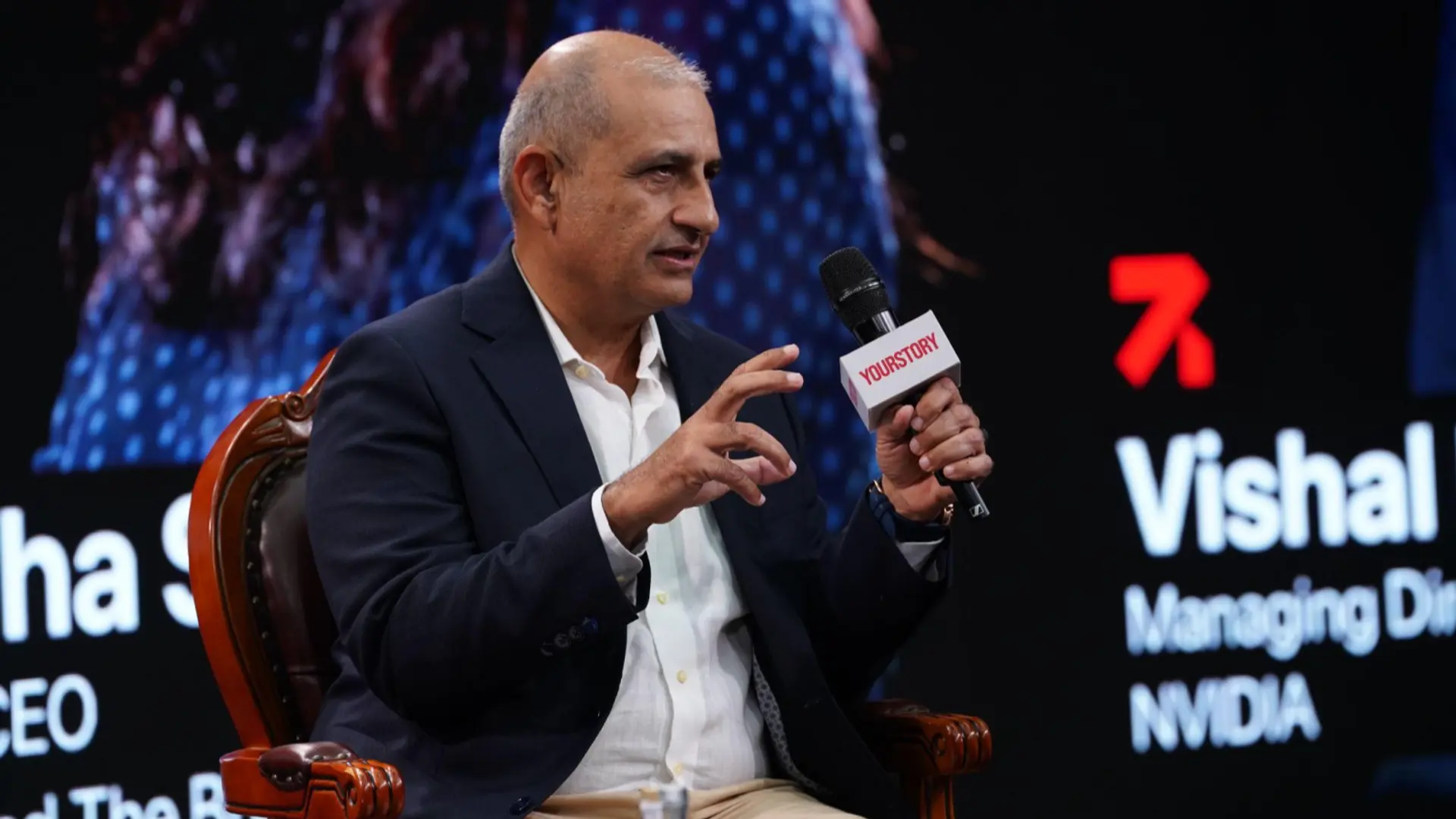

For years, the popular understanding of artificial intelligence (AI) has been shaped by the idea that it is simply software that automates or accelerates tasks. But Vishal Dhupar, Managing Director, South Asia, NVIDIA, suggests that this view misses the true hinge point in AI’s evolution.
The breakthrough did not come from lines of code alone, but from the hardware that made modern neural networks workable at scale, Dhupar shared during a fireside chat at TechSparks 2025, with Shradha Sharma, Founder and CEO of YourStory.
He explained that the relationship between software and hardware is interdependent, using a simple analogy to make the point.
“Think about it. Everybody says fuel is important, but if there were no engine, how would you consume it? Now, everybody says there is an engine, but if there were no fuel, how are you going to run it? It just depends upon how you look at it,” Dhupar noted.
For decades, researchers knew what they wanted neural networks to do, but they lacked the computing power to make those models learn well enough to be useful. The algorithms were not new; the ability to train them was.
“For 60 years, we continued to find solutions to the problem of perception. We created neural networks, we had enough data, we kept on trying,” he said. “And suddenly one set of bright people in Toronto figured out… the computer will write the software that no human can write. And it got solved through the GPU.”
The turning point was not accidental. NVIDIA had already been building CUDA (Compute Unified Device Architecture), its parallel computing platform, long before the commercial payoff became clear. At the time, it appeared to many like a costly, unnecessary bet.
“CUDA was introduced at a time when everybody said that you as a company are not doing well, why are you adding cost to it. For six years, we had a burden trying to get CUDA going,” he recalled. It was only when deep learning caught up to the hardware in 2012 that the industry realised what had changed: “The entire humanity rationalised.”
Industrialisation of intelligence
Dhupar described the current moment in AI not as a technological upgrade, but as a shift in how intelligence itself is produced and distributed. Instead of merely storing and retrieving information from databases or search engines, AI systems now generate new answers in real time. This marks the move from information access to intelligence manufacturing.
“Today, we actually pose a question, the system thinks and generates a novel answer that sometimes surprises you, augments your intelligence,” he explained. “Up till today, we would basically retrieve information from webpages or databases. Today, the system generates.”
This new capability has changed the role of data centres. They have evolved into what Dhupar calls AI factories: not just storage hubs but facilities that actively produce intelligence.
“Data centres have moved down to be AI factories. And these AI factories basically produce tokens. And tokens are the new currency. And most importantly, it is industrialisation of intelligence,” he said.
India’s AI capability
Dhupar argued that India holds a decisive advantage in the global AI race: a unique combination of data, talent and domestic demand. But these assets will only translate into leadership if the country builds the necessary infrastructure to convert data into intelligence.
“The end game is how we serve 1.4 billion people speaking officially 22 languages,” he said. “We have our own common sense, our own sensibility… That cannot be done from the Western world. It has to be done here.”
The foundation for this, he stressed, is AI factories: national-scale computing power that allows the country to train and deploy models tailored to Indian contexts.
“You require AI factories to produce the token and have a grid to bring intelligence to each one of us. Just like how electricity needed a grid to reach every household.”
He outlined the roadmap clearly: rapidly build compute infrastructure, clean and organise datasets, and encourage society to embrace AI as a productivity multiplier rather than a threat.
“The first thing I’ll do is accelerate the pace of building infrastructure... The second is to accelerate the pace of datasets, and clean them… The third is to embrace it fully,” he said.
Exporting intelligence
Dhupar also highlighted that India’s long-standing reputation as a software exporter is poised to evolve. Instead of exporting labour and code execution capacity, India can export intelligence itself: AI models, systems and solutions shaped by its scale and constraints.
By building models that address linguistic diversity, affordability and infrastructural limitations, India creates technologies that naturally serve much of the Global South. Countries across Africa, Asia and Latin America share similar constraints and would adopt Indian-developed AI in the same way many nations are already adopting UPI.
“Your IP can be exchanged with countries similar to ours. And therefore you will be the benchmark for the global south,” he said.
This represents a shift from being the world’s back office to being a global source of intelligence production.
“We become a nation that is not only exporting software, we export intelligence. People come here. And that is how we continue to become the global capital of intelligence.”

Edited by Jyoti Narayan