



Articulus Surgical aims to make advanced robotic surgery accessible across India
Articulus Surgical builds affordable, compact robotic systems for India's space-constrained hospitals.


Open surgeries—where surgeons make large incisions to directly operate on internal organs—typically discharge patients in 6-8 weeks, but complete recovery often takes 6-9 months or more, depending on the patient's condition. Advanced surgical robotics could make these surgeries less invasive, leading to relatively quick recovery times as well as less pain and fewer complications.
However, access to advanced robotics remains limited. High equipment costs, complex infrastructure requirements, and the constraints of existing hospital setups, cramped operating rooms and staff shortages mean that only a small portion of India's population can currently benefit from these technologies.
The founder's vision
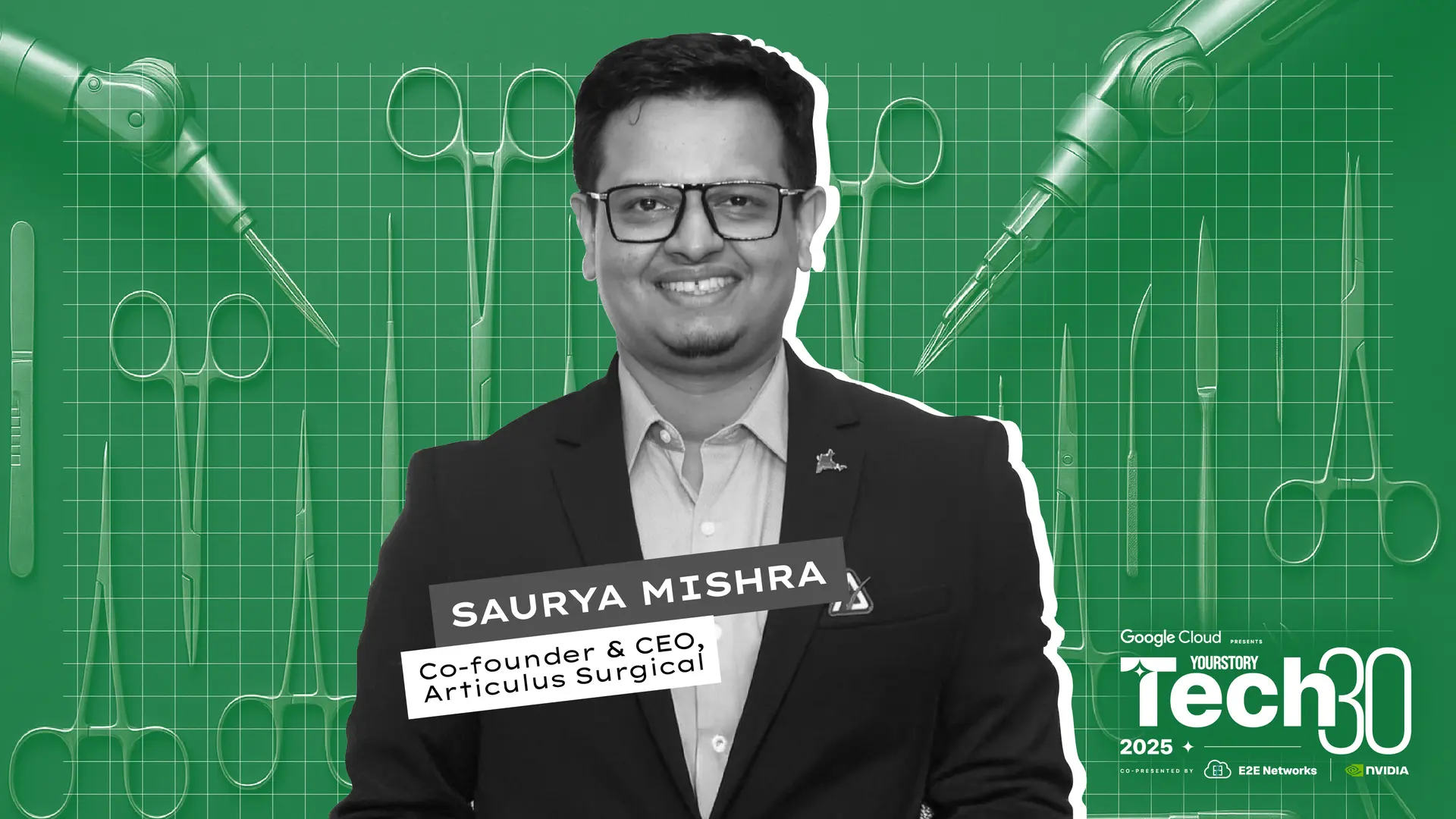
In 2021, Saurya Mishra founded Articulus Surgical in Bengaluru to make advanced surgical robotics accessible across India's Tier II and III cities. Coming from a family of surgeons in Cuttack, Odisha, he witnessed healthcare disparities firsthand. The motivation became personal when his mother's long recovery time from open hysterectomy surgery interrupted her PhD work.
"We aim to make advanced medical technologies, particularly surgical robotics, accessible to everyone, not just the privileged few," Mishra says.
An IIT Kharagpur alumnus with 14 years in medical devices, including roles at Philips Healthcare and leading R&D for a robotic pathology startup, he decided to build Articulus in India to deliver surgical robotics at a sustainable price point.
Three surgical systems
Articulus offers three surgical robotics products—Pulsar, Galaxi and Nebula, that focus primarily on gynaecology procedures, though the technology extends to multiple surgical specialities.
Pulsar is the flagship fully robotic system that allows surgeons to operate remotely with precise, stabilised motions. Surgeries are performed through very small incisions in the patient's body, reducing scars to just a millimetre or two. Patients are typically discharged in 24-48 hours with minimal pain.
The system is compact, approximately 2x2 feet at the base, 4 feet tall, portable, and designed for high-volume settings with space constraints of Indian hospitals. This product launches in early 2026.
Galaxi is a semi-robotic camera control system for laparoscopic procedures, helping surgeons manipulate and hold cameras with enhanced control during surgeries. Nebula is a robotic training platform that allows medical students and practising surgeons to practice surgeries in a virtual environment with a full surgical console.
"Our solutions focus on human-robot collaboration with no artificial intelligence elements. Robot + surgeon is better than robot alone and better than surgeon alone," Mishra says.
The engineering
The system follows an "operate by wire" concept: surgeons sit at a console away from the patient, manipulating robotic arms while viewing real-time video from inside the patient's abdomen. The system captures hand movements, including orientation, speed, and motion, at 10,000 times per second, with each hand controlling a separate instrument.
The complete system comprises three robots and one Galaxi endoscope unit, using 5–8 mm instruments that replicate human wrist movements through small incisions.
Articulus says it has built its technology stack entirely in-house, “90–95% of components manufactured in India,” Mishra says. Each robot includes 6-8 custom-developed motors that move in perfect synchrony, controlled by a proprietary operating system that filters out unintended movements in real time.
The system eliminates hand tremors, resists fatigue during 11–12-hour procedures, and ensures steadier, more precise control, allowing surgeons to focus on clinical decisions rather than physical strain.
Articulus targets hospitals and medical colleges across Tier I, II, and III cities, positioning itself for global scalability in markets facing similar healthcare challenges. Its product line addresses high-volume procedures, including hysterectomies, cholecystectomies, inguinal hernia repairs, pyloroplasties, bariatric and oncological surgeries, and various abdominal minimal-access operations.
Funding and roadmap ahead
Articulus competes with global players like Intuitive Surgical’s Da Vinci system, CMR Surgical, and Medtronic, though its approach differs. The startup has raised Rs 8.8 crore in seed funding from IHFC, Gaurav Agarwal, and Sandeep Daga (Nine River Capital), with early support from Startup India, a BIRAC Bio-Innovation Grant, and Yenepoya Medical College.
It has also received recognition as part of NASSCOM Emerge 50 2025, CNBC's Top 100 Startups 2024, and Forbes India's December 2023 emerging startups edition, with support from the Royal Academy of Engineers, UK.
Articulus holds CDSCO test licences with full certification targeted for mid-2026, alongside ISO 13485 certification in progress. Preclinical trials are underway, with clinical studies planned to begin in early 2026. The startup plans to deploy 5,000 systems across India while targeting global markets with similar healthcare challenges. Its stepwise adoption model, training with Nebula, upgrading to the semi-robotic Galaxi, and finally to the full Pulsar system, aims to make robotic surgery more accessible and scalable for India.
Articulus Surgical is part of YourStory’s Tech30 cohort—a selection of India’s most promising startups of 2025—unveiled at TechSparks Bengaluru.

Edited by Affirunisa Kankudti