



Cause is key to building a personal brand: Jatin Saini’s playbook for founders
At TechSparks 2025, Jatin Saini, Founder of consulting firm House of Creators, taught a masterclass on how founders can use LinkedIn’s growing influence to build authentic, purpose-led personal brands.



For startup founders trying to build their personal brand online, the starting point isn’t content or algorithms—it’s a clear cause, according to Jatin Saini, Founder of consulting firm House of Creators.
“Cause helps in longevity, and it’s something that’s honest. So we have to find out your cause and purpose today," said Saini, at a masterclass at TechSparks 2025.
“If you don't have a real reason behind why you're doing it, you will not have stories or experiences to share,” he added.
And if one is really passionate about the cause and wants to be taken seriously, LinkedIn is the platform for that, Saini advocated.
His firm helps founders and investors build their personal brand on the Microsoft-owned platform.
Saini pointed out that personal branding has become essential for founders, especially those building consumer-facing companies. The decade-old playbook of relying purely on performance marketing no longer works.
“Why is performance marketing today not giving the kind of results it did 10 years ago?” he asked. “Because now everybody is doing it. If you start building your personal brand today, ten years later you’ll be trusted a lot more.”
He also argued that this is the perfect time for founders and investors to build a presence on LinkedIn, given how few people are truly influential on the platform.
“Out of more than a billion users, only about 1% actually have influence,” said Saini. “There are 10 million content creators, executive coaches, and around 900,000 founders across the world—that’s your competition. But only 1% of them truly have reach and credibility.”
According to Saini, once a founder identifies their cause, three elements become crucial to building a long-term personal brand.
The first is credibility. “Credibility is proof. Past work that serves as evidence,” he said, pointing to Zomato founder Deepinder Goyal as an example.
Last year, Goyal went undercover as a delivery partner and shared on social media how delivery workers faced challenges entering and exiting malls, with some even climbing several flights of stairs to make deliveries. Following his post on X, a mall set up a dedicated pickup point and deployed staff to shuttle food from restaurants to that location—resolving the issue Goyal had highlighted.
Saini also cited Kunal Shah, Founder of Cred, who used LinkedIn to share that his company had sent millions of credit card payment reminders to users, collectively helping them save Rs 1,100 crore.
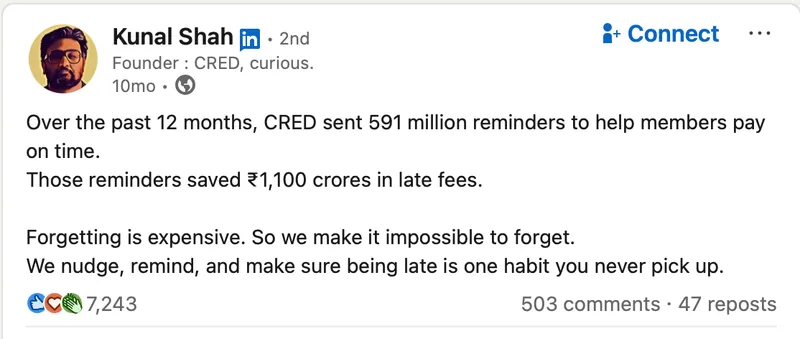
“Now, this is proof of action,” Saini said. “Not a promise that we’ll go carbon-free by 2050 or become a decacorn by 2040. It’s about showing what’s already been done—the action, the result, and the insight behind it.”
The second pillar is authority. According to Saini, founders can build authority by sharing their perspectives on issues shaping public conversations. He cited the example of Zepto Co-founder Aadit Palicha who defended the quick commerce industry after Union Minister Piyush Goyal questioned the sector’s focus on “delivery boys” instead of deep technology. Palicha argued that quick commerce platforms contribute meaningfully to the economy by creating jobs, generating taxes, and attracting foreign investment.
Saini stressed that opinions must feel authentic and come from a founder’s own experiences rather than recycled commentary. It’s fine to take a contrarian stance, he said, but founders should be mindful not to get drawn into unnecessary controversy.
“There are risks, and I’d suggest not overdoing something unless you truly believe in it,” said Saini. “Don’t forget why you’re building your brand — to empower your cause and gain more influence to do what you believe in. The goal isn’t to create controversy; it’s to strengthen your purpose.”
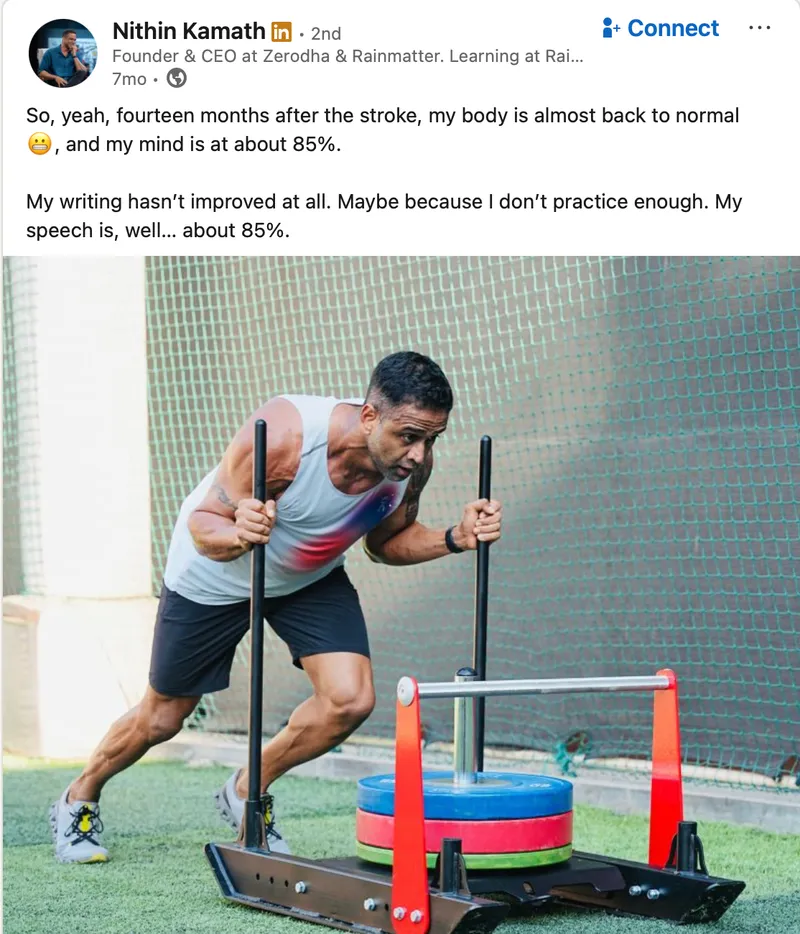
The third element is trust. “Earning trust requires being more human,” Saini said. “What’s a personal decision you made, and what were its professional consequences? Sharing that honestly is what earns trust.”
He cited Nithin Kamath, Founder of Zerodha, who shared a post about being hospitalised and later recovering. By openly sharing his health journey and then coming back with an update, Kamath showed vulnerability and continuity—traits that strengthen the human connection behind a personal brand. “This builds trust,” emphasised Saini.

Edited by Swetha Kannan