



From data chaos to GenAI confidence: Inside NetApp’s Vision for smarter hybrid cloud startups
At TechSparks 2025, NetApp’s Vasanthi Ramesh broke down how unified storage, metadata intelligence, and composable architectures can help startups turn data challenges into GenAI opportunities.

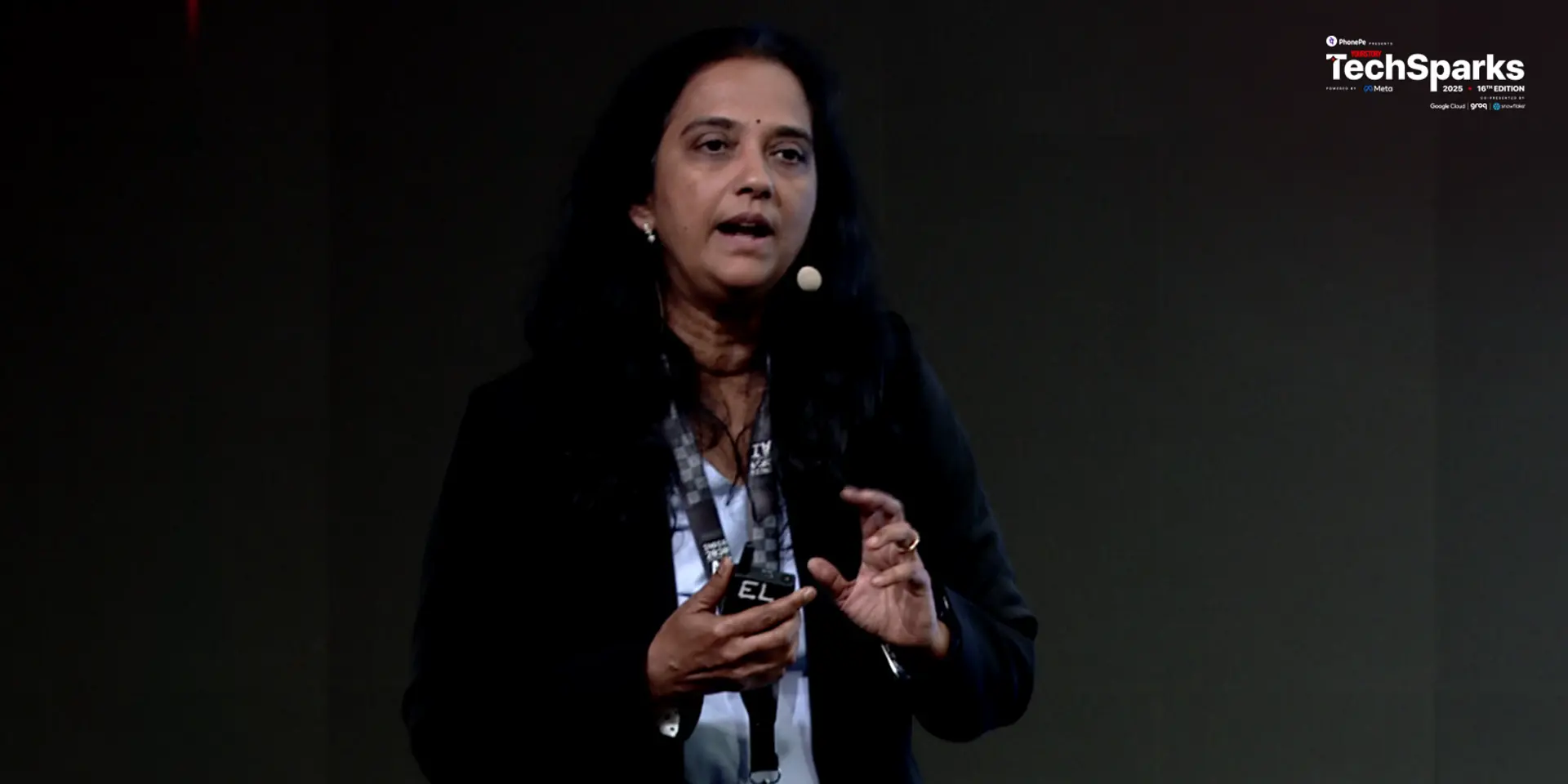

Early-stage startups face a range of challenges such as data siloes, infrastructure gaps, and heavy costs. How can hybrid cloud AI data management help startups create unified data access, automate and build scalable pipelines? At TechSparks 2025, Vasanthi Ramesh, VP Engineering and Engineering Site Leader, NetApp India, explored how hybrid cloud environments can boost accuracy, reliability, and innovation for hungry and ambitious startups teams in a keynote speech titled ‘Powering startup innovation: Hybrid cloud done right’.
Vasanthi opened with a simple fact: A wide array of possibilities has opened up for startups As AI rapidly advances, from predictive to generative and now agentic. Many organizations are leveraging GenAI solutions to create accessibility solutions for the visually impaired, design autonomous vehicles or discover groundbreaking protein structures. This makes this an exciting era for innovation, Vasanthi said. However, it comes with significant risks. “Almost 85% of GenAI projects fail, primarily because of data, security and cost.”
Additionally, challenges with workflow integration and leadership alignment can cause GenAI pilots to stop in their tracks. Navigating these pitfalls effectively will be essential for success in the GenAI space.
Breaking data out of the silos
Vasanthi next broached the topic of data, a key area in hybrid cloud environments. However, in these cloud environments, data is locked in silos, from data centres to private and public cloud environments. She said that leveraging this data is the true way to innovate.
Today, nearly 70% of enterprises use the hybrid cloud approach and 95% of new workloads are built on cloud-native platforms. This makes the hybrid cloud an ideal foundation for building AI applications. The hybrid cloud offers both security, privacy, governance, and fast on-premise performance, along with the flexibility, agility, and scalability of the cloud. This makes it a critical foundation for building GenAI workloads.
Vasanthi cited three main opportunities in the current AI landscape: first, at the hybrid cloud level, second in the innovation layer where AI runs, and the third with the innovation driver, where applications are executed.
The secret sauce for GenAI workloads: Storage
One of the key themes Vasanthi addressed in her keynote was storage, particularly its role in hybrid cloud environments and data management. She emphasized that storage is critical because most of the work startups do for their AI pipelines, processing, security and governance, occurs on premise, while training and inference typically takes place in the cloud. This setup introduces data gravity (large datasets that attract applications, services and other data), latency, cost, and data governance – factors that can hinder startups from building seamlessly across the stack, especially those innovating at the hybrid cloud storage layer.
She opined that the idea of storage needs to be reconsidered in this context as data requirements change at each stage. Startups require large, high-access storage during data ingestion and pre-processing; high throughput becomes essential during the model training and fine-tuning stages. For inference, both low latency and high throughput are important. These evolving requirements are leading to new market trends in storage technology.
Vasanthi proposed a unified, scalable storage architecture as a solution, one capable of handling diverse demands on a single platform. Building AI pipelines, she noted, is a complex process: GenAI workloads often involve moving and managing petabytes and hexabytes of data, making traditional pipeline approaches increasingly inefficient. Instead, she suggested adopting modern storage systems that can perform advanced pre-processing tasks, such as extracting vector embeddings, directly at the edge while seamlessly transferring data to other storage or compute resources in the cloud as required. This not only streamlines data pipelines, but also better accommodates the scale and complexity of today’s AI workloads.
“There’s a paradigm shift in how we think about storage,” Vasanthi observed. “Companies are now bringing AI to the data storage layer, rather than taking data and storage to AI.”
The opportunity to innovate
Vasanthi highlighted four major architectural trends that startups needed to watch out for: near-data compute (bringing compute resources close to where data resides); composable architectures; metadata-driven control plans (where metadata is used as the central logic to automatically manage, orchestrate, and govern the entire data platform or software ecosystem); and considerations for inference timescales. Each trend is an opportunity to innovate, especially when designing hybrid cloud storage solutions or launching startups in this space.
Vasanthi also focused on the growing shift toward composable architectures, a framework where the storage and compute layers are decoupled, running on separate nodes that can scale independently. This separation allows organizations to optimize performance and resource allocation without overprovisioning. The benefits of composable architecture extend beyond storage; it’s a powerful approach whenever two critical resources can be independently managed and scaled. Identifying and decoupling these components within the infrastructure is critical to building efficient GenAI models, she said.
Exploring the importance of metadata in an era where unstructured data is growing rapidly, Vasanthi said a vast amount of data needs to be identified, curated, and indexed. Performing these tasks across vast datasets is time-consuming, resource-intensive and complex. The solution? A metadata engine or layer that enables rapid lookups for semantic searches and curation. This approach reduces data movement as data doesn’t have to be moved from storage to third-party tools. Keeping these processes close to storage also allows startups to enforce crucial guardrails such as privacy, compliance, and data anonymization effectively.
Vasanthi tied these elements together: pipeline design, application development, and strategic use of the storage layer, to illustrate how startups can build an efficient hybrid cloud environment. In this model, a unified storage system integrates cloud and on-premises resources. A metadata curates and discovers data, performing vector embeddings to make it searchable and usable for AI workloads. Above that, data management services ensure processed data is pushed closer to where GPUs reside, typically in cloud storage, optimizing training efficiency.
Within this, composable architecture separates the storage layer from the performance layer, which interfaces directly with GPUs to deliver the high throughput and low latency necessary for efficient model training and inference.
“This way, you remove all the pain of data processing, management, and building pipelines while ensuring the right infrastructure for efficient compute,” Vasanthi explained. “When you bring it all together, your data could evolve into a knowledge graph, a future where interconnected data, offers rich information that you can use to build agents.”
