



From segmentation to personalisation: Industry experts reveal what it takes to build AI for India
At TechSparks 2025, InMobi's Mohit Saxena and MakeMyTrip's Sanjay Mohan reveal how India's next wave of AI-led personalisation, vernacular design, and data discipline is reshaping digital experiences for a billion users.

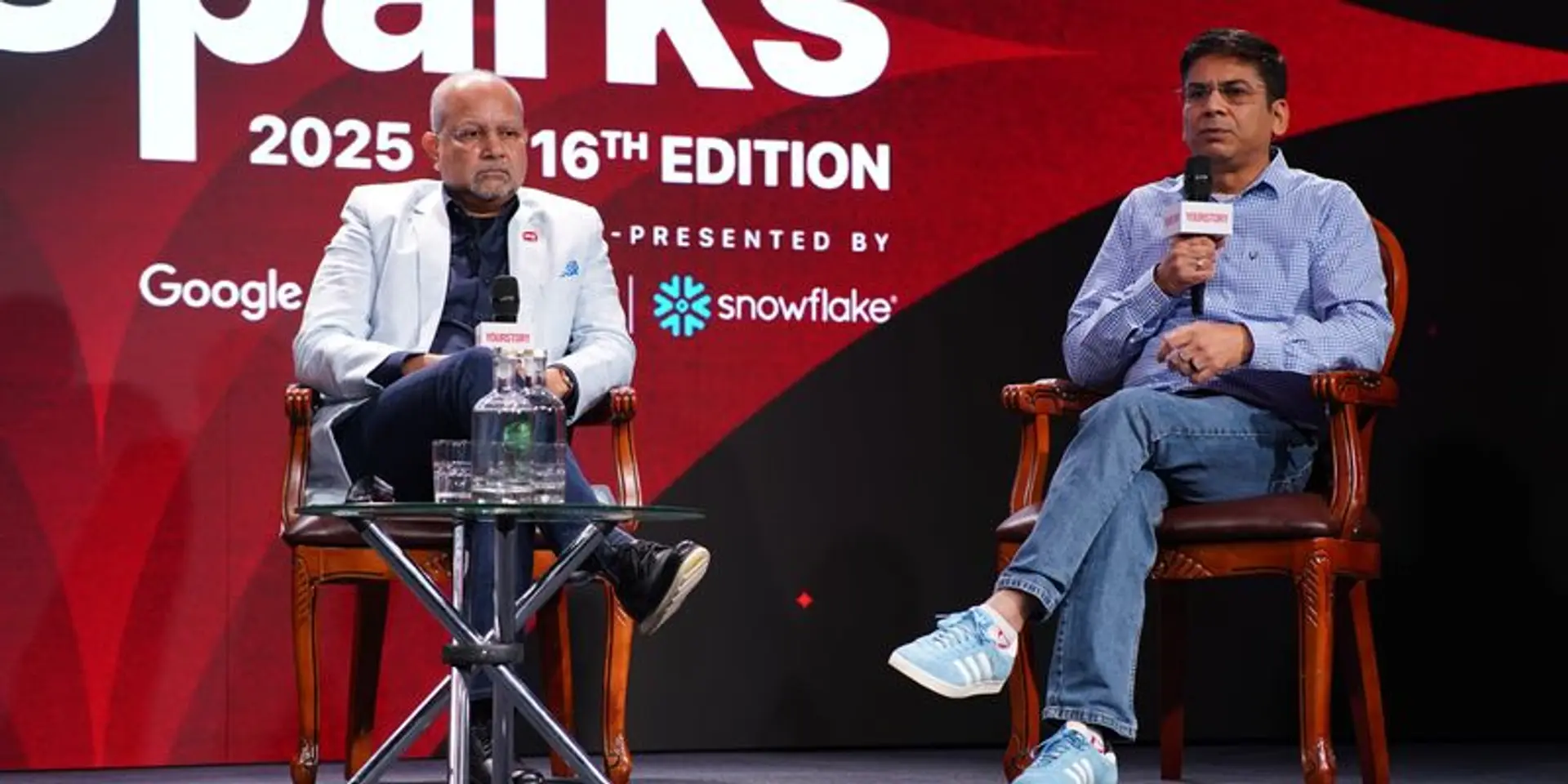

When MakeMyTrip's Group CTO Sanjay Mohan talks about personalisation, he doesn't use the word lightly. He calls it a "segment of one", technology refined enough to understand individual preferences, yet smart enough to leave room for serendipity. Across the table, InMobi Co-founder and CTO Mohit Saxena nods. Both men know that India's digital future won't be built on Silicon Valley templates. It will require something more nuanced: systems that understand context, speak multiple languages, and serve users who've never typed an English sentence.
At TechSparks 2025, YourStory's flagship startup and innovation summit, these two veteran technologists mapped out how artificial intelligence, data infrastructure, and design are converging to serve India's rapidly digitising economy.
The session, titled "India's Next-Gen Tech Stack: Engineering Intelligence for a Billion Users" and moderated by Sangeeta Bavi, COO of YourStory, revealed both the promise and pragmatism behind building for scale.
From prediction to discovery
At InMobi, personalisation takes shape through platforms like Glance, which deliver tailored content and experiences to millions. Saxena described how the company's visual AI systems help users preview accessories or clothing on themselves, blending computer vision with behavioural insights.
"Discovery in fashion and lifestyle has always been fragmented," he explained. "If I can help users see what fits and looks good before they buy, that's powerful." AI doesn't just improve personalisation—it simplifies decision-making in categories drowning in choice.
But building and scaling these systems demands serious investment. Saxena revealed that InMobi's annual infrastructure spending exceeds $100 million. "AI is expensive," he said. "When we began, one model inference cost us ten rupees. We've brought it down to three cents, but it takes deep optimisation across hardware, software, and model layers."
Then there's the accuracy challenge. "AI models are not designed to be engineers. They hallucinate," Saxena said, drawing laughter from the audience. "Early versions of our avatar models produced eleven fingers or four legs. We had to engineer for control and consistency."
The segment of one
For Mohan, personalisation is an evolving discipline that began with crude segmentation, grouping travellers into large cohorts based on geography or purchase history. Over time, MakeMyTrip's approach matured toward individual-level recommendations shaped by real-time behaviour and contextual data.
"Personalisation started as segmentation," he said. "You begin with big cohorts, but eventually you aim for a segment of one. That's when technology begins to understand the traveller instead of just classifying them."
Yet Mohan cautioned against over-optimisation. Travel is inherently serendipitous. "There has to be some fuzziness in recommendations. If I've stayed in a hotel once, I may not want to go back. If I've visited a city before, I might look for something new. That unpredictability is what keeps travel delightful."
Saxena agreed, framing it as a balance between "exploration and exploitation." Exploitation refines recommendations based on known preferences. Exploration introduces variety and the unexpected. "That's where discovery happens," he said. "AI should not just mirror past choices but help you find what you didn't know you might like."
Building for Bharat
With more than 900 million internet users, India's next wave of digital growth will come from non-English speakers in Tier-2 and Tier-3 towns. Mohan's focus has been on making technology accessible to precisely these users.
"Typing in Indian languages is painful," he said. "Voice changes that entirely." MakeMyTrip's voice assistant, Myra, now supports Hindi, Tamil, Telugu, and Bengali, with plans to expand further. "People speak more than they type," Mohan noted. "Voice input gives us longer, more natural conversations, and richer context for understanding user intent."
This is what he calls "inclusive personalisation"—technology that adapts not just to who users are, but how they communicate. It's a design philosophy that acknowledges India's linguistic diversity as a feature, not a complication.
The discipline behind the intelligence
Both leaders emphasised that AI innovation rests on disciplined data management. Mohan said the first sign that a company's data platform is maturing is when data scientists stop complaining about quality issues. "It's more about discipline and process than engineering heroics," he said. "Getting the vocabulary and pipelines unified takes years, not months."
Saxena echoed this, noting that InMobi's experience running one of the world's largest mobile ad networks has taught it to respect latency and precision. "In mobile, latency is unforgiving," he said. "We serve users from the nearest data centre—US users from the US, Japan from Japan, India and Southeast Asia from Singapore. It's about staying as close to the user as possible."
When asked how they balance traditional AI with newer generative models, both leaders emphasised pragmatism. "For structured tasks like predicting flight prices or cancellations, traditional models work best," Mohan said. "Generative AI helps when you're interpreting unstructured data, like summarising hotel reviews or personalising recommendations."
Saxena added that both technologies coexist naturally. "If the answer is right, it's right," he said. "The goal is not to replace one with the other but to choose what delivers the best outcome."
What comes next
As the conversation drew to a close, Bavi asked both leaders to describe the future of technology in one word. Mohan chose "multimodal," reflecting how future systems will blend text, voice, and vision seamlessly. Saxena called it "the real era of AI."
Their exchange captured a pivotal moment in India's digital evolution, a transition from building for scale to engineering for sophistication, from serving users to truly understanding them.
The "segment of one" isn't just a technical achievement. It's a recognition that behind every data point is a person with preferences, habits, and the occasional desire to be surprised.

Edited by Jyoti Narayan