




SPJIMR WISE Tech
View Brand PublisherThe future of payments is autonomous, and 86400 is (already) building it
86400 is building AI-driven payment infrastructure that predicts failures before they happen, reconciles transactions in minutes instead of days, and prepares for a world where bots, not humans, initiate payments.


When Mobileware Technologies reintroduced itself as 86400, the rebrand wasn’t just cosmetic. It was a statement of intent. Named after the 86,400 seconds in a day, the company reflects a reality that now defines India’s payments landscape: money must move every second, without pause, without downtime, and without room for error.
Over the past eight years, 86400 has quietly become one of the most critical players in India’s digital payments stack. It powers over 100 banks, operates hosted platforms for UPI and IMPS, and processes nearly 150 crore transactions a month, a staggering load handled by a team of just 150 engineers.
But the story isn’t simply about scale but also about the strain that scale creates. Traditional core banking systems were built for around 100 transactions per second (TPS). ATM networks operate even slower. UPI’s design baseline was 500 TPS. Yet India today routinely touches 10,000 TPS at peak, pushing the country’s payment infrastructure into territory no legacy system was designed for.
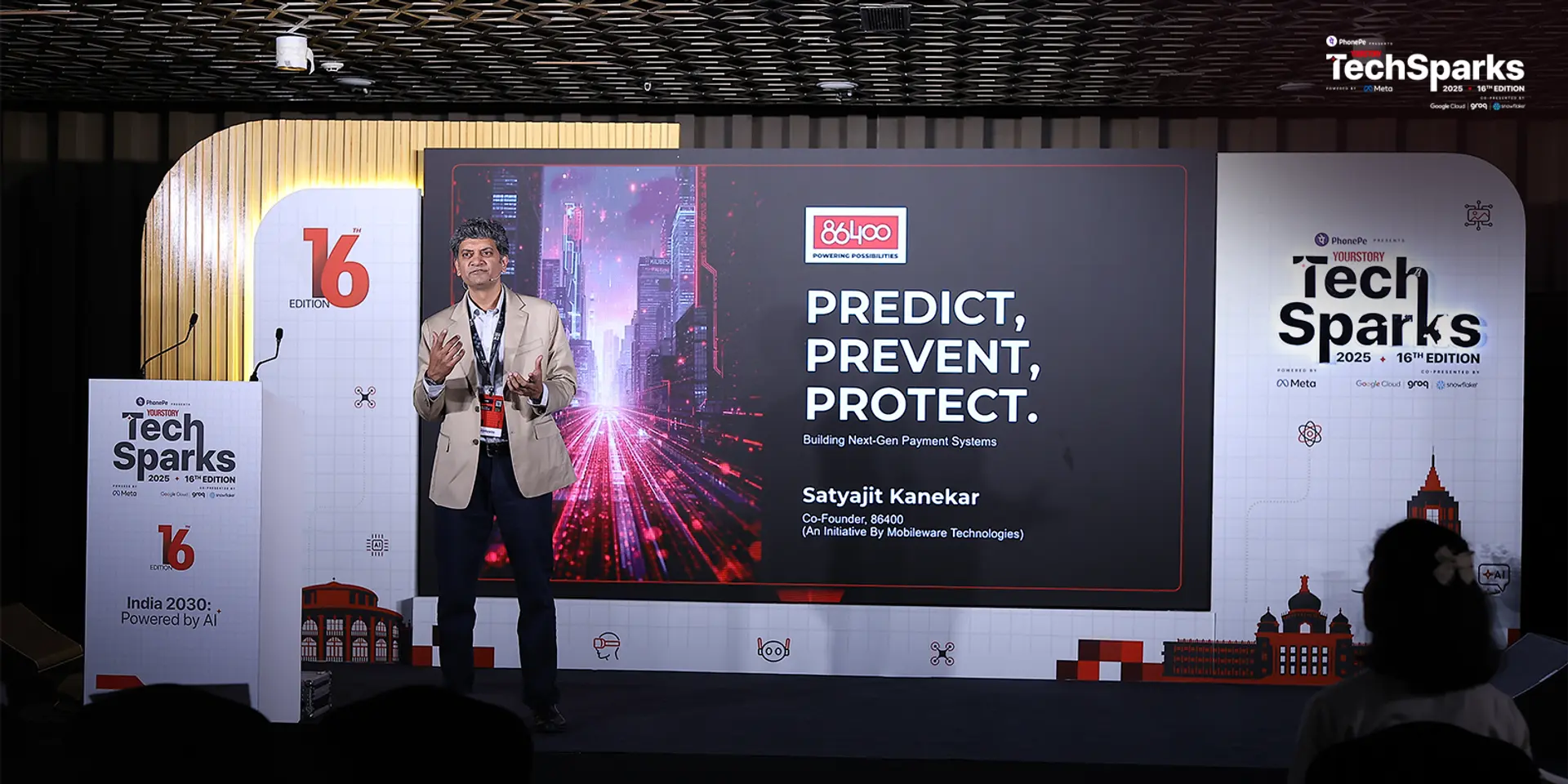
In his keynote at TechSparks 2025, Satyajit Kanekar, Co-founder, 86400, summed up the challenge with a candid assessment. “No banking system in the world was built for this kind of volume. And that’s exactly where AI becomes not just useful, but necessary.”
Moving from reactive to predictive payments
Kanekar made the shift clear. “Traditional systems respond after a failure. AI predicts before it happens,” he said.
For years, fraud detection depended on rules and post-mortem analysis. Reconciliation was batch-based. Uptime was hoped for, not guaranteed. 86400 decided to flip this model. Two major problem areas became AI opportunities:
1. Real-time reconciliation:
Reconciliation is the backbone of trust. A UPI transaction must match across the payment switch, the bank’s core ledger, and NPCI’s records. At 745 million transactions per day, manual or batch-based approaches break instantly. 86400’s AI-driven reconciliation now processes data continuously, not at end-of-day. It also reduces reconciliation time from three days to 15 minutes and allows bank teams to query data using a chat interface, not portals or filters, as well as eliminates error-prone, file-based workflows.
“Operations teams can simply ask, What is the status of these 100 transactions across National Payments Corporation of India (NPCI) and the switch? And get answers instantly,” explained Rohan Agrawal, Product Manager at 86400.
2. Smart orchestration: Routing payments with intelligence
86400, Kanekar claimed, is the only technology provider in India offering multi-bank orchestration from a single switch. AI helps decide which bank is least likely to fail right now, which bank is near downtime, which route offers better success rate, and where merchants get the best commercial outcomes.
The impact is a 2–2.5% lift in revenue simply through reduced declines and better routing. This is critical because every failed UPI payment is a lost conversion for merchants.
The future: AI agents making payments, not humans
One of the most provocative ideas in the keynote came from Agrawal: “We all use ChatGPT. But how many of us have ever bought something through ChatGPT?”
NPCI recently piloted conversational payments, allowing UPI transactions directly inside AI interfaces. This hints at a near future where AI agents buy groceries for you, digital assistants pay your bills, and bots negotiate better rates on your behalf. But this unlocks new questions like:
- How does a bot authenticate a payment without a PIN or face ID?
- How do merchants differentiate between malicious bots and “good bots”?
- How will PSPs authorise non-human transactions?
86400 is building the infrastructure to answer these questions - reliable rails where both humans and AI agents can participate securely in the economy.
The challenge
While the benefits are undeniable in terms of better success rates, real-time reconciliation, faster settlement, AI also introduces its own risks. In a highly regulated environment like India, every decision must have an audit trail, eEvery fraud flag must be explainable, and every transaction journey must be defensible. The RBI demands traceability, not just accuracy. And AI’s “black box” nature is a direct challenge.
Kanekar was candid, “We’ve had situations where the regulator asked us to show the reasoning behind an AI decision, and we couldn’t explain it. That’s not acceptable. Explainability is non-negotiable.”
This is not just a technology problem; it’s an industry-wide call to build transparent AI for BFSI.
The opportunity ahead
Despite challenges, India is on the verge of another payments leap. With conversational payments, multi-bank orchestration, predictive fraud detection, and AI-first infrastructure, the next decade will be defined by autonomous payments, self-healing systems, near-zero-failure transactions, AI-driven compliance, intelligent reconciliation, and bots acting as consumers.
“Payments are already frictionless,” Kanekar said. “But we can make them effortless.”
The message from 86400 is clear: predict, prevent, protect, and build payment systems that are ready for the future before it arrives.
