




Gurukeerthi Gurunathan: Democratizing Diamonds and AI
From digitising diamonds to embedding emotions in jewelry, Gurukeerthi Gurunathan is reshaping how India buys, wears, and connects with jewelry.

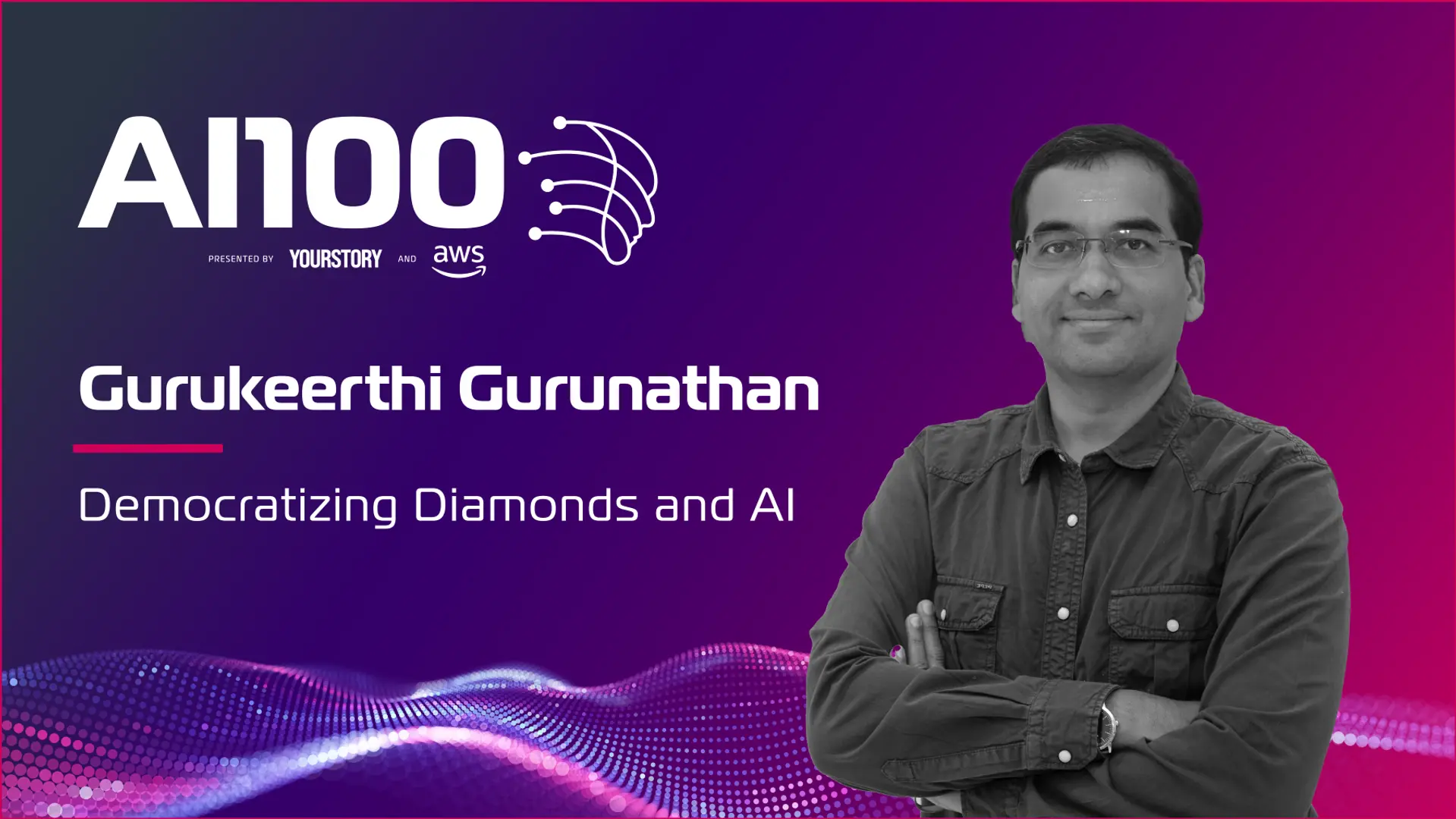

One of India’s oldest industries—jewelry—has been slow to embrace technology, held back by high costs, limited skilled talent, and cultural resistance. But players like CaratLane are changing that.
Gurukeerthi Gurunathan, Co-founder and CTO of CaratLane, recalls how the company set out in 2008 to digitise diamonds, bring transparency to the process, and make jewelry more accessible.
“We launched with a simple mission: diamond jewelry designed to be worn every day. It didn’t have to sit in a locker or break the bank. We wanted to democratise it so that anyone in the country could see the prices and trust the transparency of our systems when buying diamond jewelry,” he says.
CaratLane started as an online-first business—an unusual approach in an industry defined by exclusivity, heavy inventory, and high price points. By positioning diamond jewelry as an everyday accessory rather than a rare luxury, the company carved a niche and scaled quickly.
Gurunathan believes this democratization was possible only through a digital-first model: “Had we focused on physical retail as well, it would have taken us many more years to reach the level of success we enjoy today.”
By 2017–18, the company began experimenting with AI and machine learning. “Traditional logic-driven programming couldn’t capture evolving customer behaviour online,” Gurunathan says.
Machine learning enabled smarter recommendations, better pattern recognition, and personalized experiences, helping CaratLane refine how it engaged with millions of digital shoppers.
CaratLane: Born digital
A digital-first mindset was established from Day 1 at CaratLane, shaping business growth. The company’s approach has always been to determine what processes can be scaled, and how machines can augment human capabilities.
CaratLane has creatively leveraged technology in customer feedback. Its app allows customers to swipe left or right on designs. Combined with insights from jewelry consultants, the system quickly captures preferences, feeding them directly to designers. This reduces costly trial-and-error, minimizes inventory risk, and allows faster design iterations.
On the backend, Enterprise Retail Planning (ERP) systems track margins daily, ensuring financial insights flow back into decision-making.
AI: Embedding emotions and efficiency into jewelry
At CaratLane, AI isn’t just a tool; it’s the foundation for scaling as a digital-first jewelry brand. Data and AI are central to the design process. Jewelry tastes vary widely across India, and Guru notes that what sells in one city may not in another. To capture these nuances, the company validates designs using buyer insights from different regions.
In retail, CaratLane’s 340+ showrooms are staffed with jewelry consultants armed with AI-enabled handheld devices. These assist with product recommendations, policy clarifications, and internal calculations, helping consultants engage in deeper, more meaningful conversations with customers. The result: higher conversion rates, greater personalization, and a smoother shopping experience.
On the customer side, CaratLane has launched several AI-driven initiatives, the most distinctive being Postcards. Using image recognition, the system identifies the buyer and recipient of a ring, and links it to a personalized video message from the gifter. Recipients simply scan their ring through the CaratLane app to unlock the message, turning a piece of jewelry into a memorable, interactive experience.
“The essence of Postcards is to actually embed the emotion of a customer into a ring. It can be embedded in jewelry, but we launched it specifically for rings, because rings are used during the exchange of vows. The customer will be able to play the video and keep the ring, and the memories etched into it, forever,” Gurunathan says.
AI also plays a central role in digital marketing. With millions browsing CaratLane’s website and app, algorithms help classify customers into high-intent and low-intent segments. This allows the company to optimize human outreach, promotional offers, and marketing spend, ensuring resources are directed towards customers most likely to convert. Continuous iterations refine the targeting further, driving efficiency across campaigns.
Another critical application is inventory optimization. With 340 stores and over 8,000 designs, deciding which products to stock where, and in what quantity, is a highly complex problem. CaratLane leverages AI models to make these allocation decisions, ensuring faster inventory turns, better availability, and reduced customer wait times. This balance of efficiency and accessibility is essential in an industry with high inventory costs.
In order to cultivate this environment - where AI is leveraged with creativity - Gurunathan emphasizes the importance of leadership and guidance, where employees are empowered to enhance the customer experience at every touchpoint.
Tech, talent, and the AI mindset
At CaratLane, the challenges of AI adoption were threefold - talent, infrastructure and mindset. Early on, the company needed in-house AI expertise to keep pace with fast-moving advances. Building that team was slow at first, but today CaratLane has a strong AI/ML function driving innovation.
Infrastructure was another hurdle. Training models required heavy compute loads - a time-consuming and costly endeavour. Improvements in processing power and platforms have made this more manageable.
The final challenge is cultural: making sure that teams across departments and functions embrace AI. Today at CaratLane, engineers code faster, finance teams model smarter, and business teams analyze and allocate inventory more effectively – all thanks to AI.
When it comes to the future of retail, Gurunathan is especially excited about virtual try-on technology in lifestyle products, enabling customers to visualize themselves wearing jewelry or apparel from home, and purchase complete looks with a single click. These innovations, he believes, bridge imagination and action, reshaping retail and ecommerce experiences while demonstrating how AI can enhance both convenience and creativity for consumers.
AWS: Solving complex retail problems
CaratLane’s AI journey has been closely tied to its partnership with AWS, which began as early as 2013—well before AWS set up its India presence. Initially relying on co-located servers in Singapore, CaratLane has grown alongside AWS for more than a decade, with the cloud provider playing a pivotal role in scaling both infrastructure and innovation.
From an AI perspective, AWS delivers three layers of value. The first is infrastructure at scale—compute instances that engineers can depend on without worrying about local limitations. The second is a suite of powerful platforms like Amazon SageMaker and Bedrock, which simplify end-to-end AI workflows, enabling CaratLane to design, develop, and deploy applications seamlessly.
The third, often overlooked, is talent support. AWS architects and AI experts work directly with CaratLane’s teams, helping solve complex retail challenges with domain-agnostic expertise. This collaborative approach accelerates experimentation and problem-solving. AWS also supports the wider ecosystem by extending credits that make testing AI/ML workloads more accessible—even for established players.
Ethics and beyond
For Gurunathan, AI safety and responsibility are critical concerns. He acknowledges that current systems are not fully protected - making guardrails essential - from filtering harmful or offensive content to safeguarding users’ mental well-being.
He believes transparency is vital in retail. For instance, customers should know whether they are interacting with an AI agent or a human, and data must be handled with stringent privacy standards. Of equal importance is addressing AI hallucinations and biases, which can derail decisions and damage customer trust.
“People spend their hard-earned money on buying this very small product. Ultimately, jewelry is a very small product for a large sum of money. So what they expect, in turn, is a lot of transparency and trust in the system,” he says.
Gurunathan stays updated on AI by relying on his teams, who constantly share new developments and insights within the group. He also follows industry trends and news across digital platforms and publications, highlighting how AI dominates headlines even with dedicated weekly sections.
Outside of work, he stays grounded by spending time with his family, especially his two children. Weekends often see him travelling to different villages in Tamil Nadu, where his spiritual beliefs have led him to build support systems and connect with communities. For Gurunathan, life is a balance between technology, tradition, and a deeper journey of truth.