


How stories shape decisions, trust & startup outcomes: A masterclass with Ameen Haque
Ameen Haque, Founder of Storywallahs and one of India’s leading storytelling coaches joins Amit Somani for a deep-dive into the craft of storytelling in business. If you're a founder, operator, leader, or creator, this conversation will reshape the way you pitch, lead, persuade, and communicate.

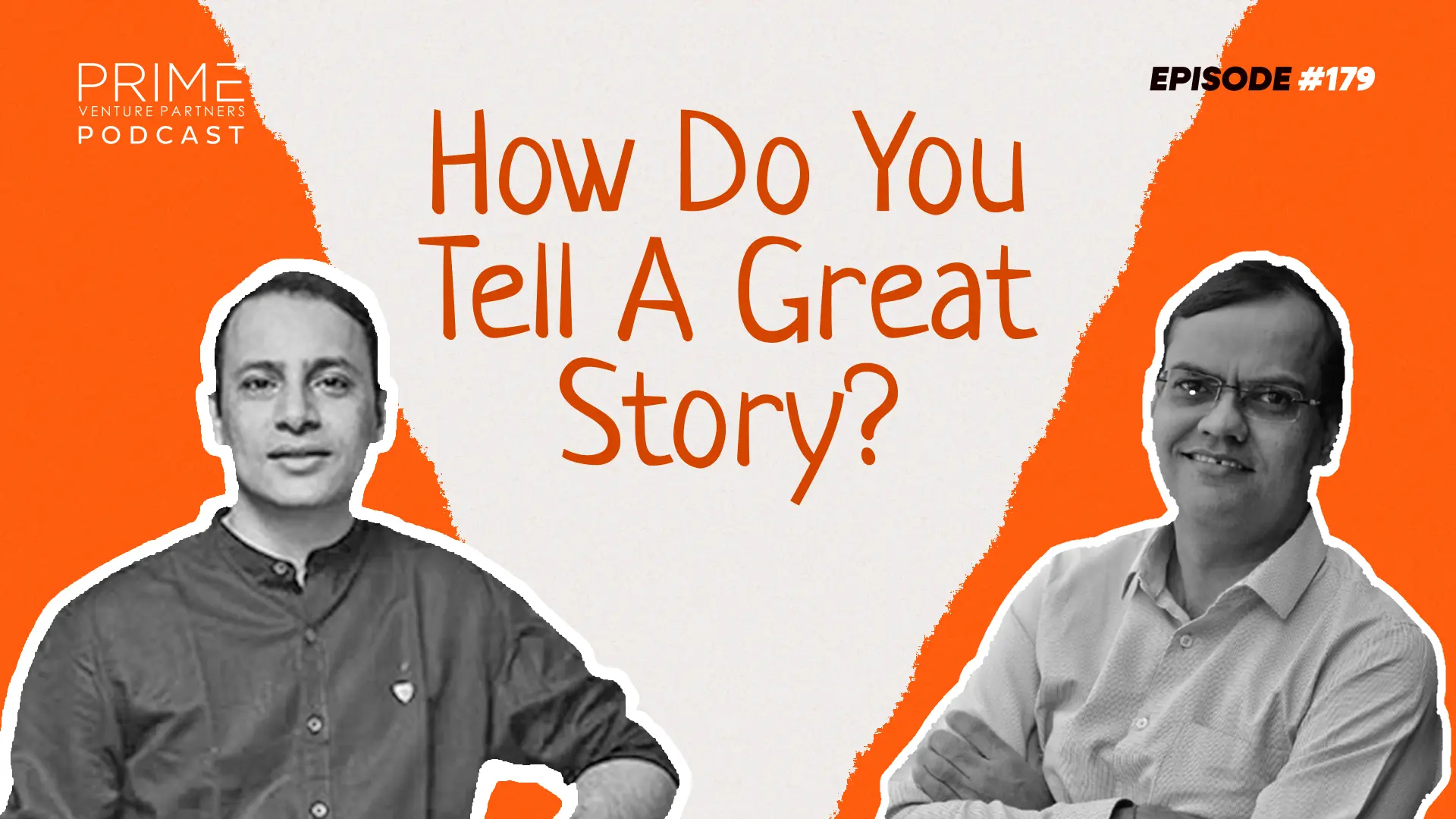

Ameen Haque, Founder of Storywallahs and one of India’s leading storytelling coaches, brings decades of experience as a storytelling coach, theatre practitioner, and communication strategist. For him storytelling is not a skill you pick up from a workshop or a clever list of hacks. It begins in identity, in awareness, and in culture.
“Most of us grew up in middle-class India hearing your work should do the talking,” he says. “But in today’s world, your work sitting out there doesn’t mean people will remember it.”
And that’s where the shift begins.
Living the story
“Storytelling is not vocabulary. It’s not articulation. It’s not oratory. Your actions speak louder than words.”
His philosophy is anchored in one idea: you cannot tell a powerful story if you’re not living it: for instance, a founder building a fitness startup who is unfit, a food entrepreneur who isn’t passionate about food, an edtech founder who doesn’t feel for education. He says the gap is not in communication, it’s in authenticity.
He shares a moment that captures this idea: “There’s a story I love telling. Ratan Tata’s car broke down on a highway. When his colleagues went looking for him, they found him next to the driver, sleeves rolled up, helping fix the car. You can write in golden letters that you treat people equally. But the story is not what you say, it’s what you do.”
When others tell your story
“The best story about your work cannot be told by you. It can only be told by somebody else.”
For Haque, real storytelling begins when you create a surplus, an experience so thoughtful that others retell it for you. Your customers, employees, investors, and partners must become the carriers of your story.And they won’t do it out of obligation.
He recalls staying at a hotel in BKC: “We noticed your shaving foam was getting over. Here’s one from our side.”
“How much does it cost? Nothing. Almost nothing.”
And yet, years later, he is still telling that story. “They converted the customer into an ambassador.”
Attention is not the problem
“It’s not that our eyes have become one or our ears have become one. It’s the amount of information that has exploded.”
He laughs about the modern myth of shrinking attention spans. People don’t remember their spouse’s birthday, he says. "How can they remember all the work you did last year?"
We’re no longer in an era where good work rises automatically. We are drowning in data: WhatsApp messages, emails, feeds, reels, photos, opinions, noise. Against that backdrop, hoping to be discovered is wishful thinking. Your story must cut through the fog. Your story must reach the people you want to move.
And that starts with intention. Which is why founders must tell their story:
“In this age to believe that my work will speak for itself is a myth.”
The opening makes or breaks the story
Haque returns repeatedly to one rule: “Think a lot, think a lot, think a lot about how you’re going to open the story. The opening makes or breaks the story.”
He draws an inference across a conference keynote, a movie opening frame, a blog, a reel. If the first moment doesn’t land, the rest is irrelevant. He explains it simply: “If the blog’s title doesn’t draw you in, you won’t read the rest of the blog.”
“We listen to the opening at a conference, and if it’s not interesting, we step out. Even if the best content is later, that guy could be presenting amazing insights on the seventh slide, but we are not in the room.”
Painting the picture
Haque describes one of his favourite tools for visual storytelling: “Imagine a dash where dash.”
He gives the telecom example: “Imagine a world where the network is like your shadow… This network follows you wherever you go.”
And another: “Imagine a hospital where the bathrooms are as clean as the path lab.”
Because, he says, “Every entrepreneur is trying to build a world… What we are really looking for are citizens for this world.” If the audience can see the world, they join. If they cannot, they move on.
Stories are not long or short. They are good or bad.
Haque takes a lesson from cinema for storytellers in business and startups with: length doesn’t matter if storytelling is powerful. No one asks the director of Baahubali to “come to the point.” even though Part 1 and Part 2 are 7 hours long.
He delivers an extremely liberating line for listeners, “Stories are not long or short. They are good or bad. And when they are bad, they feel long.”
Practise with a chief objections officer
Haque ends with a structural insight for founders : “There is the D of Data. There is the D of Decision. But in the middle is the D of Discussion.” And that is where magic lives.
Most founders design a 30-minute pitch for a 30-minute meeting. It never works. Because what convinces an investor is not the final slide, it’s the moment in the middle where they lean forward and say, “Tell me more.”
Haque shares a relevant practical advice: “Practise with real human beings... If you can, make them COO - Chief Objections Officer.”
Because in every meeting, there is one person who is very pessimistic and will say, ‘We tried this six years ago, it didn’t work.' And preparing for that is the difference between drowning and surviving.
Listen to the full podcast episode to gain more insights,
Timestamps:
00:00 – Introduction
02:00 – Why humans think in stories, not facts
02:23 – “We are all storytellers”
03:18 – Why good work fails without a good story
04:54 – The “lion vs hunter” mindset shift
06:16 – Storytelling through action: The Ratan Tata example
07:23 – Living your story vs. Telling it
14:39 – Why customers should be your storytellers
15:23 – The hierarchy of difficulty
16:40 – Behavioural economics & persuasion
38:03 – Stories aren’t long or short — they’re good or bad
40:58 – Editing is the most underrated storytelling skill
41:48 – Learning from masters: music, art & observation