



Clearing the clutter: Cosmoserve aims to remove debris from Earth’s orbit
By cutting costs and boosting sustainability, Cosmoserve pioneers next-gen space debris removal technology.

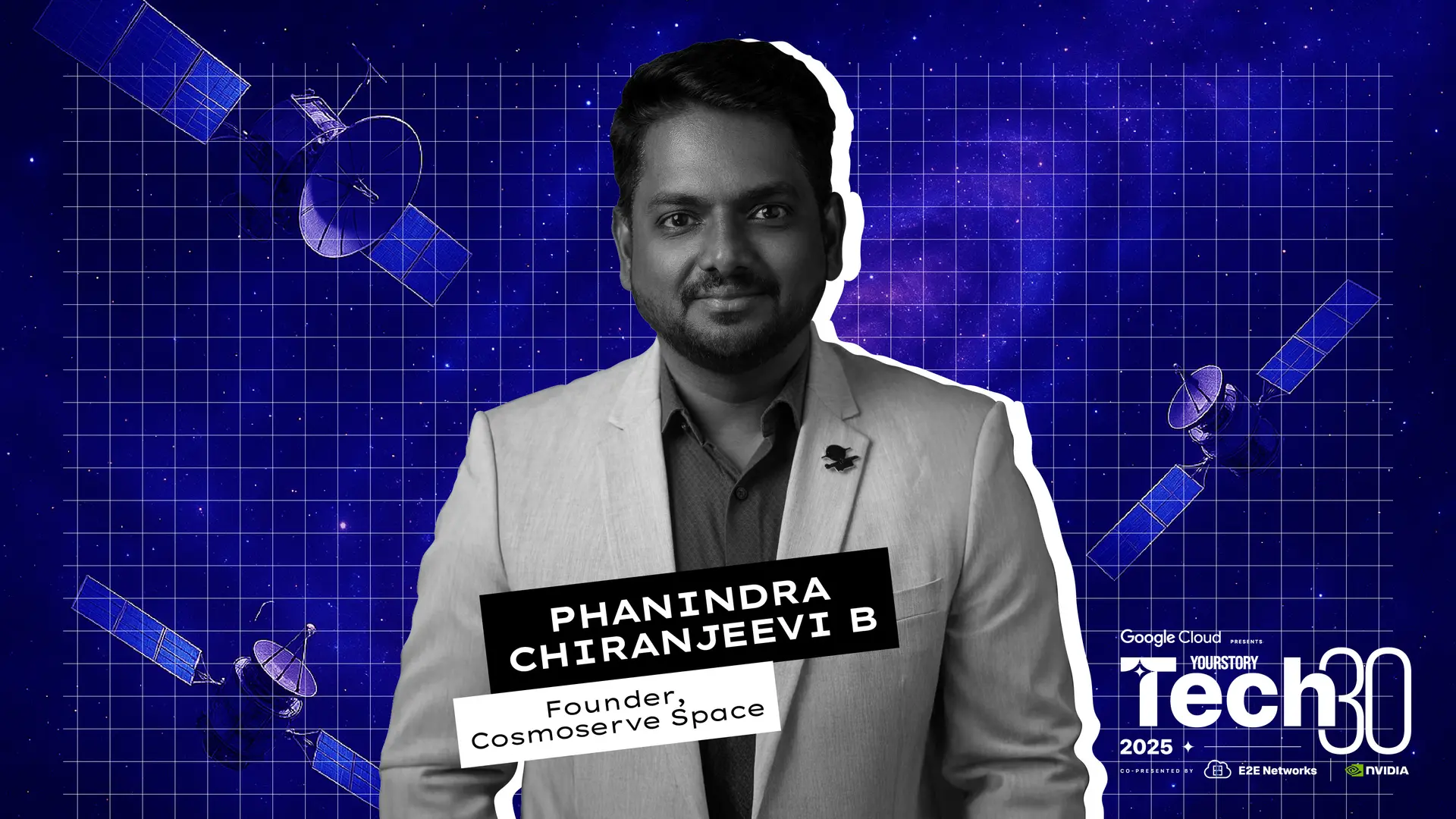

Space debris is a growing concern for space missions. According to the Space Environment Statistics Reports, over 50,000 large objects and more than 1.2 million smaller debris fragments orbit the Earth, most of them defunct.
These objects can collide with working satellites, creating more trash and triggering a chain reaction known as the Kessler Syndrome, which could eventually make certain orbits unusable.
To address this concern, Hyderabad-based Cosmoserve Space is developing an autonomous robotic spacecraft that can capture and safely remove dead satellites from orbit. The startup’s goal is to make space operations safer and ensure long-term access to space for future generations.
Cosmoserve Space was founded by Dr Chiranjeevi Phanindra B., a former scientist at ISRO, in 2015. During his 14-year career at ISRO, Chiranjeevi worked on the Gaganyaan human spaceflight mission and specialised in the aerothermal aspects of rockets at the Vikram Sarabhai Space Centre.
He also contributed to developing environmental control systems for India’s first crewed space capsule. His experience representing India at the Inter-Agency Space Debris Coordination Committee, a UN-linked global body focused on debris mitigation, exposed him to the scale of the issue and the need for technological intervention.
The solution
Cosmoserve is developing autonomous robotic spacecraft designed to capture and deorbit dead satellites. The startup’s approach draws inspiration from nature, specifically, the Venus flytrap. Using soft robotic arms, the spacecraft can “hug” and secure defunct satellites before executing a de-boost manoeuvre that pulls them into the Earth’s atmosphere, where they safely burn up.
The startup operates in two domains: end-of-life services, which help satellite operators dispose of their spacecraft after mission completion, and active debris removal, catering to governments and space agencies working to clean up orbit.
Currently, similar services by global companies cost around $5-6 million per satellite removal. Cosmoserve aims to reduce this cost by up to 90%, bringing it down to between $300,000 and $500,000 per removal, a major step toward making space sustainability economically viable.

Ideation to launch
The startup has so far raised $3.17 million in a pre-seed round. The team of 10 engineers is working from T-Hub in Hyderabad. “We plan to complete our ground demonstration by December 2025, followed by an in-space demonstration by December 2026,” says Phanindra.
The company is currently pre-revenue and focused on proving its technology before onboarding clients.
Market and competition
According to the Bisresearch Report, the global market for active debris removal and end-of-life satellite services is projected to grow significantly, with one recent analysis by BIS Research estimating a compound annual growth rate (CAGR) of 27.66% from 2020 to 2030. Cosmoserve aims to capture at least 20% of this market after commercialising.
Its primary competitors include Astroscale (Japan), ClearSpace (Switzerland), and Surrey Satellite Technology Ltd (UK), all pioneers in the field.
“Our soft-robotics-based approach, along with future refuelling depots in orbit, is designed to overcome the key limitations of existing debris removal systems,” Phanindra asserts.
The road ahead
Cosmoserve plans to begin client missions by 2028, focusing on commercial satellite operators and government agencies.
Alongside, it aims to deploy large refuelling stations to extend spacecraft lifespan and reduce mission costs further. With its cutting-edge robotics and sustainability-first vision, Cosmoserve Space is positioning itself as a key player in shaping the future of orbital infrastructure and responsible space operations.
Cosmoserve is part of YourStory’s Tech30 cohort—a selection of India’s most promising startups of 2025—unveiled at TechSparks Bengaluru.
